









As production requirements continue to grow, many manufacturers discover that their existing grinding equipment can no longer keep up.
What worked well during laboratory development or pilot production may become a bottleneck when output increases. Particle size becomes harder to control. Production cycles become longer. Maintenance costs start rising.
At this stage, choosing the right large-capacity nano grinding system becomes essential.
A Horizontal Nano Sand Mill is often the preferred solution for manufacturers seeking higher throughput, better grinding efficiency, and stable long-term operation.
Why Many Factories Upgrade to Horizontal Sand Mills
When production volumes increase, grinding efficiency becomes one of the most important factors affecting profitability.
A properly designed horizontal grinding system offers several advantages:
- Higher production capacity
- Better energy utilization
- More stable particle size distribution
- Continuous production capability
- Lower operating costs per ton
These benefits make horizontal sand mills widely used in battery materials, coatings, inks, and fine chemical manufacturing.
What Should Buyers Focus on When Selecting a Nano Sand Mill?
Many purchasing decisions focus only on motor power.
In reality, grinding performance depends on several factors working together.
Grinding Structure
The grinding rotor determines how efficiently energy is transferred to the grinding media.
This machine utilizes a high-efficiency pin-type rotor system designed to generate strong shear force and impact energy.
The result is:
- Faster particle size reduction
- Improved dispersion quality
- Better grinding efficiency
- More consistent finished products
Production Capacity
For industrial production, output capacity directly affects profitability.
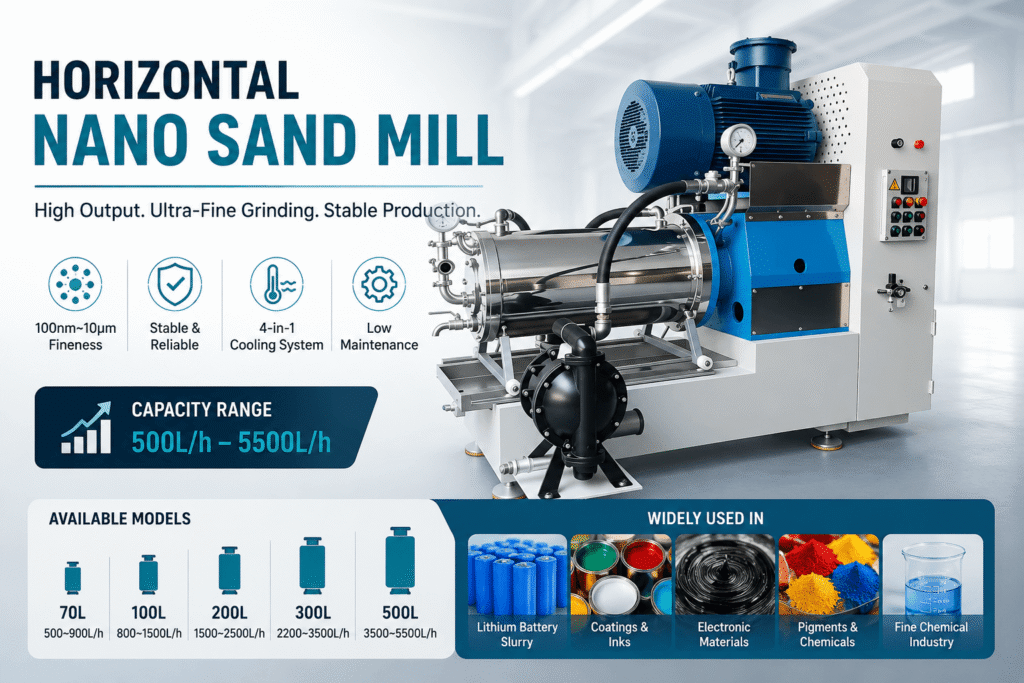
The Horizontal Nano Sand Mill is available in capacities ranging from:
- 70L
- 100L
- 200L
- 300L
- 500L
Depending on the model, production capacity can reach:
500L/h to 5500L/h
This makes it suitable for both medium-scale and large-scale manufacturing facilities.
Particle Size Requirements
Different industries require different levels of fineness.
This machine can achieve grinding fineness from:
100nm to 10μm
Such performance is particularly important for:
- Lithium battery slurry
- Nano pigments
- Electronic materials
- Ceramic inks
- Digital printing inks
Consistent particle size often leads to better product performance and improved production stability.
Temperature Control Is Often Overlooked
Many grinding processes generate substantial heat.
Without proper cooling, manufacturers may experience:
- Material degradation
- Viscosity instability
- Color variation
- Reduced product quality
To address this challenge, the Horizontal Nano Sand Mill incorporates a 4-in-1 cooling system covering:
- Grinding chamber
- Chamber cover
- Mechanical seal
- Main shaft
This helps maintain stable temperatures throughout long production runs.
How Maintenance Affects Production Costs
Unexpected downtime can become extremely expensive in continuous production environments.
The machine adopts:
- Double mechanical seals
- Wear-resistant contact components
- Durable grinding chamber materials
Optional material configurations include:
- Zirconia
- Silicon carbide
- Polyurethane
These materials help extend equipment lifespan while reducing maintenance frequency.
Industries That Benefit Most from Horizontal Nano Grinding
Lithium Battery Manufacturing
Battery performance often depends on slurry consistency and particle distribution.
Ultra-fine grinding helps improve electrode quality and production stability.
Industrial Coatings
Better particle dispersion improves color consistency, gloss, and coating performance.
Printing and Digital Inks
Nano-scale grinding supports higher color strength and smoother printing results.
Electronic Materials
Conductive pastes and specialty electronic materials require precise particle control.
Fine Chemical Production
Specialty chemicals often demand stable grinding quality and repeatable production performance.
Key Technical Specifications
| Item | Specification |
|---|---|
| Model Range | 70L – 500L |
| Grinding Fineness | 100nm – 10μm |
| Applicable Viscosity | 2000 – 60000 cps |
| Grinding Media | 0.1 – 1.2mm Zirconia Beads |
| Grinding Structure | Pin-Type Rotor |
| Separation System | Dynamic / Static Large-Flow Screen Discharge |
| Capacity | 500L/h – 5500L/h |
| Cooling System | 4-in-1 Integrated Cooling |
Is a Horizontal Nano Sand Mill Right for Your Production Line?
If your production process requires:
- Nano-scale grinding
- High throughput
- Consistent particle size
- Continuous operation
- Low maintenance costs
Then a large-capacity Horizontal Nano Sand Mill is often one of the most cost-effective investments available.
It combines production efficiency, grinding precision, and operational reliability into a single solution designed for modern industrial manufacturing.
Final Thoughts
Choosing grinding equipment isn’t simply about purchasing a machine. It’s about building a reliable production process.
The Horizontal Nano Sand Mill is designed for manufacturers that need both high output and precise grinding performance. From lithium battery materials and nano pigments to coatings, inks, and specialty chemicals, it provides the stability, efficiency, and scalability required for long-term industrial success.