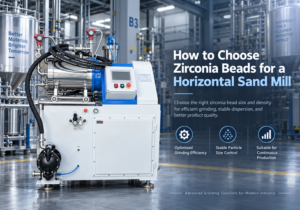










In the field of high-energy wet grinding, achieving target particle sizes—whether sub-micron or nano-scale (100nm to 10μm)—depends heavily on the synergy between the wet sand mill and the grinding media. Choosing the right mill sand media, specifically Yttria-Stabilized Zirconia (YSZ) beads, is one of the most decisive factors in operational efficiency, dispersion quality, and equipment wear.
This guide explores how selecting zirconia bead sizes ranging from 0.1mm to 1.2mm impacts nano fineness, and how pairing the correct media with advanced Nano Sand Mill technology unlocks ultimate milling performance.
The Physics of Media Selection: Bead Size vs. Particle Fineness
The primary rule of wet grinding: smaller beads provide more contact points, while larger beads deliver higher kinetic energy per impact.
To achieve sub-micron or true nano-level dispersion without crushing the media or clogging the mill, engineers rely on the 1:100 to 1:1000 ratio rule:
- Initial Feed Size: The selected zirconia bead diameter should generally be 30–50 times larger than the initial feed particle size ($D_{90}$) to avoid clogging and ensure mechanical nip.
- Target Particle Size: The final target size ($D_{90}$) is often 100 to 1000 times smaller than the grinding bead diameter.
Zirconia Bead Size vs. Target Fineness Breakdown
Below is a detailed matching guide for selecting media size based on your desired final product fineness:
| Bead Diameter | Feed Particle Size (D90) | Target Particle Size (D90) | Typical Applications | Recommended Equipment |
| 0.8mm – 1.2mm | 50μm – 150μm | 2μm – 10μm | Architectural Coatings, Heavy Pigments, sand mill for paint | vertical sand mill, Disc horizontal sand mill |
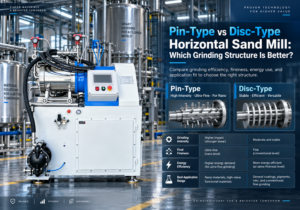
| 0.4mm – 0.6mm | 10μm – 30μm | 500nm – 2μm | Automotive Refinishes, Gravure Inks, Industrial Coatings | Pin-Type horizontal sand mill |
| 0.2mm – 0.3mm | 1μm – 5μm | 200nm – 500nm | Lithium Battery Cathode/Anode, Ceramic Slurries | High-Energy Nano Sand Mill |
| 0.1mm – 0.2mm | < 1μm | < 100nm (Ultra-Fine Nano) | MLCC Electronics, Inkjet Inks, Nano Calcium Carbonates | Pin-Type Nano Sand Mill with Centrifugal Separation |
Dynamic Media Separation in Micro-Grinding
When using micro-beads (0.1mm–0.3mm), conventional dynamic screen separators can easily clog. Ultra-fine milling requires a specialized Nano Sand Mill equipped with a high-efficiency rotor and a dynamic centrifugal separation system to prevent bead jam while maintaining high flow velocity.
Sand Mill Selection Across Key Industries
Different industrial sectors require tailored milling setups:
Coatings & Paints Industry
In sand mill in paint industry applications, high output and color strength are critical. A horizontal sand mill using 0.6mm–1.0mm beads provides an optimal balance between throughput, energy consumption, and dispersion uniformity.
R&D and Formula Testing
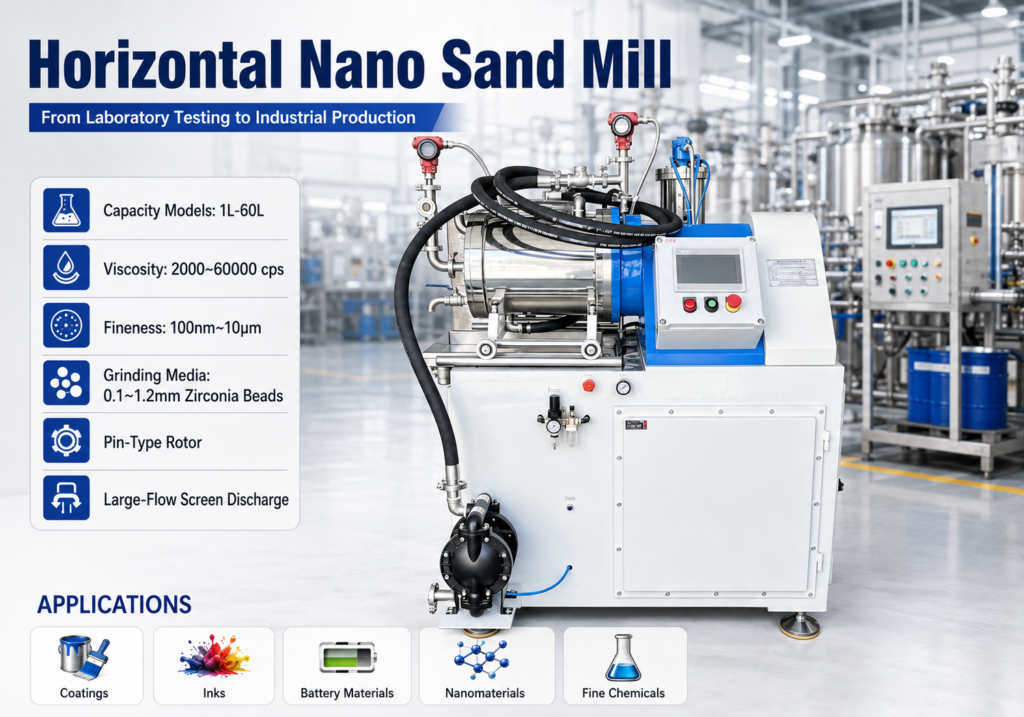
When developing new formulations, a lab sand mill allows process engineers to run rapid tests with minimal sample sizes before scaling up to continuous industrial production lines.
Battery Materials and Fine Chemicals
For advanced energy storage (e.g., LFP, silicon-carbon anodes) and electronic pastes, particle uniformity ($D_{97}$) and minimal metallic contamination are non-negotiable. High-energy pin-type machines using 0.1mm zirconia beads are the industry standard for these demands.
Unlocking True Nano Fineness: Musen Machinery Pin-Type Nano Sand Mill
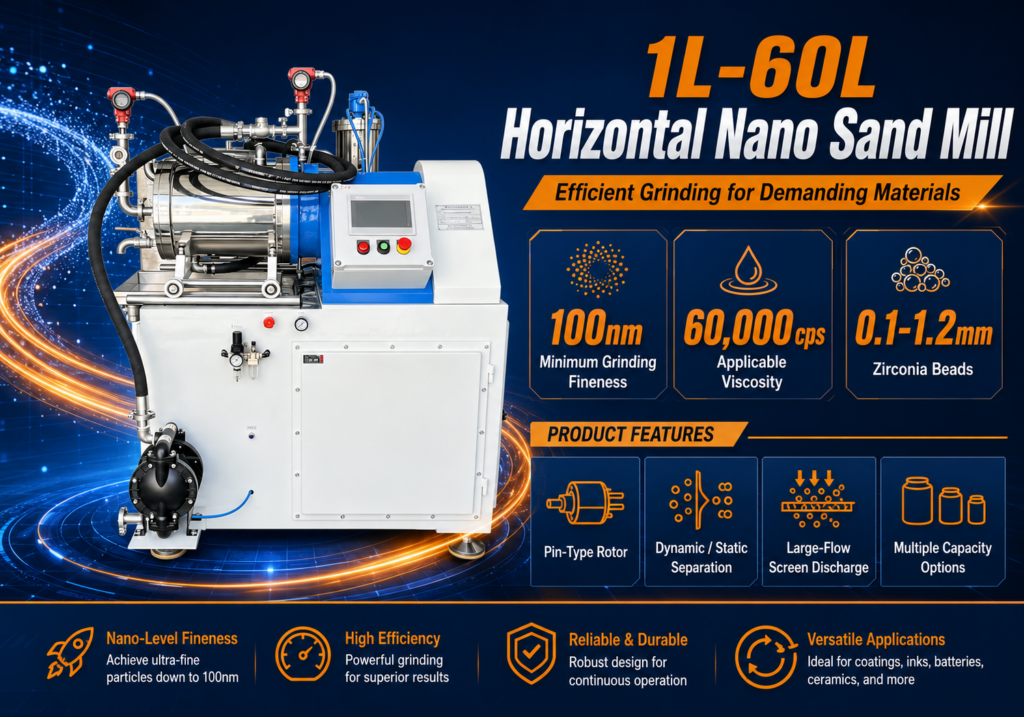
Using ultra-fine 0.1mm zirconia media requires an ultra-precise milling chamber capable of handling high kinetic energy density. The Pin-Type Nano Sand Mill by Musen Machinery is designed specifically to meet these continuous, high-efficiency requirements across battery, coating, ink, and fine chemical industries.
- High-Efficiency Pin Rotor System: Delivers intense shear force and uniform energy distribution, allowing continuous operation with ultra-small micro-beads down to 0.1mm.
- Double Mechanical Seals & Advanced Cooling: Equipped with double mechanical seals and a precision cooling system, ensuring stable operation, zero-leakage, and precise temperature control for heat-sensitive slurries.
- Versatile Industry Application: Ideal for lithium battery materials, ceramic slurries, electronic pastes, cosmetics, agrochemicals, and specialty chemical applications.
About Musen Machinery
Founded in 1998, with over 20 years of data accumulation, Musen Machinery focuses on intelligent integrated equipment and provides professional system solutions for global industrial customers.
- Verified Nano-Scale Performance: Grinding fineness of $\text{CaCO}_3$ can reach $D_{97} \le 70\text{nm}$, verified by third-party Malvern laser particle size analyzer or TEM.
- German-Style Precision: With our production base, R&D center, and sales team in Dongguan, we adopt German-style rigorous craftsmanship to continuously develop and upgrade equipment, offering ideal solutions from laboratory machines to complete production lines.
- Full Turnkey Capabilities: We specialize in wet grinding and dispersion technology, providing full sets of chemical production equipment including mixing, grinding, filtering, and filling.
Conclusion: Matching Media to Machine
Achieving target fineness between 100nm and 10μm requires matching the right zirconia bead size with the appropriate mill design. While 0.8mm–1.2mm beads excel in traditional paint and industrial coatings, scaling down to sub-micron or nano-levels requires 0.1mm–0.3mm beads paired with a specialized Nano Sand Mill.
Looking to optimize your wet grinding process or upgrade your production line? Contact Musen Machinery today to speak with our application specialists and request a trial demo.