









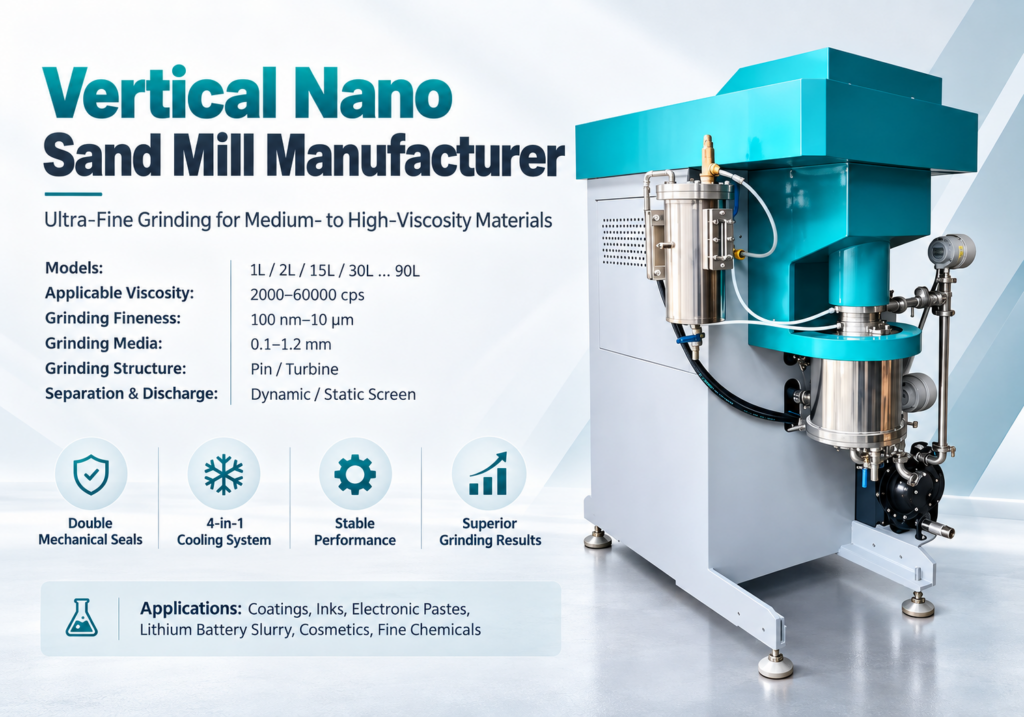
Manufacturers processing high-viscosity coatings, printing inks, electronic pastes, and lithium battery slurries often encounter three major production challenges: insufficient grinding efficiency, unstable particle size distribution, and excessive temperature during continuous operation.
Traditional mixing equipment may not provide enough grinding energy to achieve the required fineness, while unsuitable grinding configurations can lead to poor material circulation, screen blockage, and inconsistent product quality.
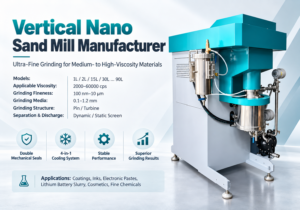
The Vertical Nano Sand Mill from Musehn is engineered to address these challenges through a compact vertical structure, high-efficiency pin or turbine grinding systems, and integrated temperature management. With models ranging from 1L to 90L, it provides flexible solutions for laboratory research, formulation development, and small-batch production.
Why Do High-Viscosity Materials Need a Vertical Nano Sand Mill?
High-viscosity materials behave differently from ordinary low-viscosity liquids during wet grinding. As viscosity increases, material circulation becomes more difficult, and the grinding media may not distribute energy evenly throughout the chamber.
This can create several production problems:
- Low grinding efficiency: Poor material circulation reduces effective contact between grinding media and agglomerates.
- Uneven particle size: Insufficient dispersion energy can leave unwanted particle clusters.
- Excessive heat generation: High-energy grinding can increase material temperature and affect sensitive formulations.
- Unstable production: Inconsistent processing conditions can result in batch-to-batch quality variations.
- Cleaning difficulties: Multiple formulations require equipment configurations that support convenient material discharge and cleaning.
Choosing the right vertical grinding equipment helps manufacturers improve process control and achieve more consistent dispersion results.
How Does a Vertical Nano Sand Mill Improve Grinding Performance?
The Musehn Vertical Nano Sand Mill combines a compact vertical architecture with high-efficiency wet grinding technology.
During operation, grinding media move inside the grinding chamber and generate impact and shear forces that help break down agglomerates and improve material dispersion.
Its main technical specifications include:
| Technical Parameter | Specification |
|---|---|
| Models | 1L / 2L / 15L / 30L / 90L |
| Applicable Viscosity | 2,000–60,000 cps |
| Grinding Fineness | 100 nm–10 μm |
| Grinding Media | 0.1–1.2 mm |
| Grinding Structure | Pin Type / Turbine Type |
| Separation & Discharge | Dynamic / Static Screen |
| Seal Configuration | Double Mechanical Seals |
| Cooling Configuration | 4-in-1 Cooling System |
The stated fineness range represents the equipment’s application range. Actual results depend on material characteristics, formulation, grinding media, and operating parameters.
Pin Type or Turbine Type: Which Grinding Structure Should You Choose?
Different materials require different grinding conditions. Selecting an appropriate rotor structure is essential for improving grinding efficiency.
Pin Type Grinding Structure
The pin-type rotor generates intensive impact and shear forces between the grinding media and material.
It can be considered for applications requiring stronger mechanical interaction and efficient agglomerate breakdown.
Typical applications include:
- Pigment dispersions
- High-performance coatings
- Electronic pastes
- Selected battery material formulations
Turbine Type Grinding Structure
The turbine-type structure promotes material circulation inside the grinding chamber.
It is suitable for evaluating applications where material flow and circulation are important to the grinding process.
Typical applications include:
- Printing inks
- Fine chemical formulations
- Cosmetic raw materials
- Selected medium-to-high-viscosity materials
The final rotor selection should be based on viscosity, particle characteristics, target fineness, and material testing rather than viscosity alone.
How to Prevent Overheating During Nano Grinding?
Temperature control is one of the most important considerations in fine grinding.
When grinding energy increases, heat can accumulate inside the chamber and affect temperature-sensitive formulations. This is particularly important for electronic materials, specialty chemicals, and certain cosmetic ingredients.
The Musehn Vertical Nano Sand Mill incorporates a 4-in-1 cooling system to support temperature management during operation.
The cooling system covers four important areas:
- Grinding chamber cooling: Helps remove heat generated inside the grinding chamber.
- Machine cover cooling: Supports temperature management around the upper chamber area.
- Mechanical seal cooling: Helps maintain suitable operating conditions around the sealing assembly.
- Shaft cooling: Helps control heat around the rotating shaft.
Together, these cooling arrangements support more stable grinding conditions during extended operation.
For heat-sensitive materials, manufacturers should specify their maximum allowable processing temperature before selecting the equipment.
How to Reduce Leakage and Contamination Risks?
When processing high-value materials, equipment sealing and material compatibility directly affect production reliability.
The Musehn Vertical Nano Sand Mill uses double mechanical seals to reduce leakage risks during operation.
Different grinding contact materials can also be considered according to application requirements and chemical compatibility.
For example:
- Zirconia: An option for applications requiring high wear resistance and reduced metal contamination.
- Silicon carbide: An option for demanding wear-resistance and material-purity requirements.
- Polyurethane: An option for selected applications requiring specialized wear-resistant contact materials.
The correct configuration should be confirmed according to the material’s chemical properties, purity requirements, and operating conditions.
Which Industries Use a Vertical Nano Sand Mill?
The compact vertical design and flexible grinding configurations make this equipment suitable for several industries.
1. Coatings and Paints
Coating manufacturers need consistent pigment dispersion to improve formulation stability and product appearance.
The machine can support wet grinding and dispersion of selected coating formulations.
2. Printing Inks and Pigments
Ink manufacturers often face challenges with pigment agglomeration and inconsistent dispersion.
Suitable grinding conditions help improve particle distribution and support stable ink production.
3. Electronic Pastes
Electronic materials may require controlled particle size, high dispersion quality, and strict contamination management.
The available grinding media and contact material options can be evaluated according to the formulation.
4. Lithium Battery Slurry
Battery material manufacturers require consistent processing of active materials, conductive additives, and other slurry components.
The vertical nano grinding configuration can be evaluated for selected battery slurry applications, subject to material compatibility and contamination testing.
For additional background, the U.S. Department of Energy’s battery manufacturing research describes slurry processing and milling capabilities used in battery research and development.
5. Cosmetics and Fine Chemicals
For cosmetic raw materials and specialty chemical formulations, controlled grinding conditions and temperature management are important for maintaining product consistency.
How to Select the Right Vertical Nano Sand Mill Capacity?
Choosing equipment based only on chamber volume may result in an unsuitable production configuration.
Before selecting a model, manufacturers should evaluate:
- Material viscosity and flow characteristics
- Required grinding fineness
- Batch volume and expected production output
- Grinding media size and material
- Temperature sensitivity
- Chemical compatibility and contamination requirements
- Required cleaning frequency
Musehn offers 1L, 2L, 15L, 30L, and 90L models to support different processing scales.
Smaller models are suitable for laboratory formulation development and material testing, while larger configurations can be evaluated for pilot production and small-batch manufacturing.
The actual model should be selected according to the material and required processing capacity.
Frequently Asked Questions About Vertical Nano Sand Mills
What is a vertical nano sand mill used for?
A vertical nano sand mill is used for wet grinding and dispersion of materials such as coatings, printing inks, electronic pastes, lithium battery slurries, cosmetics, and fine chemicals.
What viscosity can the Musehn Vertical Nano Sand Mill handle?
The specified applicable viscosity range is 2,000–60,000 cps. Actual processing suitability depends on material flow characteristics and operating conditions.
What particle size can the machine achieve?
The specified grinding fineness range is 100 nm–10 μm. The actual achievable particle size depends on the material, formulation, grinding media, and processing parameters.
What grinding media can be used?
The equipment supports grinding media sizes from 0.1 mm to 1.2 mm. The appropriate bead size and material should be selected according to the application.
What is the difference between pin and turbine grinding structures?
Pin-type structures generate impact and shear forces, while turbine-type structures promote material circulation. The optimal configuration depends on the specific grinding requirements.
How does the machine control grinding temperature?
The integrated 4-in-1 cooling system covers the grinding chamber, cover, mechanical seal, and shaft to help manage heat during operation.
Is the vertical nano sand mill suitable for laboratory and pilot production?
Yes. The listed 1L, 2L, 15L, 30L, and 90L models provide options for laboratory development, material testing, and small-batch production.
Solve Your Nano Grinding Challenges with Musehn
Poor material circulation, unstable dispersion, excessive temperature, and contamination risks can all affect the quality of high-value formulations.
The Musehn Vertical Nano Sand Mill combines flexible grinding structures, fine grinding media, double mechanical seals, and a 4-in-1 cooling system to address these common processing challenges.
Whether you are developing a new coating formulation, improving printing ink dispersion, or processing advanced electronic materials, choosing the right grinding configuration is essential.
Contact Musehn Machinery to discuss your material, viscosity, target fineness, and production requirements. Our engineering team can help evaluate a suitable vertical nano grinding solution and arrange material testing.
Visit https://www.sandmillms.com/ to explore Musehn grinding equipment solutions.