









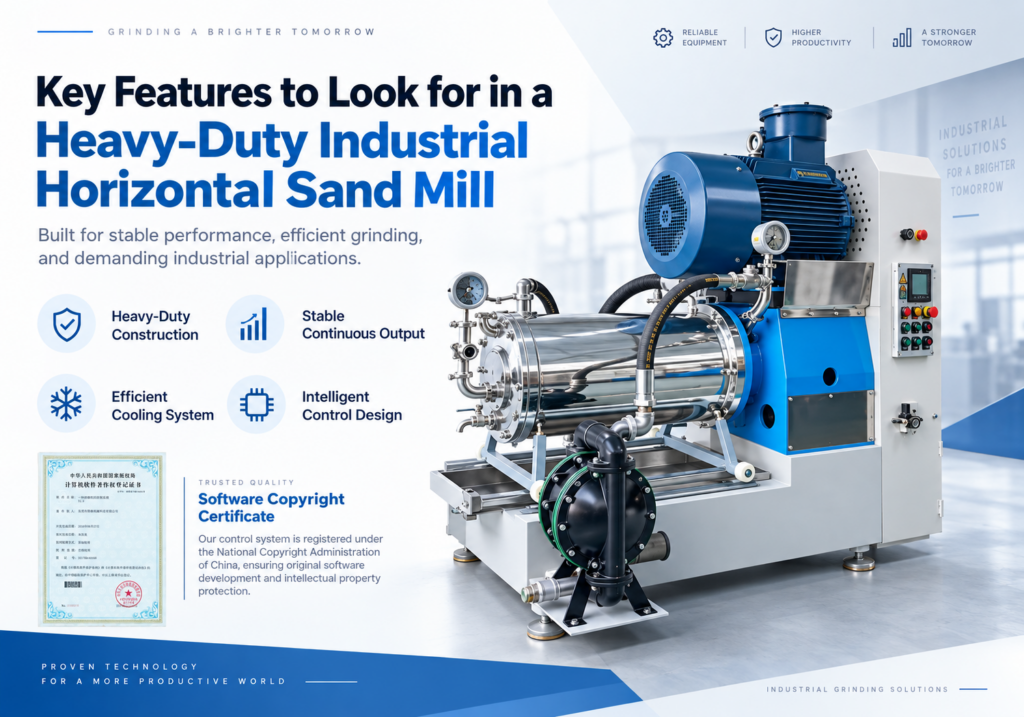
Not every horizontal sand mill is built for heavy-duty, round-the-clock industrial operation. While entry-level machines may handle light-duty or intermittent production adequately, manufacturers running continuous, high-volume, or abrasive processes need a horizontal bead mill engineered specifically for sustained industrial workloads. This article outlines the structural and engineering features that separate a true heavy-duty horizontal sand mill from a standard-duty unit — so you know exactly what to look for before committing to equipment for demanding production environments.
Why “Heavy-Duty” Matters in Horizontal Sand Mill Selection
A heavy-duty horizontal sand mill is designed to operate continuously, under high load, often processing abrasive or high-viscosity materials, without the frequent breakdowns or accelerated wear that undersized equipment experiences. For industries such as industrial coatings, heavy pigment concentrates, agrochemical suspensions, and new energy battery slurry production, choosing a machine that isn’t built for sustained heavy-duty use often results in higher long-term costs — more downtime, more frequent part replacement, and inconsistent product quality. Below are the features that actually determine whether a horizontal sand mill can handle heavy-duty industrial demands.
1. Reinforced Frame and Structural Rigidity
Heavy-duty operation places continuous vibration and mechanical stress on the machine base. A properly engineered horizontal sand mill should feature a reinforced, dimensionally stable frame that maintains rotor alignment and chamber integrity even after years of continuous operation. Poor structural rigidity leads to premature seal failure, rotor misalignment, and inconsistent grinding performance over time.
2. High-Torque, Industrial-Grade Drive System
Sustained processing of viscous or abrasive materials requires a motor and drive train capable of maintaining stable rotor speed under continuous heavy load. Look for a horizontal sand mill with an industrial-grade motor sized appropriately for your maximum expected load — not just average operating conditions — to avoid speed fluctuation, overheating, or premature drive component wear.
3. Wear-Resistant Chamber Lining and Rotor Components
Abrasive slurries and high-solid-content materials accelerate wear on any grinding chamber, but a true heavy-duty horizontal sand mill is built with wear-resistant lining materials and hardened rotor components specifically engineered to extend service life under continuous abrasive load. This single feature has an outsized impact on total cost of ownership over the equipment’s lifespan.
4. High-Capacity Cooling System
Continuous, heavy-duty grinding generates sustained frictional heat that a standard-duty cooling jacket may not be able to dissipate effectively. Heavy-duty horizontal sand mills are equipped with larger heat-exchange surface areas and higher coolant flow capacity, allowing the machine to maintain stable operating temperatures even during extended, uninterrupted production runs.
5. Robust Sealing System
Seals are one of the most common failure points in any bead mill under heavy-duty use. A properly engineered horizontal sand mill should feature a sealing system designed for extended service life under continuous pressure and abrasive wear — minimizing leakage risk, media contamination, and unplanned maintenance stops.
6. Modular, Interchangeable Component Design
Heavy-duty industrial environments demand fast, predictable maintenance. A horizontal sand mill built with modular, fully interchangeable components allows wear parts to be replaced quickly and consistently, without custom machining or extended downtime — a critical feature for facilities running continuous production schedules.
7. Stable Feed and Discharge System for Continuous Operation
Heavy-duty production lines often run for extended periods without interruption, which places continuous demand on the feed pump and discharge separation system. Look for a horizontal sand mill engineered to maintain consistent flow rates and stable media separation over long, uninterrupted runs, avoiding clogging or inconsistent particle size distribution during extended operation.
8. Proven Manufacturing Standards and Quality Certification
Heavy-duty industrial equipment is a long-term capital investment, so the manufacturing standards behind it matter as much as the individual features. A horizontal sand mill built under recognized quality systems (such as ISO9001) and rigorous dimensional tolerance standards provides greater assurance of consistent, reliable performance across every unit — not just the demo model.
Heavy-Duty Horizontal Sand Mill Feature Checklist
| Feature | What to Verify |
|---|---|
| Reinforced frame | Structural rigidity under continuous vibration/load |
| Industrial-grade drive system | Motor sizing for maximum, not just average, load |
| Wear-resistant chamber/rotor | Lining and component material specifications |
| High-capacity cooling | Heat-exchange surface area and coolant flow rate |
| Robust sealing system | Seal material and expected service life under load |
| Modular component design | Fast, standardized part replacement |
| Stable feed/discharge system | Consistent flow and separation over long runs |
| Quality certification | ISO9001 or equivalent manufacturing standards |
About Musehn Machinery
Dongguan Musehn Machinery Technology Co., Ltd. is a premier manufacturer specializing in high-end chemical grinding, dispersion, and conveying equipment, including heavy-duty industrial-grade horizontal sand mills built for continuous, high-load production across coatings, inks, agrochemicals, pharmaceuticals, cosmetics, and new energy materials.
As a dedicated subsidiary of LECJX, Musehn Machinery represents the global arm of our group — while LECJX remains focused on the Chinese domestic market, Musehn is strategically positioned to lead our group’s expansion and service operations in overseas markets.
Building on a manufacturing legacy established in 1998, Musehn has integrated cutting-edge Swiss technology with premium German materials. Our engineering philosophy centers on dimensional stability and full component interchangeability, ensuring that every horizontal sand mill we produce is built to withstand the demands of heavy-duty, continuous industrial operation while meeting international industrial standards. We strictly adhere to ISO9001 quality protocols and 5S management systems to guarantee excellence in every unit we export.
With numerous national patents — including Patent No. LC30037688.0 — and a modular design approach, Musehn’s horizontal sand mill equipment is engineered to minimize maintenance downtime and operational costs for our clients, directly addressing the wear-resistance and modular-maintenance features that heavy-duty industrial buyers require. We believe that superior quality is the ultimate global currency.
Supported by expert technical consulting and a 24/7 global service hotline, Musehn Machinery is committed to delivering reliable, precision-engineered horizontal sand mill solutions built for the demanding, continuous operating conditions of the international fine chemical and new material industries.
Frequently Asked Questions (FAQ)
Q1: What makes a horizontal sand mill “heavy-duty” compared to a standard model?
A: Heavy-duty models feature a reinforced frame, industrial-grade drive system sized for maximum load, wear-resistant chamber and rotor materials, high-capacity cooling, robust sealing, and modular components designed for fast maintenance — all engineered to sustain continuous, high-load operation without frequent breakdowns.
Q2: How does chamber lining material affect a horizontal sand mill’s lifespan under heavy-duty use?
A: Abrasive, high-solid-content materials accelerate wear on standard linings. Heavy-duty horizontal sand mills use hardened, wear-resistant lining materials specifically selected to extend service life and reduce the frequency of costly chamber replacements.
Q3: Can a heavy-duty horizontal sand mill run 24/7 without extended downtime?
A: When properly specified — with adequate cooling capacity, robust sealing, and industrial-grade drive components — a heavy-duty horizontal sand mill can support continuous, round-the-clock operation with scheduled maintenance intervals rather than frequent unplanned stops.
Q4: Does Musehn Machinery manufacture heavy-duty horizontal sand mills for continuous industrial production?
A: Yes. Musehn Machinery engineers horizontal sand mills for heavy-duty, continuous industrial operation, built under ISO9001 quality protocols with wear-resistant components, patented modular design, and backed by 24/7 global technical support.
Q5: What maintenance schedule should I expect for a heavy-duty horizontal sand mill?
A: Maintenance intervals depend on material abrasiveness, viscosity, and operating hours. A modular, interchangeable-component design allows scheduled wear-part replacement (seals, liners, media separators) to be completed quickly, minimizing production interruption compared to non-modular designs.
Q6: How do I know if my application requires a heavy-duty horizontal sand mill rather than a standard model?
A: If your production runs continuously, involves abrasive or high-solid-content materials, or requires consistent quality over extended operating hours, a heavy-duty configuration is generally the safer long-term investment. Share your process details with our engineering team for a specific recommendation.