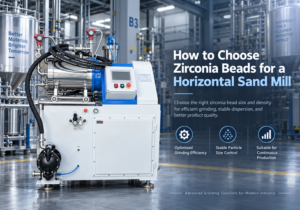










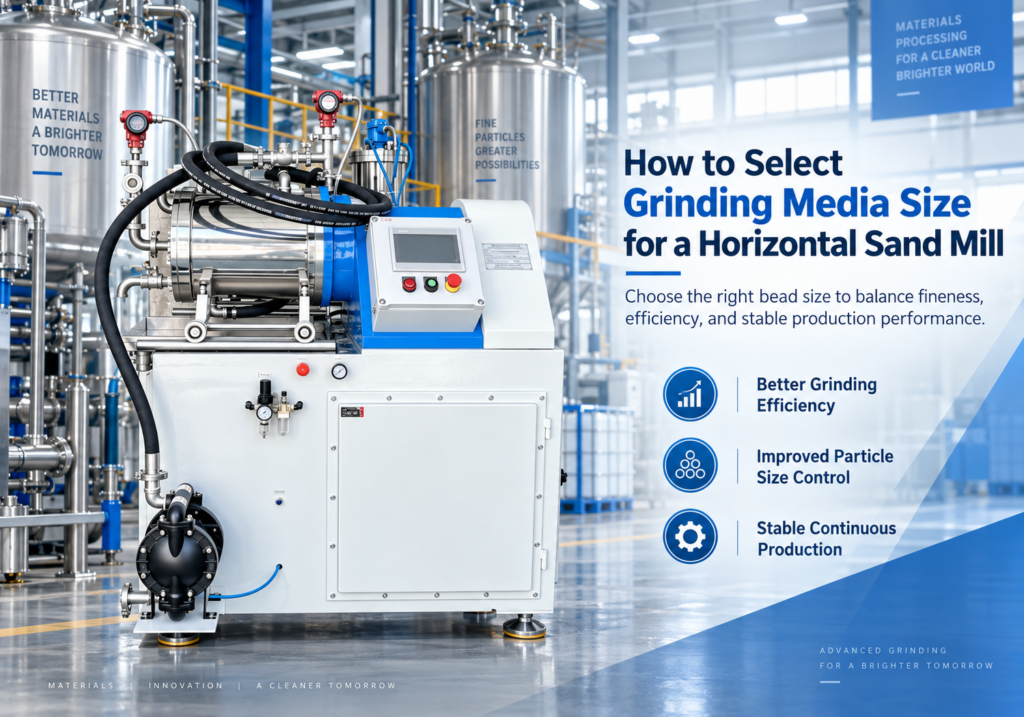
In industrial wet grinding and nano-dispersion processes, choosing the correct horizontal sand mill is only half the equation. The key to achieving target particle size distribution, maximizing throughput, and minimizing operational costs lies in grinding media size selection.
Whether you are dispersing lithium battery slurry, nano-inks, electronic pastes, or high-end coatings, using the wrong size zirconia beads can lead to inefficient grinding, excessive heat generation, machine wear, or screen clogging.
This guide provides a systematic approach to selecting the optimal grinding media size for a horizontal sand mill, explaining the mathematical principles, viscosity dynamics, structural considerations, and real-world industrial recommendations.
1. The Core Rule: Target Particle Size vs. Grinding Media Diameter
The fundamental rule of media selection in a horizontal bead mill is based on the contact point probability and energy transfer required to break down agglomerates.
The Golden Ratio in Wet Grinding
As a general engineering guideline:
- The grinding bead diameter should be 1,000 to 2,000 times larger than the initial raw material particle size ($D_{90}$).
- The grinding media diameter should be 100 to 300 times larger than the required final discharge fineness.
| Target Fineness Range | Recommended Media Size (∅) | Primary Industrial Applications |
| 500nm – 2.0 $\mu m$ | 0.4 mm – 0.6 mm | Automotive coatings, industrial paints, textile inks |
| 200nm – 500nm | 0.2 mm – 0.3 mm | High-end inkjet inks, MLCC ceramic pastes, pesticides |
| 50nm – 200nm | 0.05 mm – 0.1 mm | Lithium iron phosphate ($LiFePO_4$), nano-pharmaceuticals, CMP slurries |
Using beads that are too large reduces the total number of contact points inside the grinding chamber, drastically increasing process time. Conversely, using beads that are too small without sufficient kinetic energy will result in ineffective collisions, preventing the material from breaking past sub-micron thresholds.
2. Factors Influencing Grinding Media Size Selection
When determining the ideal bead size for your wet grinding mill, consider the following interconnected parameters:
A. Material Viscosity & Flow Behavior
Material viscosity significantly impacts bead movement. High-viscosity materials (e.g., 2000–3000 cps) exert strong drag forces on the grinding beads:
- Higher Viscosity: Requires sufficient kinetic energy to overcome liquid resistance. Larger beads or higher rotor tip speeds are traditionally needed, but advanced Pin & Turbine structures allow ultra-small media (down to 0.05mm) to operate effectively even in medium-to-high viscosity slurries.
- Lower Viscosity: Smaller beads move freely and maximize shear rate without causing excessive fluid dynamic bypass.
B. Machine Separation System Architecture
Traditional horizontal sand mills rely on dynamic gap separators or physical mesh screens to retain media inside the chamber.
- The Screen Limit: Physical mesh screens risk clogging when using beads smaller than 0.2mm.
- The Screen-Free Advantage: Modern advanced sand mills utilize a screen-free separation system. By replacing physical mesh with centrifugal media separation, operators can seamlessly run ultra-fine media (0.05mm – 0.6mm) without media compression, screen blinding, or pressure spikes.
C. Rotor Structure and Kinetic Energy Density
The geometric design of the rotor determines how effectively energy is imparted to the grinding media:
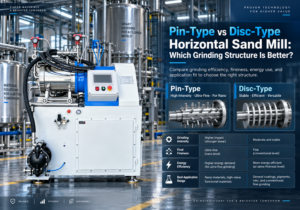
- Peg / Pin Type: Delivers high kinetic energy impacts suitable for tough particles.
- Turbine Type: Promotes smooth axial circulation and uniform kinetic energy distribution.
- Pin & Turbine Dual-Power Structure: Combines intense collision forces with rapid fluid movement, enabling uniform activation of tiny 0.05mm zirconia beads across the entire chamber length.
3. Why Yttrium-Stabilized Zirconia (YSZ) Beads Are the Industry Standard
Selecting the right bead size is meaningless if the media density and material composition fail under operational stress. Yttrium-Stabilized Zirconium Oxide ($ZrO_2$) beads are the premium choice for high-energy horizontal sand mills due to:
- High Specific Density ($\ge 6.0 g/cm^3$): Provides high kinetic impact energy ($E = \frac{1}{2} m v^2$) even at small bead diameters.
- Superior Wear Resistance: Prevents contamination in sensitive applications like electronic pastes and nano-pharmaceuticals.
- High Sphericity & Smooth Surface: Minimizes friction-induced heat generation and preserves internal machine components.
4. Recommended Equipment: Musehn Screen-Free Nano Sand Mills
When precise media size control and sub-micron grinding are critical to your production line, matching your media strategy with high-precision machinery is essential.
Dongguan Musehn Machinery Technology Co., Ltd. (the global export arm of LECJX, backed by a manufacturing legacy dating back to 1998) offers a line of Screen-Free Nano Sand Mills engineered specifically for flexible media size application.
Key Specifications & Capability Highlights:
- Model Capacities: Available in 10L, 30L, 90L, 150L, and 200L configurations to scale smoothly from pilot testing to full continuous production.
- Grinding Media Range: Engineered to operate efficiently with 0.05mm to 0.6mm zirconia beads.
- Achievable Fineness: Reaches 50nm to 500nm ultimate particle size.
- Viscosity Range: Optimally handles materials from 2000 to 3000 cps.
- Advanced Architecture: Combines a Pin & Turbine dual-power grinding structure with a screen-free separation system, eliminating discharge clogging while ensuring maximum energy transfer.
- Swiss Precision & German Engineering: Built under ISO9001 protocols with modular component interchangeability and proprietary national patents (e.g., Patent No. LC30037688.0).
5. Frequently Asked Questions (FAQ)
Q1: What is the risk of using grinding beads that are too small for my horizontal sand mill?
If the machine lacks an optimized separator, small beads can cause severe hydraulic packing, leading to discharge blockage, pressure surges, excessive internal wear, and overheating. Utilizing a screen-free nano sand mill prevents these issues by using centrifugal force rather than physical mesh to retain beads as small as 0.05mm.
Q2: How much grinding media should be loaded into a horizontal bead mill?
Typically, the bead filling ratio ranges between 70% and 85% of the grinding chamber’s net volume. Higher filling ratios increase contact points and grinding speed but require efficient cooling jackets to manage temperature rise.
Q3: How do I know when my grinding beads need to be replaced?
Over time, grinding media wears down due to continuous friction. Regularly sample and sieve your media. If average bead diameter decreases by >10-15%, or if you detect broken beads during maintenance, the media batch should be sieved to remove under-sized media or completely replaced to maintain target grinding efficiency.
Q4: Can I run 0.1mm beads in a standard horizontal sand mill designed for 0.6mm beads?
Not without evaluating the separation mechanism. Standard gap or screen separators designed for 0.6mm beads will allow 0.1mm beads to leak into the finished product or rapidly blind the separator screen. Upgrading to a machine designed with a dynamic screen-free separation system ensures full operational flexibility across media sizes ranging from 0.05mm to 0.6mm.
Summary
Selecting the ideal grinding media size requires balancing target particle fineness ($50\text{nm} – 500\text{nm}$), fluid viscosity ($2000 – 3000\text{ cps}$), and internal separator technology. By pairing premium Yttrium-stabilized zirconia beads with advanced engineering solutions—such as Musehn’s Screen-Free Nano Sand Mills—manufacturers can achieve predictable, repeatable, and ultra-fine dispersion across all high-end chemical and new material applications.