








A few months ago, a plant manager from a mid-sized cosmetics company in Europe wrote to us with a familiar problem. Their old open-top mixing vessel was fine for thin lotions, but the moment they tried to scale up a heavier, silicone-based cream, they started seeing air pockets, uneven texture, and batch rejects. They needed more volume, more control, and — increasingly important given today’s freight costs and longer shipping lanes from overseas suppliers — a partner they could trust to get the specification right the first time.
That story isn’t unique. As global supply chains keep shifting — companies diversifying sourcing beyond a single region, freight rates fluctuating, and buyers doing more due diligence before committing to a supplier — manufacturers are paying much closer attention to two things: production capacity and equipment reliability. A 2 ton covered mixing tank sits right at that intersection. It’s large enough to support real commercial-scale output, but it’s still compact enough to fit into most existing production lines without a full facility rebuild.
What a Covered (Vacuum) Mixing Tank Actually Solves
An open tank works fine for water-thin liquids. But once viscosity climbs — creams, gels, adhesives, coatings, inks, ointments — an open system starts working against you. Air gets whipped into the batch, oxidation creeps in, and dispersion becomes inconsistent from one batch to the next.
That’s the whole reason vacuum mixing tanks exist. By sealing the vessel and mixing under vacuum, you pull dissolved air and micro-bubbles out of the product as it’s being blended, rather than trying to remove them afterward. Combine that with a dual-action mixing system — a high-speed homogenizing disperser paired with a slower anchor or frame agitator that continuously scrapes the tank wall — and you get a batch that’s smooth, stable, and genuinely consistent from the first liter to the last.
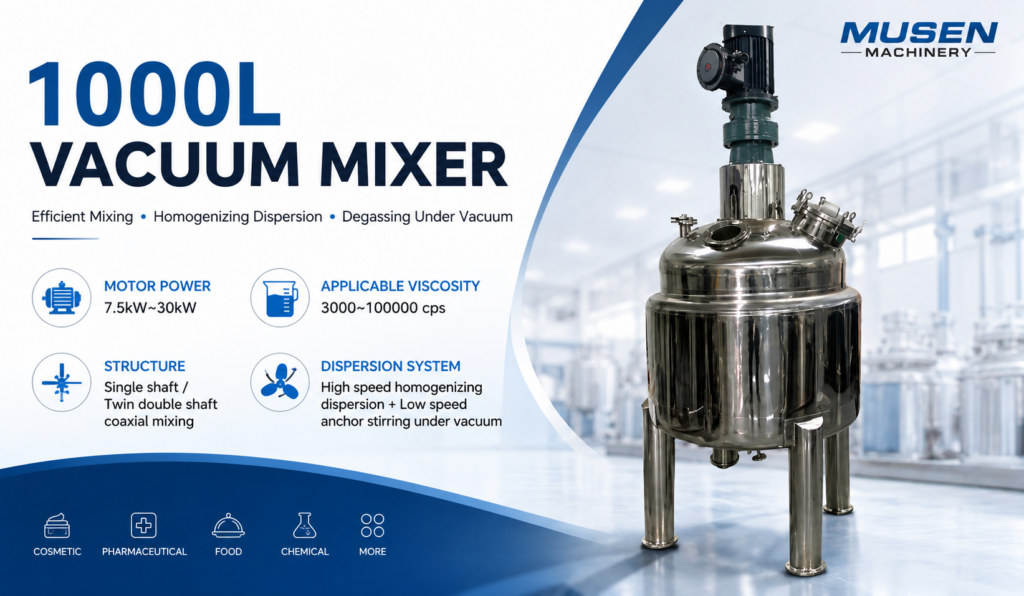
Across our tank range, from 1000L platforms up through our 2 ton covered mixing tank, this is the same core engineering approach:
- Motor power scaled from roughly 7.5kW up to 30kW depending on batch size and product viscosity
- Workable viscosity range from around 3,000 cps up to 100,000 cps, covering everything from lotions to heavy pastes
- Single-shaft or twin double-shaft coaxial mixing, so the configuration can be matched to the product rather than forcing the product to fit the machine
- High-speed dispersion combined with low-speed anchor stirring under vacuum, running simultaneously rather than as separate steps
It’s a setup that shows up constantly in cosmetics (creams, lotions, ointments), pharmaceuticals, food emulsions, and industrial chemical production — adhesives, coatings, printing inks, and specialty pastes.
Built in Dongguan, Tested the German Way
Musen Machinery was founded in 1998, which by industry standards makes us one of the longer-running names in wet grinding and dispersion equipment. Over that time, one thing hasn’t changed: we don’t ship a machine out the door until we’re confident it holds up in a real production environment, not just on paper.
We run our own production base, R&D center, and sales team out of Dongguan, and we’ve built our internal process around what we describe internally as a German-style discipline — tight tolerances, repeatable testing, and documentation you can actually verify. When we say our grinding fineness for CaCO₃ can reach D97 ≤ 70nm, that isn’t a marketing number; it’s a figure confirmed with a third-party Malvern laser particle size analyzer or TEM imaging, so customers auditing a new supplier have something concrete to check against.
We also don’t just build tanks in isolation. Because our background is in wet grinding and dispersion technology, we design and supply complete chemical production lines — mixing, grinding, filtering, and filling — so a 2 ton covered mixing tank we deliver is built to work as one link in a bigger process, not a standalone box that creates a bottleneck somewhere else in your plant.
Choosing the Right Size and Configuration
Not every product needs 2 tons of vacuum mixing capacity, and not every plant should jump straight to the largest tank available. A few questions we usually walk customers through before recommending a configuration:
- What’s your target batch size today, and realistically, in two years?
- What’s the viscosity range of your product line — is it one formula, or several with very different flow characteristics?
- Do you need heating or cooling jacket integration for temperature-sensitive formulations?
- Is your facility set up for single-shaft mixing, or would a twin double-shaft coaxial system give you better dispersion for your specific product?
Getting this right up front saves far more money than it costs — an undersized tank means running more batches per day than necessary, while an oversized one just ties up capital and floor space.
Frequently Asked Questions
What products can a 2 ton covered mixing tank actually handle? Generally anything in the medium-to-high viscosity range — roughly 3,000 to 100,000 cps. That covers cosmetic creams and lotions, pharmaceutical ointments, food pastes and sauces, adhesives, coatings, and printing inks.
What’s the difference between a single-shaft and a twin double-shaft coaxial mixer? A single-shaft system is simpler and works well for moderate viscosity products. A twin double-shaft coaxial setup runs a high-speed disperser and a low-speed anchor agitator on independent, aligned shafts at the same time, which generally gives better results on thicker or harder-to-disperse formulations.
Is stainless steel 304 or 316L better for our product? It depends on what’s in contact with the material. SUS316L offers stronger corrosion resistance and is generally preferred for pharmaceutical-grade or acidic/saline formulations, while SUS304 is a cost-effective option for many cosmetic and general chemical applications. We can advise based on your product’s formulation.
Can the tank be customized with heating or cooling? Yes. Jacketed heating and cooling systems are available as options, along with variable-speed drives, depending on your process temperature requirements.
How long does manufacturing and shipping typically take? Lead time depends on the specific configuration and current production schedule. Because we manufacture in-house in Dongguan, we can usually give a firm timeline once we understand your specifications, and we work with freight partners across multiple regions to help coordinate delivery.
Do you provide third-party quality verification? Yes. For grinding and dispersion performance, we can provide particle size verification using a Malvern laser particle size analyzer or TEM imaging, so you have independent data rather than just our word for it.
What kind of after-sales support is available? Our sales and technical team supports customers after installation, including guidance on operation, maintenance, and spare parts, whether the tank is running as a standalone unit or as part of a full mixing–grinding–filtering–filling line.
Can you build a full production line around this tank, not just the tank itself? Yes — this is actually where we spend most of our engineering time. We regularly design complete systems that combine mixing, wet grinding, filtering, and filling equipment so the tank integrates directly into your existing or planned production flow.
Have a formulation you’re trying to scale up? Send us your target batch size and viscosity range, and our team can recommend a configuration — from our 1000L platform up to the 2 ton covered mixing tank — that fits your production line.