









How Horizontal Sand Mills Work: Structure, Dispersion Principle & Selection Guide
Article Body
If your production line depends on ultra-fine grinding and stable dispersion — whether you’re making lithium battery slurry, industrial coatings, printing inks, or nano pigments — the horizontal sand mill is likely the single most important piece of equipment on your floor. Yet many buyers still aren’t sure exactly how it works, or how to choose the right supplier and model for their material and output targets.
This guide breaks down the core structure of a horizontal sand mill, the dispersion principle behind the grinding process, and the practical factors you should weigh before choosing a horizontal sand mill factory to work with — using real production data from our Large Capacity Nano Sand Mill series as a working example.
What Is a Horizontal Sand Mill?
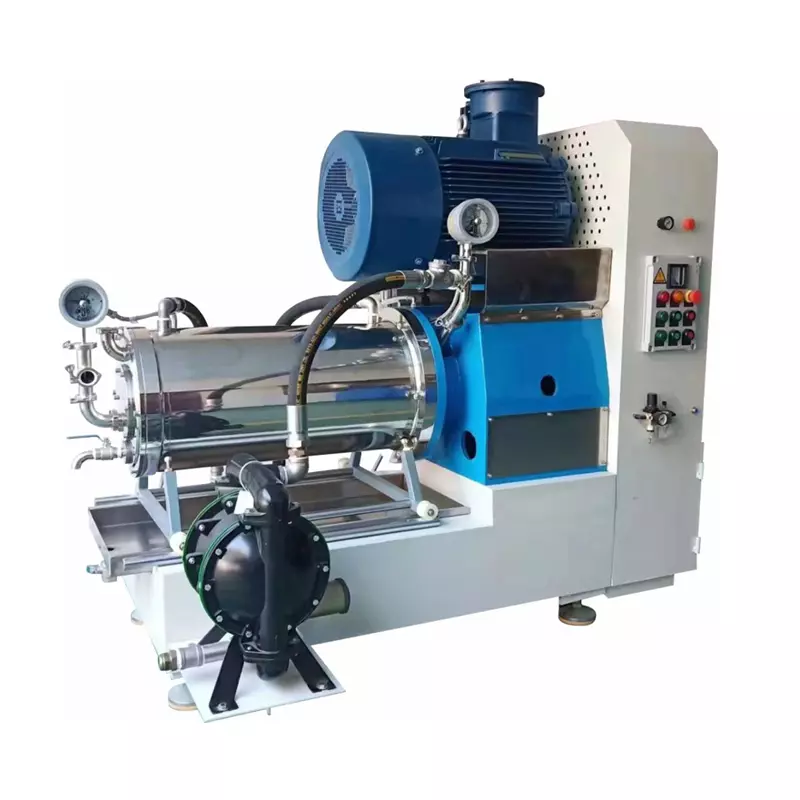
A horizontal sand mill is a wet grinding and dispersion machine that uses a rotating shaft and small grinding media (typically zirconia beads) inside a horizontally mounted cylinder to break down solid particles suspended in a liquid. The result is a smooth, stable, uniformly dispersed slurry — critical for products where particle size directly affects performance, color strength, viscosity, or shelf stability.
Compared to vertical mills, the horizontal design allows for higher media filling ratios, more even energy distribution across the chamber, and better handling of high-viscosity, heat-sensitive, or abrasive materials — which is why the horizontal sand mill is the standard choice for large-scale fine chemical and battery material production.
Core Structure of a Horizontal Sand Mill
While designs vary between manufacturers, most industrial horizontal sand mill machines share the following key components:
1. Grinding Chamber (Cylinder) A horizontally mounted, wear-resistant cylinder filled with grinding media and the material to be processed. Cylinder volume is usually the basis for model naming (e.g., 70L, 100L, 200L).
2. Rotor The rotor drives the grinding media at high speed to create the shear and impact forces that break down particles. A pin-type rotor, in particular, is widely used in a high-efficiency horizontal sand mill for nano-level dispersion because it generates strong, evenly distributed shear throughout the chamber rather than concentrating force in one zone.
3. Grinding Media Typically zirconia beads ranging from 0.1mm to 1.2mm, though silicon carbide or polyurethane media can be used depending on the material’s abrasiveness and purity requirements. Smaller beads generally produce finer particle sizes but require more precise separation systems.
4. Separation & Discharge System This is what keeps the grinding beads inside the chamber while letting the finished slurry flow out. Two common approaches are dynamic separation and static large-flow screen discharge — both designed to prevent bead loss and screen clogging while maintaining high throughput.
5. Mechanical Seal A double mechanical seal design prevents leakage at the shaft, which is especially important when processing corrosive, flammable, or high-value materials.
6. Cooling System Grinding generates significant heat, which can degrade heat-sensitive materials or affect final product color and stability. A well-designed cooling system — ideally covering the chamber, cover, seal, and shaft — keeps temperatures stable throughout long production runs.
The Dispersion Principle Explained
The grinding and dispersion process inside a horizontal sand mill works in three overlapping stages:
- Impact — Grinding media collide with agglomerated particles, breaking large clusters into smaller fragments.
- Shear — As the rotor spins, media and slurry are forced through narrow gaps, generating intense shear forces that further reduce particle size and separate particles from each other.
- Dispersion — Broken particles are evenly distributed throughout the liquid medium, preventing re-agglomeration and producing a stable, uniform suspension.
The efficiency of this process depends heavily on rotor design, bead size, bead filling ratio, chamber geometry, and flow rate — which is why equipment selection isn’t just about picking a “bigger” machine, but choosing the right horizontal sand mill for your material’s viscosity and target fineness.
Selection Guide: What to Consider Before Buying a Horizontal Sand Mill
1. Target Fineness Are you aiming for micron-level or nano-level particle size? Nano-level dispersion (sub-100nm) requires finer media, precise rotor design, and tighter separation tolerances.
2. Material Viscosity Low-viscosity inks and high-viscosity coatings behave very differently inside the chamber. Confirm the mill’s rated viscosity range matches your product.
3. Production Volume Batch size and required hourly throughput determine cylinder volume and driving power. Underestimating this leads to bottlenecks; overestimating wastes capital and energy.
4. Contact Materials Zirconia, silicon carbide, and polyurethane each offer different wear resistance and purity levels. If you’re producing light-colored or high-purity products, contact material selection directly affects final product color and contamination risk.
5. Cooling & Sealing For heat-sensitive formulations (many battery slurries and cosmetic raw materials fall into this category), a robust multi-point cooling system isn’t optional — it’s essential for consistent quality.
6. Choosing the Right Horizontal Sand Mill Factory Beyond the machine itself, the supplier matters. Low-maintenance designs reduce downtime, but you should still confirm spare parts availability, service response time, R&D capability, and the manufacturer’s track record before committing to a horizontal sand mill factory.
Product Spotlight: Large Capacity Nano Sand Mill (LC Series)
To put these principles into a concrete example, here’s how our LC Series horizontal sand mill line is configured for large-volume industrial production:
| Model | Cylinder Volume (L) | Driving Power (kW) | Capacity (L/h) | Bead Size (mm) | Bead Filling (%) | Weight (kg) | Outline Size (mm) |
|---|---|---|---|---|---|---|---|
| LC-70L | 70 | 75 | 500–900 | 0.1–1.2 | 70–85 | 2800 | 2200×1400×2500 |
| LC-100L | 100 | 90 | 800–1500 | 0.1–1.2 | 70–85 | 3800 | 2400×1550×2700 |
| LC-200L | 200 | 110 | 1500–2500 | 0.1–1.2 | 70–85 | 5200 | 2700×1750×2900 |
| LC-300L | 300 | 132 | 2200–3500 | 0.1–1.2 | 70–85 | 6500 | 2900×1900×3100 |
| LC-500L | 500 | 160 | 3500–5500 | 0.1–1.2 | 70–85 | 9000 | 3300×2100×3300 |
Key specs:
- Applicable viscosity: 2,000–60,000 cps
- Grinding fineness: 100nm–10μm
- Grinding media: 0.1–1.2mm zirconia beads
- Grinding structure: Pin-type rotor
- Separation & discharge: Dynamic / static large-flow screen discharge
Features:
- Double mechanical seal design prevents leakage and ensures stable operation
- Optional contact materials (zirconia, silicon carbide, polyurethane) adapt to different material and wear requirements
- High-efficiency pin-type rotor delivers thorough grinding and uniform dispersion for nano-level processing
- 4-in-1 cooling system (chamber, cover, seal, shaft) suits heat-sensitive materials
- Low-maintenance design reduces downtime and long-term operating costs
- High-purity, wear-resistant contact parts keep white products color-stable and black products glossy
Applicable industries: Lithium battery slurry, nano pigments, ceramic inks, digital printing inks, pesticide suspensions, electronic pastes, cosmetic raw materials, coatings, and fine chemicals.
Why Fineness Verification Matters
Manufacturer claims about grinding fineness are only meaningful when independently verified. Our CaCO₃ grinding results, for example, reach D97 ≤ 70nm, confirmed by third-party Malvern laser particle size analysis and TEM imaging. When evaluating any horizontal sand mill factory, ask for verifiable test data — not just spec sheet numbers.
About Dongguan Musen Machinery — Your Trusted Horizontal Sand Mill Factory
Founded in 1998, Dongguan Musen Machinery Technology Co., Ltd. has spent over 20 years focused on wet grinding and dispersion technology, offering intelligent integrated equipment and system solutions to industrial customers worldwide. As an established horizontal sand mill factory, our production base, R&D center, and sales team are all located in Dongguan, where we apply German-style rigorous craftsmanship to continuously develop and upgrade our equipment — from laboratory-scale machines to complete production lines.
Beyond horizontal sand mill manufacturing, we provide full sets of chemical production equipment including mixing, grinding, filtering, and filling systems, giving customers a single point of contact for end-to-end wet processing solutions.
Looking for the right horizontal sand mill for your production line? Get in touch with our team — a specialized horizontal sand mill factory with 20+ years of experience — to discuss your material, viscosity, and fineness requirements. We’ll help you match the right model and configuration to your production goals.