









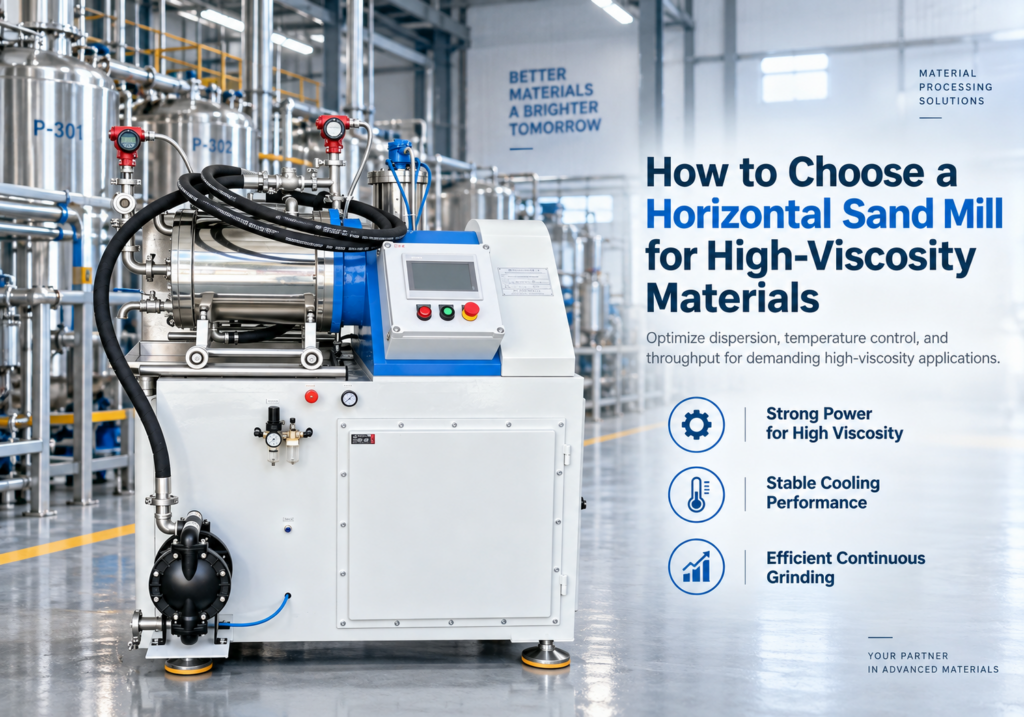
In the fine chemical, advanced materials, and high-end coating industries, processing high-viscosity slurries presents unique engineering challenges. High-viscosity materials (ranging from 2,000 to 30,000+ cPs) often lead to severe flow resistance, rapid temperature spikes, screen clogging, bead compaction, and uneven particle size distribution during wet grinding.
Selecting the right horizontal sand mill (also known as a horizontal bead mill or wet grinding mill) is critical to achieving target nano-scale fineness while ensuring continuous, energy-efficient production.
This comprehensive guide breaks down key selection criteria for high-viscosity wet grinding, essential features to look for, and a recommended manufacturer for industrial-grade grinding equipment.
1. Key Challenges in Grinding High-Viscosity Materials
Before choosing a horizontal sand mill, it is essential to understand how material viscosity impacts the grinding process:
- Screen Clogging & Flow Resistance: Traditional sand mills rely on mesh screens to separate grinding beads from the processed slurry. High-viscosity or sticky materials tend to block these screens quickly, leading to backpressure, production halts, and potential seal failures.
- Overheating Risks: Higher viscous resistance generates substantial kinetic friction during grinding. Without an effective cooling system, thermal degradation of heat-sensitive materials (such as electronic pastes or color filters) can occur.
- Bead Accumulation: In inefficient chamber designs, viscous drag pushes micro-grinding media toward the discharge end, causing uneven bead distribution, poor grinding efficiency, and high media wear.
- Energy Consumption: High-viscosity processing requires strong kinetic energy transfer without overloading the drive system or overheating the slurry.
2. Crucial Features to Look for in a High-Viscosity Horizontal Sand Mill
To overcome these operational bottlenecks, evaluate potential bead mills against the following design standards:
A. Grinding Structure: Pin & Turbine Dual-Power Systems
For medium-to-high viscosity applications, dynamic agitation is paramount.
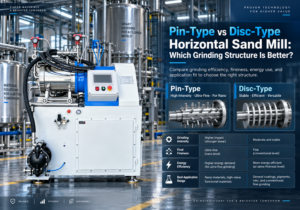
- Pin-type structures impart high shear forces and dynamic kinetic energy directly to the grinding beads, breaking down tough agglomerates effectively.
- Turbine structures assist in axial force distribution and fluid circulation, preventing media compaction at the discharge zone.A combined Pin & Turbine grinding structure maximizes energy efficiency, provides intense impact forces, and maintains steady material throughput even under higher viscous loads.
B. Dynamic Screen-Free Separation System
Conventional dynamic or static screens struggle with high viscosity. Opting for a screen-free separation system eliminates screen clogging entirely. Modern screen-free separators use centrifugal separation technology to maintain continuous material discharge and smooth fluid flow without pressure build-up—even when using ultra-small 0.05mm to 0.6mm zirconia beads.
C. Chamber Cooling & Thermal Management
Look for equipment featuring double-jacketed or full-body cooling channels across the grinding chamber and rotor assembly. Efficient heat dissipation prevents thermal degradation and allows high-energy grinding without exceeding maximum material temperature limits.
D. Media Compatibility & Precision Fineness
Achieving sub-micron or true nano-scale fineness (50nm to 500nm) requires using micro zirconia beads (0.05–0.6mm). Ensure the chamber components (rotor and liner) are made of high-wear-resistant materials such as silicon carbide, zirconia ceramics, or high-alloy hardened steels to avoid material contamination.
3. Machine Specifications & Capacity Selection Matrix
When selecting a horizontal bead mill, select chamber capacity based on batch volume and hourly production targets:
| Model / Chamber Volume | Applicable Viscosity Range | Target Grinding Fineness | Compatible Grinding Media | Recommended Applications |
| 10L / 30L | 2,000 ~ 3,000+ cPs | 50nm ~ 500nm | 0.05 ~ 0.6mm Zirconia Beads | R&D, pilot line production, high-value nano inks |
| 90L / 150L / 200L | 2,000 ~ 3,000+ cPs | 50nm ~ 500nm | 0.05 ~ 0.6mm Zirconia Beads | Industrial continuous production lines |
4. Recommended Manufacturer: Dongguan Musehn Machinery Technology Co., Ltd.
When searching for a reliable, high-precision horizontal sand mill manufacturer, Dongguan Musehn Machinery Technology Co., Ltd. stands out as a premier global supplier specializing in high-end chemical grinding, dispersion, and conveying equipment.
About Musehn Machinery
As the dedicated international division of the LECJX group, Musehn Machinery builds on a manufacturing legacy established in 1998. Musehn combines Swiss engineering concepts with premium materials to serve overseas markets in precision chemical processing, lithium battery materials, nano inks, electronic pastes, and high-end functional coatings.
Why Choose Musehn Horizontal Sand Mills?
- Advanced Engineering Standards: Integrates German material science with Swiss precision machining, ensuring dimensional stability and 100% full component interchangeability.
- Proprietary Innovation: Backed by multiple national design patents (including Patent No. LC30037688.0) and modular engineering designs that minimize maintenance downtime and lower lifecycle operational costs.
- Screen-Free Nano Grinding Tech: Musehn’s flagship Screen-Free Nano Sand Mill models (10L, 30L, 90L, 150L, 200L) feature a Pin & Turbine dual-power structure and a clog-free separation design, making them ideal for high-viscosity, continuous nano-dispersion down to 50nm.
- Strict Quality & Global Support: Operating under strict ISO9001 quality protocols and 5S management systems, Musehn provides expert technical consulting and a 24/7 global service hotline for seamless international installation and troubleshooting.
5. Frequently Asked Questions (FAQ)
Q1: What is the main advantage of a horizontal sand mill over a vertical sand mill for high-viscosity materials?
A: Horizontal sand mills offer consistent bead distribution across the entire chamber length due to gravity-neutral horizontal orientation. This prevents media settling, enables higher power density, facilitates superior cooling efficiency, and delivers tighter particle size distribution (PSD) for high-viscosity slurries compared to vertical designs.
Q2: Why is a screen-free separation system better for sticky or viscous slurries?
A: Traditional dynamic or static mesh screens clog easily when handling high-viscosity slurries or sticky dispersions, leading to frequent cleaning stops and pressure spikes. A screen-free centrifugal separation system keeps the micro zirconia beads inside the grinding zone without physical mesh screens, ensuring continuous discharge, zero clogging, and zero maintenance downtime.
Q3: What size zirconia beads should be used to achieve sub-micron or nano-scale grinding?
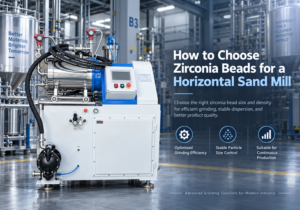
A: To achieve grinding fineness between 50nm and 500nm, ultra-fine 0.05mm to 0.6mm zirconia beads (yttria-stabilized ceramic media) are recommended. The energy transfer provided by Pin & Turbine rotors accelerates these micro beads to deliver maximum kinetic impact without media crushing.
Q4: How do I select the proper motor power and chamber size (10L vs 200L) for my factory?
A:
- 10L–30L models are best suited for small-batch flexible production, R&D labs, or pilot scale testing.
- 90L, 150L, and 200L models are engineered for full-scale continuous industrial production lines requiring high hourly volumetric flow.
For tailored capacity calculations based on your slurry’s viscosity, target d90 fineness, and flow rate, consult Musehn Machinery’s engineering team directly via their 24/7 global service hotline.