









Meta Description
Industrial 10-200L nano dual-power sand mill for 50nm-500nm wet grinding. Features screen-free separation, 4-in-1 cooling, and dual rotor design. Engineered for battery slurries, electronic pastes, and coatings.
URL Slug
/products/nano-dual-power-sand-mill
H1: Nano Dual-Power Sand Mill (10-200L) for Ultra-Fine Dispersion
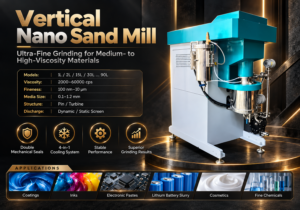
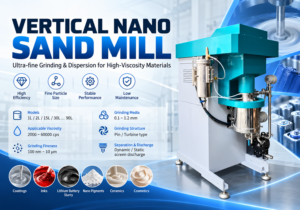
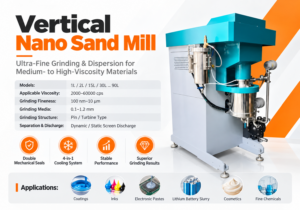
The Musehn Nano Dual-Power Sand Mill (10-200L) is an industrial-grade wet grinding system engineered for sub-micron and nano-level material dispersion. Capable of achieving stable particle sizes from 50nm to 500nm, this equipment resolves traditional grinding bottlenecks—such as screen blockages, high chamber pressure, and excessive heat generation.
It is purpose-built for industries requiring strict particle size distribution and zero metal contamination, including lithium battery slurries, electronic pastes, digital inks, and advanced ceramics.
H2: Core Engineering Features
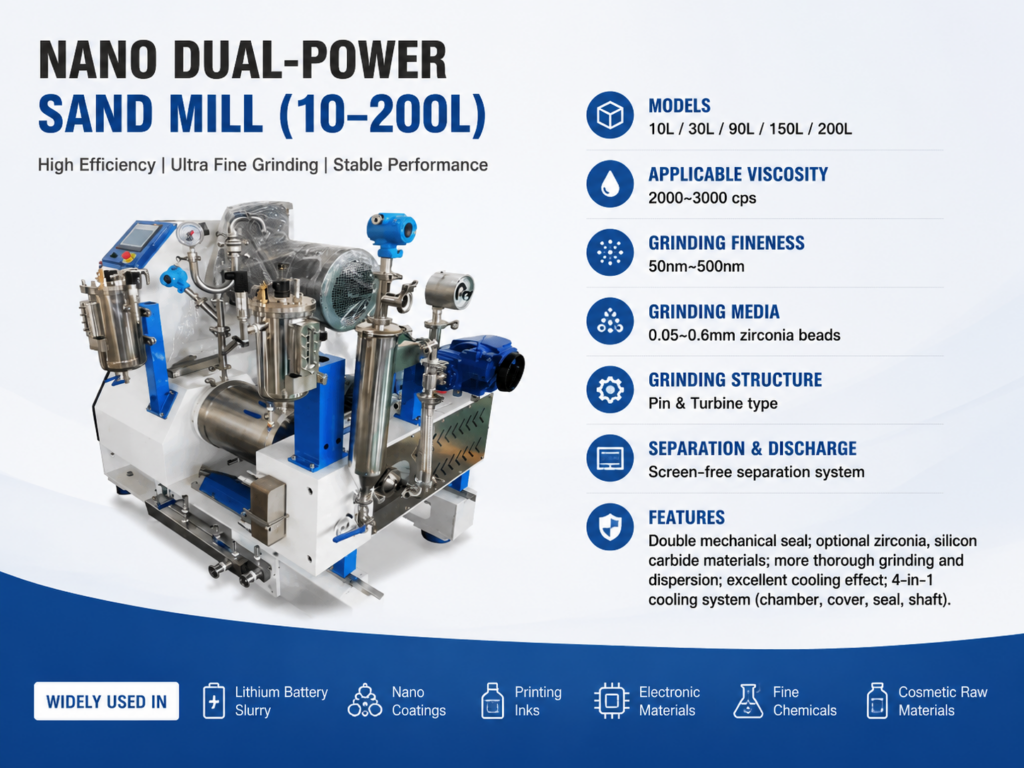
1. Dual-Rotor Grinding Architecture (Pin & Turbine)
Instead of relying on a single grinding mode, this machine integrates both Pin-type and Turbine-type mechanisms. The pin configuration delivers high-shear impact energy to break down difficult agglomerates, while the turbine structure ensures smooth material flow and uniform dispersion. This combination allows for precise adaptation to different material viscosities and hardness levels.
2. Screen-Free Dynamic Separation
Traditional static screens are prone to blocking when using ultra-fine grinding media, leading to pressure build-up and halted production. This equipment utilizes a screen-free dynamic separation system. By utilizing centrifugal force to separate the product from the media, it completely eliminates screen wear and blockages. This enables the reliable use of micro-beads as small as 0.05mm for continuous, high-throughput manufacturing.
3. 4-in-1 Thermal Management System
Nano-grinding generates significant friction and heat, which can degrade sensitive materials. The mill incorporates a comprehensive cooling matrix: Chamber Cooling + Cover Cooling + Shaft Cooling + Mechanical Seal Cooling. This rapid heat dissipation stabilizes the internal temperature, safeguarding temperature-sensitive battery polymers and chemical formulations.
4. Zero-Contamination Component Options
To meet the strict iron-free requirements of the new energy and semiconductor sectors, all internal contact parts (rotors, chamber liners, separators) can be configured with high-purity Zirconia or Silicon Carbide (SiC). A robust double mechanical sealing system further prevents lubricant leaks and ensures safe, continuous operation.
H2: Technical Specifications
| Technical Items | Specifications & Data |
| Brand | Musehn Machinery |
| Machine Type | Nano Dual-Power Sand Mill (Bead Mill) |
| Available Models | 10L / 30L / 90L / 150L / 200L |
| Grinding Fineness | 50nm – 500nm |
| Applicable Viscosity | 2,000 – 3,000 cps |
| Grinding Media Size | 0.05mm – 0.6mm (Zirconia Beads) |
| Grinding Structure | Pin & Turbine Integration |
| Separation System | Screen-Free Dynamic Separation |
| Cooling Method | 4-in-1 Cooling System |
H2: Target Industrial Applications
- Energy Storage & Batteries: Lithium iron phosphate, NCM cathode materials, anode graphite, Carbon Nanotube (CNT) conductive pastes, and solid-state battery slurries.
- Advanced Coatings & Inks: Digital inkjet inks, UV-curable inks, automotive functional coatings, and nano-pigment dispersions.
- Electronics & Semiconductors: Electronic pastes, high-end ceramic slurries, and semiconductor polishing materials.
- Fine Chemicals: Agrochemical dispersions, active cosmetic ingredients, and functional chemical additives.
H2: FAQ
Q1: What is the main advantage of a dual-power sand mill over a standard bead mill?
The dual-power design separates the driving force of the grinding rotor from the separation system. This allows for independent speed control, preventing beads from packing at the discharge end and enabling the use of ultra-fine 0.05mm media without blocking.
Q2: What is the expected grinding fineness?
Depending on the raw material hardness and initial particle size, this machine is engineered to reliably achieve stable distributions between 50nm and 500nm.
Q3: Does the screen-free separation system require special maintenance?
Because it eliminates the traditional static screen, it actually requires less maintenance. There are no screens to clean, replace, or unclog, which significantly increases continuous production uptime.
Q4: Which industries benefit most from this specific mill?
Any industry requiring true nano-level dispersion without metal contamination, particularly lithium battery manufacturing, digital ink production, and electronic materials.