









If you’ve spent any time researching grinding and dispersion equipment lately, you’ve probably noticed something: search interest around “sand mill,” “horizontal bead mill,” and “nano grinding equipment” has been climbing steadily. As coatings, inks, cosmetics, new energy materials (battery slurry, CMP slurry) and pharmaceutical formulators push toward ever-finer, more stable dispersions, the question that keeps surfacing in industry forums, trade shows, and B2B search trends is a deceptively simple one: horizontal or vertical sand mill — which one actually fits your production line?
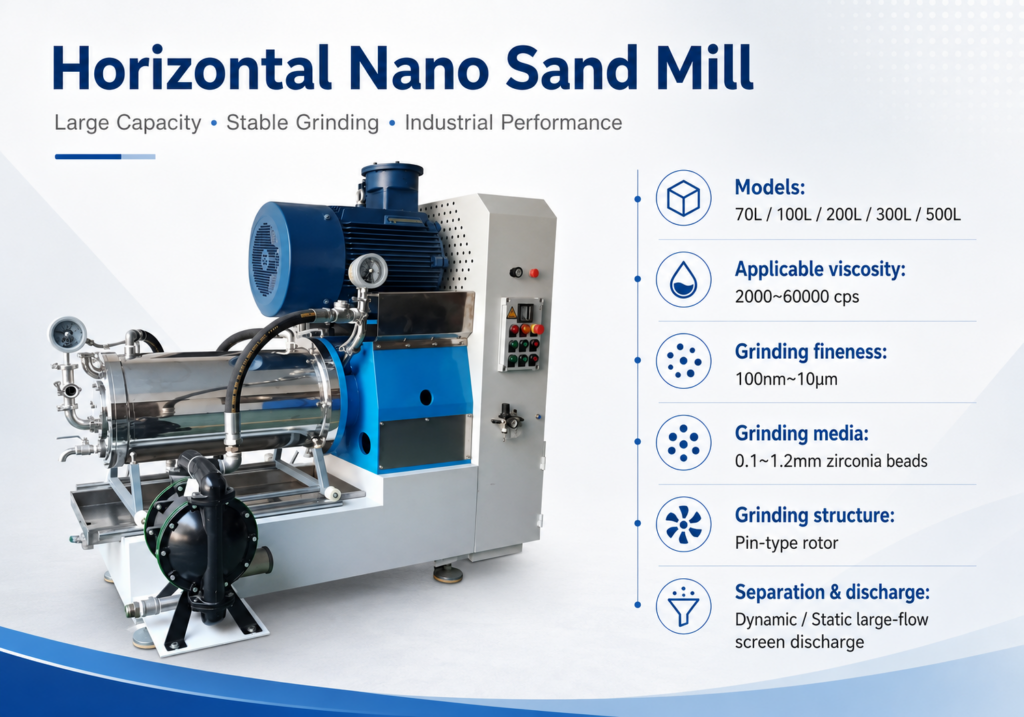
This article breaks down the real differences between the two configurations, why the market is increasingly tilting toward horizontal designs for demanding applications, and how to think about the decision for your own factory — plus an introduction to a manufacturer worth knowing if you’re currently shopping for equipment.
Why This Topic Is Trending Right Now
A few forces are driving the current wave of interest in sand mill comparisons:
- Nanotechnology demand is rising. Industries from cosmetics to new energy materials increasingly require particle fineness in the sub-100nm range, which puts real pressure on equipment selection — not every mill can reliably hit these numbers at scale.
- Cost-of-ownership scrutiny. With raw material and energy costs volatile, factory managers are researching not just purchase price but long-term efficiency, maintenance, and downtime.
- Global supply chain diversification. Buyers outside China are increasingly sourcing grinding equipment directly from Chinese manufacturers, driving a spike in comparison and due-diligence searches.
- Space and layout constraints. As factories retrofit existing space rather than build new facilities, footprint efficiency has become a real deciding factor, not just a footnote.
With that context, let’s look at what actually separates the two mill types.
The Core Difference: Chamber Orientation
Both horizontal and vertical sand mills work on the same basic principle: grinding media (typically zirconia or glass beads) is agitated at high speed inside a chamber, generating impact, friction, and shear forces that break particles down from the micron range into the nanometer range. The difference is how that chamber is arranged and what that means for performance.
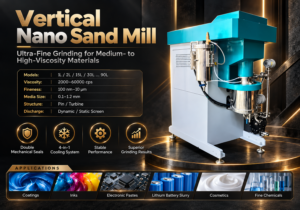
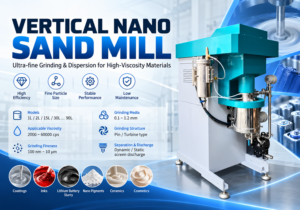
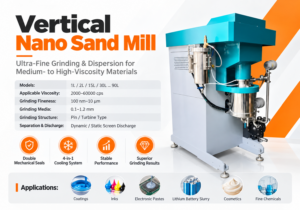
Vertical Sand Mills
In a vertical mill, the grinding chamber stands upright and the media tends to settle toward the bottom under gravity. This design is:
- Structurally simpler, which generally makes it more affordable up front
- More space-efficient, since it has a smaller floor footprint
- Easier to maintain for routine servicing
The trade-off is that gravity works against uniform media distribution. Beads can settle unevenly, creating inconsistent shear across the batch and making it harder to reach very fine, tightly distributed particle sizes. Vertical mills tend to be a solid choice for lower-viscosity materials, smaller batch sizes, and applications where “fine enough” doesn’t mean nanometer-level precision.
Horizontal Sand Mills
In a horizontal mill, the chamber lies on its side. Because gravity pulls the media perpendicular to the material flow rather than causing it to pile up, the beads stay far more evenly distributed throughout the chamber during operation. This translates into:
- More uniform particle size distribution, batch after batch
- Better sustained contact time between media and material, improving grinding consistency
- Higher throughput for continuous production, since the design supports closed-loop circulation without the media settling and clogging
- Better heat and process control, important for heat-sensitive formulations
The trade-offs are a higher initial investment and a somewhat more complex structure — but for manufacturers chasing D97 fineness in the tens of nanometers, or running high-volume continuous lines, horizontal mills have become the mainstream choice in the market.
Quick Comparison
| Factor | Vertical Sand Mill | Horizontal Sand Mill |
|---|---|---|
| Footprint | Smaller | Larger |
| Initial cost | Lower | Higher |
| Particle uniformity | Moderate | High |
| Best for | Small batches, moderate fineness | Continuous production, ultra-fine dispersion |
| Typical industries | Cosmetics, small-batch pharma | Coatings, inks, new energy materials, high-end chemicals |
How to Choose for Your Production Line
There’s no universal “better” option — the right pick depends on a few concrete questions:
- What fineness do you actually need? If your product spec requires D97 in the sub-100nm range, horizontal is generally the safer bet.
- Are you running batch or continuous production? Continuous, high-volume lines favor horizontal mills; small or variable batches may not need that level of investment.
- How much floor space do you have? Retrofits and smaller facilities may lean vertical out of necessity.
- What’s your material viscosity and abrasiveness? Highly viscous or abrasive slurries put more wear on components, which affects long-term maintenance costs regardless of orientation.
- What’s your total cost of ownership tolerance? A cheaper vertical mill that requires frequent part replacement can end up costing more over a production cycle than a well-built horizontal system.
A Manufacturer Worth Knowing: Musen Machinery
If you’re at the stage of evaluating suppliers rather than just equipment types, it’s worth looking at Dongguan Musen Machinery Technology Co., Ltd.
Founded in 1998, Musen Machinery has spent more than two decades building intelligent, integrated wet grinding and dispersion equipment for industrial customers around the world. A few things set it apart as a factory worth shortlisting:
- Proven fineness capability. Musen’s equipment can grind CaCO₃ down to D97 ≤ 70nm, verified independently through third-party Malvern laser particle size analysis and TEM imaging — not just internal claims.
- Full in-house capability. With its production base, R&D center, and sales team all located in Dongguan, Musen controls the entire process from engineering to manufacturing to after-sales support.
- German-style manufacturing discipline. The company applies rigorous, German-influenced craftsmanship standards, continuously upgrading its equipment lines rather than treating a machine design as static.
- Scalable solutions. Musen offers everything from laboratory-scale machines for R&D and small-batch testing up to complete, fully integrated production lines — useful whether you’re piloting a new formulation or scaling up an existing one.
- End-to-end chemical processing equipment. Beyond sand mills, Musen supplies full sets of equipment covering mixing, grinding, filtering, and filling — a real advantage if you’re trying to standardize a full production line under one technical partner rather than integrating equipment from multiple vendors.
For factories currently weighing horizontal vs. vertical sand mills — especially those with ultra-fine dispersion requirements in coatings, inks, cosmetics, or new energy materials — a supplier with two decades of accumulated process data and third-party-verified fineness results is a meaningfully lower-risk starting point for due diligence.
Bottom Line
Vertical sand mills still have a place for smaller operations, tighter budgets, and less demanding fineness requirements. But as production lines scale up and fineness specs push into the nanometer range, horizontal sand mills have become the mainstream choice — and that shift is exactly what’s driving the current wave of search interest in this comparison. When you’re ready to move from research to sourcing, working with an established manufacturer that can back up its specs with third-party verification, like Musen Machinery, is one of the more reliable ways to de-risk that investment.