









Choosing a horizontal sand mill with the wrong capacity is one of the most expensive mistakes a manufacturer can make. Undersized equipment creates production bottlenecks and forces overtime or double-shift operation just to keep up with demand. Oversized equipment ties up capital, wastes energy, and often runs inefficiently at partial load. Getting horizontal sand mill capacity right requires more than just picking a chamber size off a spec sheet — it means understanding how throughput, viscosity, fineness targets, and future growth all interact. This guide walks through exactly how to calculate the right capacity for your production line.
Why Capacity Sizing Is More Complex Than “Liters Per Hour”
Many buyers approach horizontal sand mill sizing by simply asking for a target liters-per-hour or kilograms-per-hour figure. But actual throughput on a horizontal bead mill is influenced by several interacting variables, not just chamber volume:
- Target particle fineness — finer targets require longer residence time or multiple passes, directly reducing effective throughput
- Product viscosity and solid content — higher viscosity slows flow rate and may require a different rotor configuration to maintain shear efficiency
- Grinding media size and density — media selection affects both grinding efficiency and achievable flow rate
- Single-pass vs. multi-pass (circulation) operation — some formulations achieve target fineness in a single pass, while others require recirculation, which changes effective capacity calculations significantly
Because of these variables, two facilities producing the same volume of finished product may need very differently sized horizontal sand mills, depending on their specific formulation and fineness requirements.
Step-by-Step: How to Calculate the Right Horizontal Sand Mill Capacity
Step 1: Define Your Required Output Volume
Start with your target production volume — typically expressed in kilograms or liters per hour, or total daily/monthly output. Include realistic operating hours per shift and expected equipment utilization rate (accounting for cleaning, changeovers, and maintenance downtime), not just theoretical maximum output.
Step 2: Confirm Your Target Fineness-of-Grind
Your required particle size directly affects how long material must remain in the grinding chamber. Finer targets reduce effective throughput per pass, which may require either a larger chamber, a higher-shear rotor configuration, or a multi-pass circulation setup to hit both fineness and volume targets simultaneously.
Step 3: Account for Viscosity and Solid Content
High-viscosity or high-solid-content materials move through a horizontal sand mill more slowly than thin, low-viscosity formulations. If your product viscosity varies across your product line, size your equipment around your most demanding formulation — not just your average product.
Step 4: Decide Between Single-Pass and Circulation (Multi-Pass) Operation
Single-pass systems process material once through the mill to reach final fineness, and generally require larger chamber capacity per unit of throughput. Circulation systems recirculate material through a smaller chamber multiple times, which can reduce capital cost but increases processing time per batch. The right choice depends on your fineness target, viscosity, and available floor space.
Step 5: Build In Capacity for Future Growth
A horizontal sand mill is typically a 10+ year capital investment. Sizing strictly to current production volume often forces a premature equipment upgrade within a few years. Where budget allows, it’s generally wise to size capacity with reasonable headroom for anticipated growth, rather than replacing the entire machine later.
Step 6: Validate With Supplier Trial Data
Before finalizing your capacity decision, request trial or pilot-scale performance data using your actual formulation from your horizontal sand mill supplier. Theoretical capacity calculations are a useful starting point, but real performance data on your specific product provides the most reliable basis for final sizing decisions.
Common Capacity Sizing Mistakes to Avoid
- Sizing based only on average product viscosity, rather than your most demanding formulation
- Ignoring realistic equipment utilization rate, leading to underestimated required capacity
- Failing to account for future production growth, resulting in premature capacity limits
- Assuming published throughput specs apply directly to your formulation, without validating against your actual product’s viscosity and fineness requirements
- Overlooking cooling and drive system capacity at the higher end of the throughput range, which can bottleneck real-world output even when chamber volume appears sufficient
Horizontal Sand Mill Capacity Planning Checklist
| Planning Factor | What to Confirm |
|---|---|
| Required output volume | Realistic hours/shift and utilization rate, not theoretical max |
| Target fineness-of-grind | Impact on residence time and effective throughput |
| Viscosity/solid content | Sized around most demanding formulation, not average |
| Single-pass vs. circulation | Trade-off between chamber size and processing time |
| Growth headroom | Avoids premature capacity ceiling within a few years |
| Supplier trial validation | Confirms theoretical sizing against real product performance |
About Musehn Machinery
Dongguan Musehn Machinery Technology Co., Ltd. is a premier manufacturer specializing in high-end chemical grinding, dispersion, and conveying equipment, offering a full range of horizontal sand mills across multiple chamber sizes and throughput capacities to match the specific production requirements of coatings, inks, agrochemicals, pharmaceuticals, cosmetics, and new energy material manufacturers.
As a dedicated subsidiary of LECJX, Musehn Machinery represents the global arm of our group — while LECJX remains focused on the Chinese domestic market, Musehn is strategically positioned to lead our group’s expansion and service operations in overseas markets.
Building on a manufacturing legacy established in 1998, Musehn has integrated cutting-edge Swiss technology with premium German materials. Our engineering philosophy centers on dimensional stability and full component interchangeability, ensuring that every horizontal sand mill we produce — regardless of chamber size or capacity configuration — meets international industrial standards. We strictly adhere to ISO9001 quality protocols and 5S management systems to guarantee excellence in every unit we export.
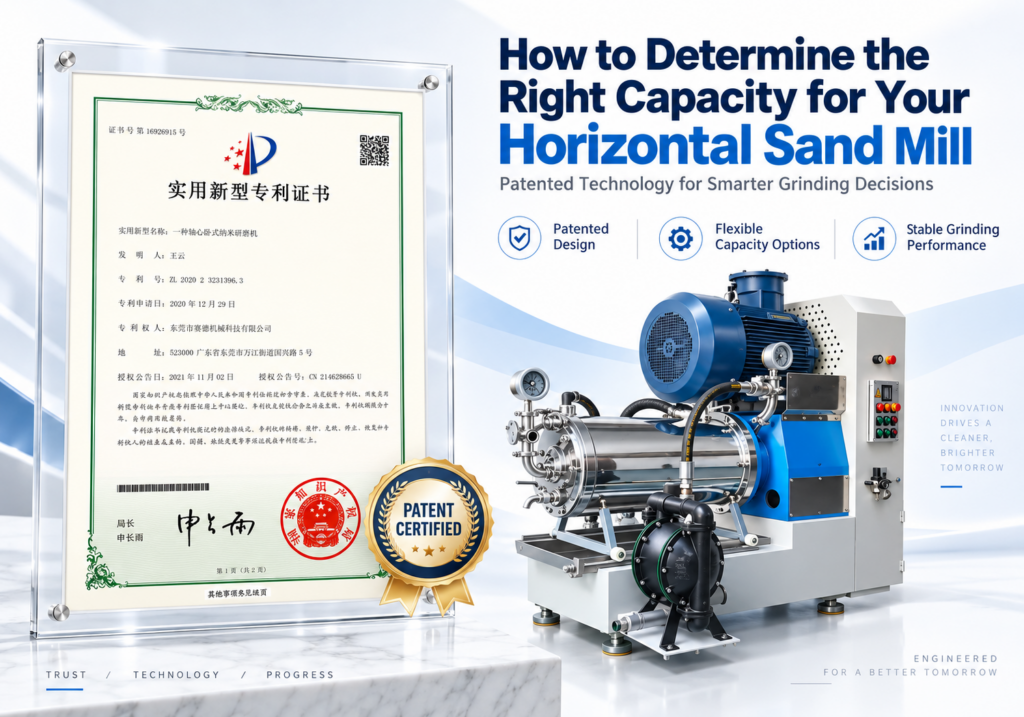
Our group’s engineering strength is backed by numerous national patents held under our group entity LECJX (Dongguan Lechi Machinery Technology Co., Ltd.), including Patent No. LC30037688.0 and a utility model patent for an enclosed-type grinding mill design (Certificate No. 10926915, Patent No. ZL 2020 2 3251398.6, Publication No. CN 214836925 U, granted November 9, 2021). As the global arm of our group, Musehn Machinery shares this patented engineering foundation and modular design approach across our full horizontal sand mill lineup, helping minimize maintenance downtime and operational costs regardless of the capacity configuration our clients select. We believe that superior quality is the ultimate global currency.
Supported by expert technical consulting and a 24/7 global service hotline, Musehn Machinery is committed to helping international buyers correctly size and configure the right horizontal sand mill capacity for their current production needs and future growth plans.
Frequently Asked Questions (FAQ)
How do I calculate the throughput I need from a horizontal sand mill?
Start with your required output volume (kg/hour or liters/hour), then factor in your target fineness-of-grind, product viscosity, and realistic equipment utilization rate — not just theoretical maximum capacity. Finer fineness targets and higher viscosity both reduce effective throughput, so these must be factored in alongside raw volume requirements.
Is it better to oversize or undersize a horizontal sand mill for future growth?
Moderate oversizing with reasonable growth headroom is generally the safer long-term choice, since a horizontal sand mill is typically a long-term capital asset. However, excessive oversizing wastes capital and can reduce efficiency at partial load, so capacity planning should be based on realistic growth projections rather than worst-case assumptions.
What is the difference between single-pass and circulation operation in a horizontal sand mill?
Single-pass systems process material once through the chamber to reach final fineness and generally require a larger chamber for a given throughput target. Circulation (multi-pass) systems recirculate material through a smaller chamber multiple times, which can lower capital cost but increases total processing time per batch.
Can the same horizontal sand mill handle different products with different viscosities?
In many cases yes, particularly with modular rotor configurations, but capacity and achievable fineness will vary by formulation. It’s important to size the equipment around your most demanding product, and to validate performance across your full product range rather than assuming uniform throughput.
Does Musehn Machinery offer horizontal sand mills in multiple capacity ranges?
Yes. Musehn Machinery manufactures horizontal sand mills across a range of chamber sizes and throughput capacities, from lab-scale development units to full industrial production platforms, all built on the same patented engineering standards under ISO9001 quality protocols.
How can I validate that a proposed horizontal sand mill capacity will actually work for my product?
Request trial or pilot-scale performance data using your actual formulation before finalizing your capacity decision. Our engineering team can help arrange validation testing to confirm real-world throughput and fineness results align with your production targets.