









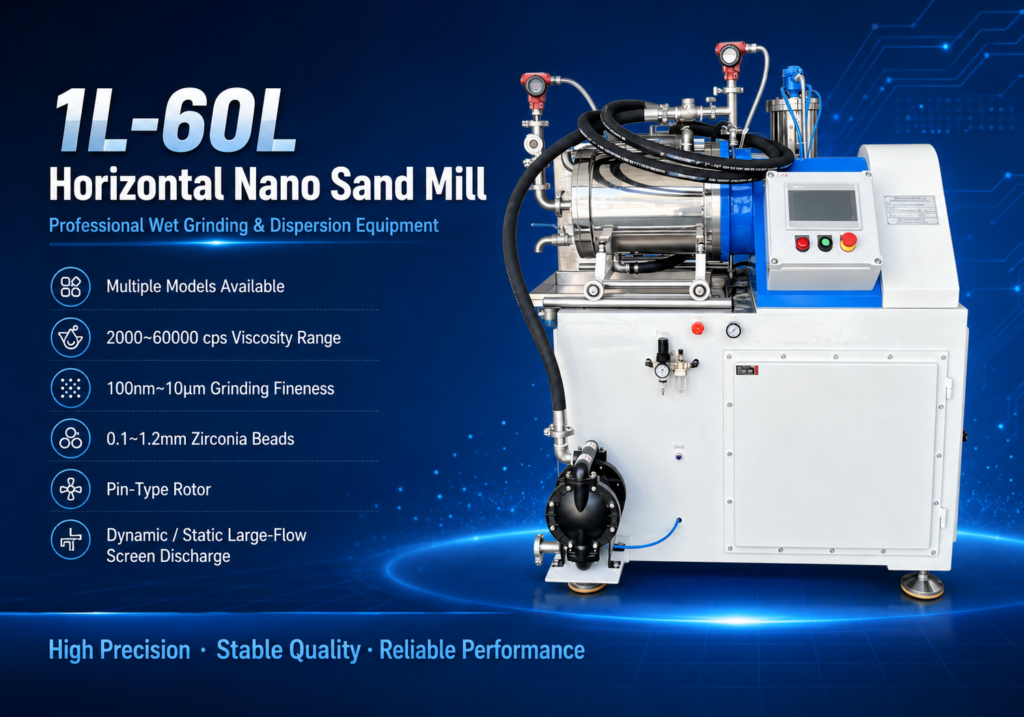
1. Understanding Screen Separation in Wet Bead Milling
Every bead mill relies on a discharge separator to retain the grinding beads inside the milling chamber while allowing the fully processed slurry to exit freely. Whether you operate a lab sand mill during R&D trials or a large-scale industrial horizontal sand mill, the discharge mechanism directly dictates:
- Maximum allowable slurry viscosity: Higher viscous drag forces require active bead repulsion.
- Minimum usable bead size: Directly correlates to achievable final particle fineness.
- Flow rate stability & system pressure: Prevents hydraulic packing and over-pressurization.
2. Static Screen Discharge: Mechanics & Clogging Triggers
How Static Separation Works
In a static separation system, a mesh screen or tubular slotted pipe (often crafted from wear-resistant tungsten carbide or stainless steel) remains stationary at the discharge outlet of the sand mill. As the slurry flows axially through the chamber, it passes through the static screen, leaving the grinding media behind.
Advantages
- Simple Mechanical Design: Minimal moving components inside the discharge zone.
- Cost-Effective: Lower initial capital investment for standard, non-critical formulations.
- Proven for Traditional Formulations: Suitable for low-viscosity, low-flow processes in traditional vertical sand mill designs or basic horizontal units.
Why Static Screens Clog
- Bead Accumulation: Hydrodynamic drag pushes grinding media towards the discharge end, pressing them directly against the stationary screen face.
- Viscous Drag & Agglomeration: High-viscosity slurries or thixotropic materials adhere to the static mesh, trapping fine particles and micro-beads.
- Restricted Bead Size: Utilizing micro-beads ($d < 0.3\text{ mm}$) with a static screen causes rapid blinding because the gap width must be exceptionally narrow, drastically reducing open filtration area.
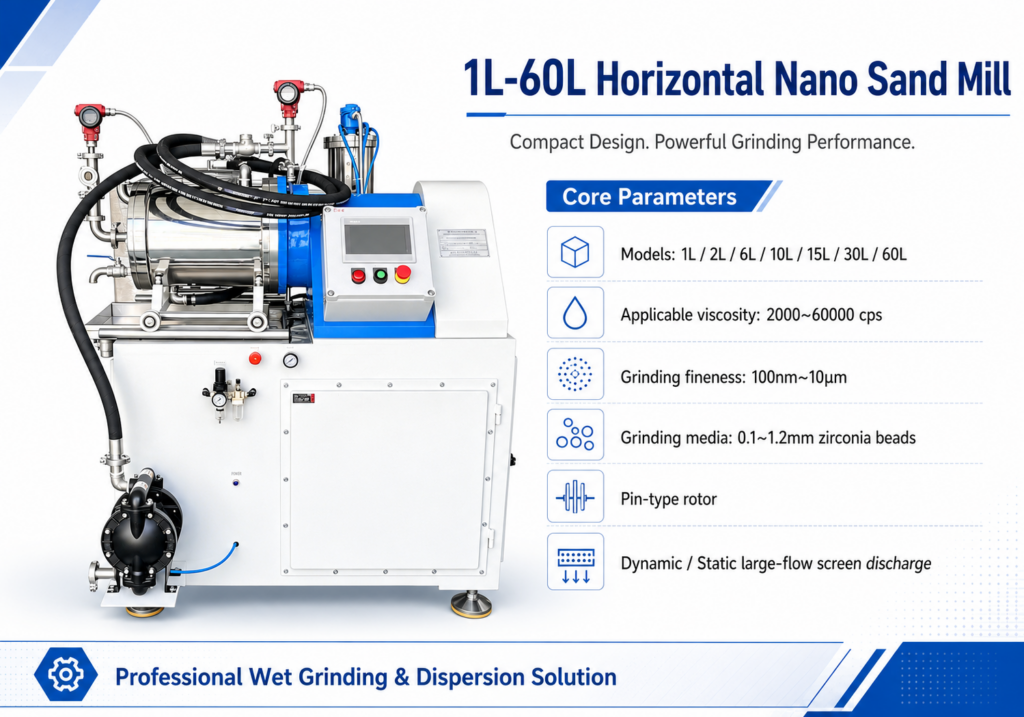
3. Dynamic Screen Discharge: How It Prevents Clogging
How Dynamic Separation Works
Dynamic screen discharge systems integrate a rotating element (a rotor cage, dynamic gap wheel, or centrifugal rotor) directly in front of or around the screen. As the main shaft rotates, the dynamic separator imparts high centrifugal forces on the mixture of grinding media and slurry.
The Anti-Clogging Centrifugal Mechanism
- Density Difference Acceleration: Grinding beads (e.g., high-density zirconia, $\rho \approx 6.0\text{ g/cm}^3$) possess significantly higher density than the liquid slurry.
- Centrifugal Repulsion: The dynamic rotor flings heavy grinding beads radially away from the screen face, returning them to the active grinding zone.
- Clear Fluid Path: Only the lighter, finely dispersed liquid slurry can navigate through the rotating gap and exit through the discharge screen.
Because the screen surface is continuously swept clean by fluid turbulence and centrifugal force, dynamic systems eliminate media packing and mesh blinding—even when operating with ultra-small micro-beads ($d = 0.05\text{ mm} – 0.1\text{ mm}$).
4. Technical Comparison: Dynamic vs. Static Screen Separation
| Technical Feature | Static Screen Separation | Dynamic Screen Separation |
| Primary Separation Force | Physical Mesh Filtration | Centrifugal Separation + Fluid Dynamics |
| Minimum Usable Bead Size | Typically $d \ge 0.4\text{ mm}$ | Down to $d = 0.05\text{ mm}$ (Nano-scale) |
| Viscosity Tolerance | Low to Medium Viscosity | Medium to High Viscosity |
| Flow Rate Stability | Decreases as blinding occurs | Highly stable, continuous high-throughput |
| Overheating Risk | High (due to pressure buildup) | Low (optimized flow & efficient cooling) |
| Recommended Equipment | Standard vertical sand mill, general mill sand setups | Advanced horizontal sand mill, high-efficiency Nano Sand Mill |
5. Industrial Applications: Paint, Coatings & Fine Chemicals
The Sand Mill in Paint Industry
When operating a specialized sand mill for paint or high-performance architectural coatings, pigment agglomerates and high-solids formulations frequently cause static screen failure. Implementing a sand mill in paint industry continuous lines with dynamic separation enables higher flow velocity, multi-pass efficiency, and exceptionally narrow particle size distribution (PSD).
Battery Materials, Electronic Pastes & Fine Chemicals
For lithium iron phosphate ($\text{LiFePO}_4$) cathodes, ceramic slurries, electronic pastes, and agrochemicals, achieving sub-100 nanometer particle size demands micro-beads. Dynamic screen separation guarantees reliable continuous operation without batch contamination or costly maintenance shutdowns.
💡 The Musen Solution: Pin-Type Nano Sand Mill
Engineered with German-style rigorous craftsmanship, the Pin-Type Nano Sand Mill from Musen Machinery eliminates slurry flow bottlenecks in demanding wet grinding applications:
- Proven Nano Fineness: Reaches calcium carbonate ($\text{CaCO}_3$) grinding fineness of $D_{97} \le 70\text{nm}$, verified by third-party Malvern laser particle size analyzers and TEM.
- High-Efficiency Pin Rotor: Maximizes kinetic energy transfer to rapidly break down tough agglomerates.
- Advanced Heat Management: Double mechanical seals and high-efficiency cooling jackets protect temperature-sensitive battery slurries, inks, and cosmetics.
- Seamless Scalability: From precision lab sand mill units for R&D testing to complete, fully automated production systems (mixing, grinding, filtering, and filling).
6. Frequently Asked Questions (FAQ) About Sand Mills
Q1: What is the main cause of screen clogging in a sand mill?
Screen clogging in a sand mill is primarily caused by media accumulation at the discharge outlet, slurry agglomeration, and high-viscosity resistance. When using static screens with micro grinding beads ($d < 0.3\text{ mm}$), hydrodynamic drag forces beads directly into the mesh gaps, restricting flow and building chamber pressure. Upgrading to a Nano Sand Mill with a dynamic separation rotor prevents this by using centrifugal force to throw beads back into the milling chamber.
Q2: What is the difference between a horizontal sand mill and a vertical sand mill?
A vertical sand mill relies heavily on gravity for media distribution, making it suitable for low-to-medium viscosity slurries and larger grinding media. A horizontal sand mill provides uniform bead distribution along the entire chamber length, higher power density, and superior cooling efficiency. Horizontal models equipped with dynamic discharge are preferred for high-throughput, ultra-fine nano grinding applications.
Q3: Why is a specialized sand mill for paint production required?
In the paint and coating industry, pigment agglomerates must be dispersed down to sub-micron or nano levels to achieve optimal color strength, transparency, and gloss. Using a high-efficiency sand mill in paint industry applications ensures a tight particle size distribution (PSD) and prevents batch-to-batch color variation while seamlessly handling high-solids and thixotropic formulations.
Q4: What bead size should be used for nano-scale wet grinding?
To achieve nano-scale fineness (e.g., $D_{97} \le 70\text{nm}$ for $\text{CaCO}_3$), micro grinding media between $0.05\text{ mm}$ and $0.2\text{ mm}$ are typically required. Using micro beads requires a high-energy pin rotor mill—like the Musen Pin-Type Nano Sand Mill—and a dynamic centrifugal screen system to prevent the small beads from escaping or blinding the discharge separator.
Q5: How do I select the right lab sand mill before scaling up to industrial production?
When choosing a lab sand mill, ensure it replicates the fluid dynamics, pin density, and cooling parameters of full-scale production models. Reliable scale-up requires testing with identical grinding media and chamber materials. At Musen Machinery, our lab series uses the exact same German-style pin technology and double mechanical seals as our mass-production lines, guaranteeing smooth technology transfer from R&D to factory floor.
Final Verdict: Which System Should You Choose?
- Choose Static Screen Discharge if you run entry-level, low-viscosity processes with large grinding beads ($d > 0.6\text{ mm}$) where low capital cost is the sole priority.
- Choose Dynamic Screen Discharge if you require continuous high-throughput production, nano-scale targets ($D_{97} \le 70\text{nm}$), micro-beads ($0.05\text{ mm} – 0.3\text{ mm}$), or process medium-to-high viscosity slurries without frequent maintenance downtime.
Founded in 1998 in Dongguan, Musen Machinery brings over 20 years of data accumulation and wet grinding expertise. We provide global industrial customers with complete intelligent integrated equipment including mixing, grinding, filtering, and filling systems.
Ready to resolve discharge clogging and elevate your wet grinding performance?
Contact our technical engineering team at Musen Machinery today for tailored process line solutions.