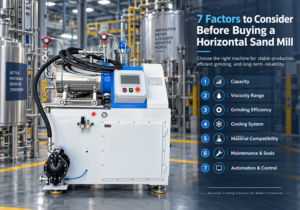










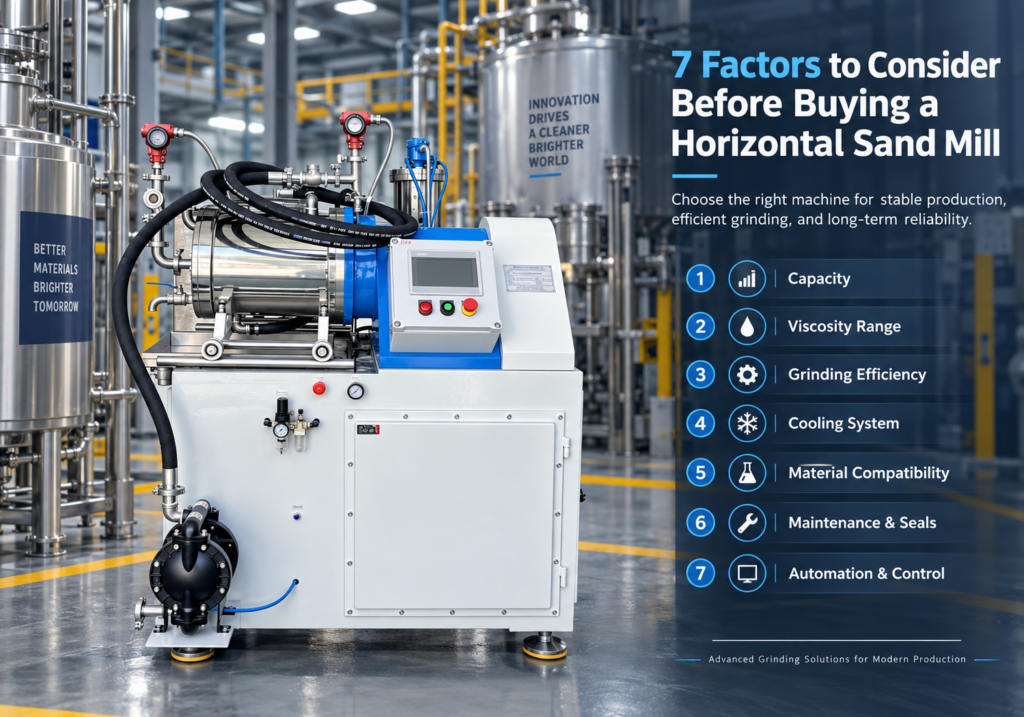
Below are the seven most important factors to review before buying a horizontal sand mill, along with what to look for in each one.
- Applicable Viscosity Range
Every horizontal sand mill is engineered to perform within a specific viscosity window. Before purchasing, confirm the viscosity profile of your actual production materials — not just a general product category. A machine rated for 2000–3000 cps low- to medium-viscosity materials will behave very differently from one designed for thick pastes or high-viscosity resins.
What to ask the supplier: Has this machine been tested with materials similar to mine, or only with reference fluids? Real-world viscosity performance data matters more than theoretical specifications.
- Target Grinding Fineness
Grinding fineness requirements vary enormously by application. Pigment dispersion may only need micron-level results, while lithium battery materials, nano inks, and electronic pastes often demand 50nm–500nm fineness. Buying a machine without confirming its actual achievable fineness — under your specific material and viscosity conditions — is one of the most common and costly sourcing mistakes.
What to ask the supplier: Can you provide fineness test data (D50/D90) for a material comparable to mine, rather than general marketing specifications?
- Grinding Media Compatibility
The mill and the grinding media it uses need to be evaluated as one system. Zirconia beads in the 0.05–0.6mm range are the industry standard for fine and nano-scale grinding, offering high density, low wear, and minimal contamination. Before buying, confirm the full bead size range the machine can run — some machines are only rated for larger beads and cannot achieve nano-scale fineness even with premium media.
What to ask the supplier: What is the smallest bead size this machine can reliably operate with, and does the separation system support it without clogging?
- Grinding Structure Design
The internal grinding structure directly determines shear force, energy efficiency, and how evenly beads are distributed throughout the chamber. A Pin & Turbine dual-power grinding structure combines strong shear generation with efficient bead circulation, helping avoid the “dead zones” that cause inconsistent particle size within a single batch — a common issue with simpler, single-mechanism designs.
What to ask the supplier: How does the grinding structure maintain consistent shear across the full batch, especially at smaller bead sizes?
- Separation and Discharge Reliability
This is one of the most overlooked — and most operationally important — factors. Traditional screen-based separators are prone to clogging and wear, especially when running fine beads (below 0.3mm) or grinding to nano-scale fineness. A screen-free separation system allows for continuous, stable discharge with significantly less maintenance downtime, which matters a great deal in continuous production environments.
What to ask the supplier: How does the separation system perform over extended production runs, and what is the typical maintenance interval?
- Production Capacity and Scalability
Match machine capacity to both your current and future production needs. A supplier offering a full model range — such as 10L, 30L, 90L, 150L, and 200L — allows you to validate a formulation at lab or pilot scale and then scale up to full production using the same grinding technology, minimizing the risk of inconsistent results during scale-up.
What to ask the supplier: Does the same grinding structure and bead compatibility carry across all model sizes, or do results change between lab-scale and production-scale units?
- Manufacturer Track Record and After-Sales Support
Equipment specifications only tell part of the story. Manufacturing heritage, quality certifications, patented technology, and responsive technical support are what determine whether a machine performs reliably over years of operation — not just during initial testing.
What to ask the supplier: What quality standards does the manufacturer follow (e.g., ISO9001), what proprietary technology backs their equipment, and what after-sales support is available for international buyers?
Screen-Free Nano Sand Mill: A Machine Built Around These 7 Factors
The Screen-Free Nano Sand Mill is engineered specifically to address the seven factors above in a single, cohesive platform for ultra-fine grinding and dispersion of low- to medium-viscosity materials.
Key specifications:
Parameter Specification
Models 10L / 30L / 90L / 150L / 200L
Applicable viscosity 2000–3000 cps
Grinding fineness 50nm–500nm
Grinding media 0.05–0.6mm zirconia beads
Grinding structure Pin & Turbine type
Separation & discharge Screen-free separation system
With a Pin & Turbine dual-power grinding structure, screen-free separation system, and efficient cooling design, this horizontal sand mill delivers stable operation, continuous discharge, and consistent nano-scale performance — from lab-scale testing through full production. It is widely used for lithium battery materials, nano inks, electronic pastes, high-end coatings, and ceramic materials, where every one of these seven factors directly affects final product quality.
Why Musehn Machinery Checks the Seventh Factor
Since manufacturer track record and support are just as important as the machine’s technical specifications, it’s worth understanding who is behind the equipment.
Dongguan Musehn Machinery Technology Co., Ltd. is a premier manufacturer specializing in high-end chemical grinding, dispersion, and conveying equipment. As the dedicated overseas subsidiary of LECJX — with LECJX serving the Chinese domestic market — Musehn Machinery is strategically positioned to lead international expansion and service for global buyers.
Manufacturing legacy since 1998, integrating Swiss engineering technology with premium German materials
Engineering philosophy centered on dimensional stability and full component interchangeability, ensuring every machine meets international industrial standards
Strict ISO9001 quality protocols and 5S management systems applied to every exported unit
Multiple national patents (e.g., Patent No. LC30037688.0) supporting proprietary grinding and separation technology
Modular design approach that minimizes maintenance downtime and long-term operational costs
24/7 global service hotline and expert technical consulting, supporting international clients from equipment selection through ongoing production
Musehn’s core belief — that superior quality is the ultimate global currency — reflects an approach where every one of the seven buying factors is engineered into the machine from the start, not treated as an afterthought.
FAQ: Common Questions Before Buying a Horizontal Sand Mill
- What is the most important factor to consider when buying a horizontal sand mill?
There isn’t a single most important factor — viscosity compatibility, target fineness, grinding media, structure, separation system, capacity, and manufacturer reliability all interact with each other. A mismatch in any one area can undermine the entire system’s performance. - How do I know if a horizontal sand mill can achieve nano-scale fineness?
Ask the supplier for real fineness test data (D50/D90) using a material similar to yours, and confirm the machine’s bead size range and separation system — both directly affect whether nano-scale fineness (50nm–500nm) is achievable in practice. - Is a screen-free separation system necessary for every application?
It becomes especially important when using fine beads (below 0.3mm) or targeting nano-scale fineness, where traditional screens are more prone to clogging. For coarser, micron-level applications, screen-based systems may still be adequate. - Can I use the same horizontal sand mill for lab testing and full production?
Yes, if the supplier offers a consistent model range (such as 10L to 200L) using the same grinding structure and media compatibility. This allows lab-validated results to transfer reliably to production scale. - What viscosity range should I confirm before purchasing?
Always confirm the mill’s rated viscosity range against your actual material — not a general category. Machines designed for 2000–3000 cps materials, for example, are suited to battery slurries, nano inks, and similar medium-viscosity formulations. - How important is the manufacturer’s quality certification?
Very important for long-term reliability. Certifications like ISO9001, combined with patented technology and a proven manufacturing history, are strong indicators of consistent build quality and component precision. - What after-sales support should I expect from a horizontal sand mill supplier?
Look for suppliers offering responsive technical consulting and global service support — ideally 24/7 — since grinding equipment often requires process troubleshooting and maintenance guidance well after installation.
Buying a horizontal sand mill is a long-term investment, not just an equipment purchase. The right machine can improve product consistency, reduce operating costs, and support years of stable production. The wrong choice can lead to constant maintenance, inconsistent fineness, and costly downtime. Before signing off on a purchase order, procurement and process engineers should evaluate a specific set of technical and operational factors — not just price and delivery time.
Below are the seven most important factors to review before buying a horizontal sand mill, along with what to look for in each one.
1. Applicable Viscosity Range
Every horizontal sand mill is engineered to perform within a specific viscosity window. Before purchasing, confirm the viscosity profile of your actual production materials — not just a general product category. A machine rated for 2000–3000 cps low- to medium-viscosity materials will behave very differently from one designed for thick pastes or high-viscosity resins.
What to ask the supplier: Has this machine been tested with materials similar to mine, or only with reference fluids? Real-world viscosity performance data matters more than theoretical specifications.
2. Target Grinding Fineness
Grinding fineness requirements vary enormously by application. Pigment dispersion may only need micron-level results, while lithium battery materials, nano inks, and electronic pastes often demand 50nm–500nm fineness. Buying a machine without confirming its actual achievable fineness — under your specific material and viscosity conditions — is one of the most common and costly sourcing mistakes.
What to ask the supplier: Can you provide fineness test data (D50/D90) for a material comparable to mine, rather than general marketing specifications?
3. Grinding Media Compatibility
The mill and the grinding media it uses need to be evaluated as one system. Zirconia beads in the 0.05–0.6mm range are the industry standard for fine and nano-scale grinding, offering high density, low wear, and minimal contamination. Before buying, confirm the full bead size range the machine can run — some machines are only rated for larger beads and cannot achieve nano-scale fineness even with premium media.
What to ask the supplier: What is the smallest bead size this machine can reliably operate with, and does the separation system support it without clogging?
4. Grinding Structure Design
The internal grinding structure directly determines shear force, energy efficiency, and how evenly beads are distributed throughout the chamber. A Pin & Turbine dual-power grinding structure combines strong shear generation with efficient bead circulation, helping avoid the “dead zones” that cause inconsistent particle size within a single batch — a common issue with simpler, single-mechanism designs.
What to ask the supplier: How does the grinding structure maintain consistent shear across the full batch, especially at smaller bead sizes?
5. Separation and Discharge Reliability
This is one of the most overlooked — and most operationally important — factors. Traditional screen-based separators are prone to clogging and wear, especially when running fine beads (below 0.3mm) or grinding to nano-scale fineness. A screen-free separation system allows for continuous, stable discharge with significantly less maintenance downtime, which matters a great deal in continuous production environments.
What to ask the supplier: How does the separation system perform over extended production runs, and what is the typical maintenance interval?
6. Production Capacity and Scalability
Match machine capacity to both your current and future production needs. A supplier offering a full model range — such as 10L, 30L, 90L, 150L, and 200L — allows you to validate a formulation at lab or pilot scale and then scale up to full production using the same grinding technology, minimizing the risk of inconsistent results during scale-up.
What to ask the supplier: Does the same grinding structure and bead compatibility carry across all model sizes, or do results change between lab-scale and production-scale units?
7. Manufacturer Track Record and After-Sales Support
Equipment specifications only tell part of the story. Manufacturing heritage, quality certifications, patented technology, and responsive technical support are what determine whether a machine performs reliably over years of operation — not just during initial testing.
What to ask the supplier: What quality standards does the manufacturer follow (e.g., ISO9001), what proprietary technology backs their equipment, and what after-sales support is available for international buyers?
Screen-Free Nano Sand Mill: A Machine Built Around These 7 Factors
The Screen-Free Nano Sand Mill is engineered specifically to address the seven factors above in a single, cohesive platform for ultra-fine grinding and dispersion of low- to medium-viscosity materials.
Key specifications:
| Parameter | Specification |
|---|---|
| Models | 10L / 30L / 90L / 150L / 200L |
| Applicable viscosity | 2000–3000 cps |
| Grinding fineness | 50nm–500nm |
| Grinding media | 0.05–0.6mm zirconia beads |
| Grinding structure | Pin & Turbine type |
| Separation & discharge | Screen-free separation system |
With a Pin & Turbine dual-power grinding structure, screen-free separation system, and efficient cooling design, this horizontal sand mill delivers stable operation, continuous discharge, and consistent nano-scale performance — from lab-scale testing through full production. It is widely used for lithium battery materials, nano inks, electronic pastes, high-end coatings, and ceramic materials, where every one of these seven factors directly affects final product quality.
Why Musehn Machinery Checks the Seventh Factor
Since manufacturer track record and support are just as important as the machine’s technical specifications, it’s worth understanding who is behind the equipment.
Dongguan Musehn Machinery Technology Co., Ltd. is a premier manufacturer specializing in high-end chemical grinding, dispersion, and conveying equipment. As the dedicated overseas subsidiary of LECJX — with LECJX serving the Chinese domestic market — Musehn Machinery is strategically positioned to lead international expansion and service for global buyers.
- Manufacturing legacy since 1998, integrating Swiss engineering technology with premium German materials
- Engineering philosophy centered on dimensional stability and full component interchangeability, ensuring every machine meets international industrial standards
- Strict ISO9001 quality protocols and 5S management systems applied to every exported unit
- Multiple national patents (e.g., Patent No. LC30037688.0) supporting proprietary grinding and separation technology
- Modular design approach that minimizes maintenance downtime and long-term operational costs
- 24/7 global service hotline and expert technical consulting, supporting international clients from equipment selection through ongoing production
Musehn’s core belief — that superior quality is the ultimate global currency — reflects an approach where every one of the seven buying factors is engineered into the machine from the start, not treated as an afterthought.
FAQ: Common Questions Before Buying a Horizontal Sand Mill
1. What is the most important factor to consider when buying a horizontal sand mill?
There isn’t a single most important factor — viscosity compatibility, target fineness, grinding media, structure, separation system, capacity, and manufacturer reliability all interact with each other. A mismatch in any one area can undermine the entire system’s performance.
2. How do I know if a horizontal sand mill can achieve nano-scale fineness?
Ask the supplier for real fineness test data (D50/D90) using a material similar to yours, and confirm the machine’s bead size range and separation system — both directly affect whether nano-scale fineness (50nm–500nm) is achievable in practice.
3. Is a screen-free separation system necessary for every application?
It becomes especially important when using fine beads (below 0.3mm) or targeting nano-scale fineness, where traditional screens are more prone to clogging. For coarser, micron-level applications, screen-based systems may still be adequate.
4. Can I use the same horizontal sand mill for lab testing and full production?
Yes, if the supplier offers a consistent model range (such as 10L to 200L) using the same grinding structure and media compatibility. This allows lab-validated results to transfer reliably to production scale.
5. What viscosity range should I confirm before purchasing?
Always confirm the mill’s rated viscosity range against your actual material — not a general category. Machines designed for 2000–3000 cps materials, for example, are suited to battery slurries, nano inks, and similar medium-viscosity formulations.
6. How important is the manufacturer’s quality certification?
Very important for long-term reliability. Certifications like ISO9001, combined with patented technology and a proven manufacturing history, are strong indicators of consistent build quality and component precision.
7. What after-sales support should I expect from a horizontal sand mill supplier?
Look for suppliers offering responsive technical consulting and global service support — ideally 24/7 — since grinding equipment often requires process troubleshooting and maintenance guidance well after installation.