









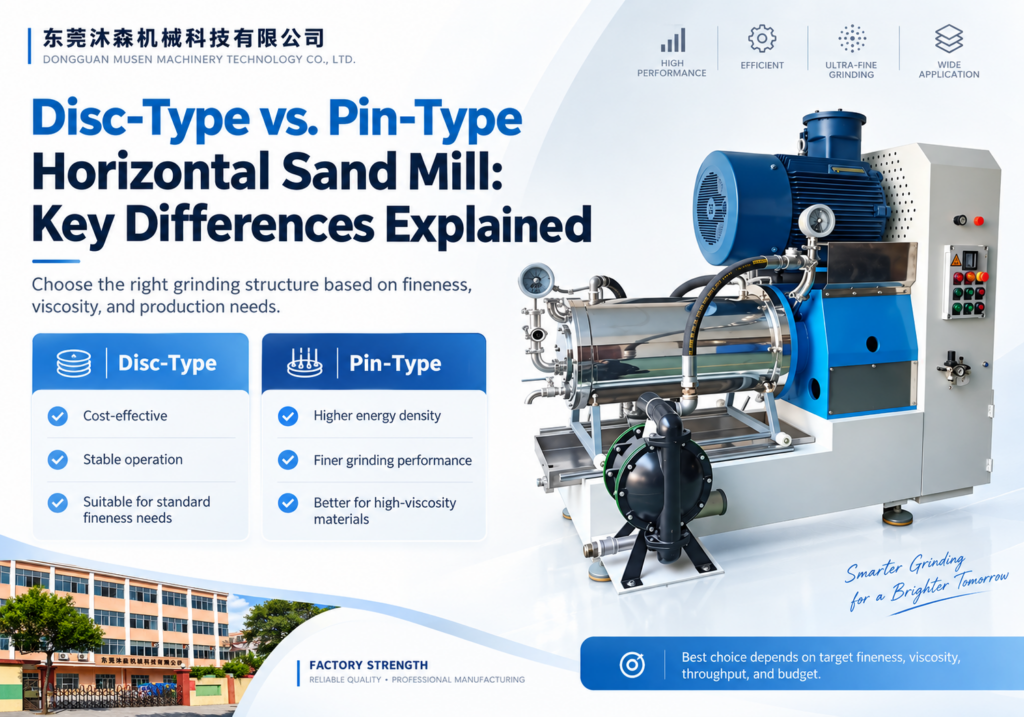
If you’ve already decided that a horizontal sand mill is the right configuration for your production line, the next decision is just as important: which rotor design fits your process — disc-type or pin-type? Both rotor styles are widely used inside a horizontal bead mill chamber, but they generate different shear patterns, handle different viscosity ranges, and suit different production goals. This article breaks down exactly how each rotor type works inside a horizontal sand mill, so you can make an informed equipment decision.
Why Rotor Type Matters Inside a Horizontal Sand Mill
A horizontal sand mill works by rotating a shaft-mounted rotor inside a cylindrical, jacketed chamber filled with grinding media and product slurry. The rotor is what actually transfers energy into the media, creating the shear, impact, and friction forces that break down particles and agglomerates. Because the chamber geometry stays largely the same across models, the rotor design is often the single biggest factor determining how a given horizontal sand mill performs on a specific formulation. The two dominant rotor types — disc and pin — approach this energy transfer very differently.
Disc-Type Horizontal Sand Mill: How It Works
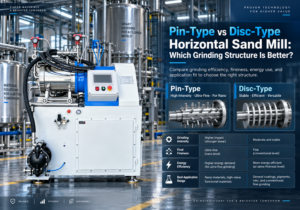
In a disc-type horizontal sand mill, a series of flat discs are mounted at intervals along the rotor shaft. As the discs spin, they generate strong centrifugal force that accelerates the grinding media outward toward the chamber wall, creating intense, concentrated shear zones at the disc edges.
Strengths of the disc-type configuration:
- Delivers higher, more concentrated shear force, effective at breaking down tough agglomerates
- Performs well with high-viscosity and high-solid-content slurries
- Well suited to achieving ultra-fine and near-nano particle sizes
- Generally offers more efficient heat dissipation due to disc spacing, which pairs well with the horizontal sand mill’s jacketed cooling system
Best-fit applications: heavy-duty industrial coatings, high-viscosity resin dispersions, ceramic slurries, and specialty pigment pastes requiring very fine, uniform particle distribution.
Pin-Type Horizontal Sand Mill: How It Works
In a pin-type horizontal sand mill, cylindrical pins are arranged radially or in rows along the rotor shaft instead of flat discs. As the rotor turns, the pins drive the grinding media through a broader, more turbulent circulation pattern, generating rapid, distributed impact forces throughout the chamber.
Strengths of the pin-type configuration:
- Delivers higher throughput, making it well suited to large-batch, continuous production
- Performs efficiently with low-to-medium viscosity materials
- Produces more uniform bead circulation, reducing the risk of media clumping in thinner formulations
- Typically offers simplified maintenance and easier media servicing
Best-fit applications: water-based coatings and paints, agrochemical suspensions, pharmaceutical intermediates, and other high-volume, lower-viscosity formulations that prioritize throughput and consistency.
Disc vs. Pin Rotor in a Horizontal Sand Mill: Side-by-Side Comparison
| Factor | Disc-Type Horizontal Sand Mill | Pin-Type Horizontal Sand Mill |
|---|---|---|
| Shear intensity | High, concentrated | Broad, distributed |
| Ideal viscosity range | Medium to high | Low to medium |
| Throughput | Moderate | High |
| Fineness potential | Excellent (fine/near-nano) | Very good for standard industrial fineness |
| Heat generation control | Efficient with jacket cooling | Efficient, well suited to fast cycles |
| Maintenance | Moderate complexity | Generally simpler |
| Typical industries | Coatings, resins, ceramics | Water-based paints, agrochemicals, pharma |
How to Decide Between a Disc-Type and Pin-Type Horizontal Sand Mill
- Check your slurry viscosity and solid content first — this single factor eliminates most of the guesswork. High viscosity generally points to disc-type; low-to-medium viscosity generally points to pin-type.
- Define your target particle fineness — if you need extremely fine or near-nano results, the disc-type horizontal sand mill typically offers more precise control.
- Estimate your required throughput — high-volume, continuous production often favors the pin-type configuration for its processing speed.
- Consider a modular/interchangeable rotor design — some horizontal sand mill platforms allow you to swap between disc and pin rotor assemblies on the same chassis, which is worth discussing with your supplier if your product mix may change over time.
- Factor in maintenance resources — if your facility has limited technical staff, the generally simpler maintenance profile of a pin-type horizontal sand mill may be an advantage.
In practice, many production facilities operate both disc-type and pin-type horizontal sand mills side by side, assigning each configuration to the product lines it handles best.
About Musehn Machinery
Dongguan Musehn Machinery Technology Co., Ltd. is a premier manufacturer specializing in high-end chemical grinding, dispersion, and conveying equipment, including a full range of horizontal sand mills available in both disc-type and pin-type rotor configurations, engineered for coatings, inks, agrochemicals, pharmaceuticals, cosmetics, and new energy materials.
As a dedicated subsidiary of LECJX, Musehn Machinery represents the global arm of our group — while LECJX remains focused on the Chinese domestic market, Musehn is strategically positioned to lead our group’s expansion and service operations in overseas markets.
Building on a manufacturing legacy established in 1998, Musehn has integrated cutting-edge Swiss technology with premium German materials. Our engineering philosophy centers on dimensional stability and full component interchangeability, ensuring that every horizontal sand mill — whether disc-type or pin-type — meets international industrial standards. We strictly adhere to ISO9001 quality protocols and 5S management systems to guarantee excellence in every unit we export.
With numerous national patents — including Patent No. LC30037688.0 — and a modular design approach, Musehn’s horizontal sand mill equipment is engineered to minimize maintenance downtime and operational costs for our clients, including support for interchangeable rotor assemblies where applicable. We believe that superior quality is the ultimate global currency.
Supported by expert technical consulting and a 24/7 global service hotline, Musehn Machinery is committed to helping international buyers select the right rotor configuration — disc-type or pin-type — for their specific horizontal sand mill application, and to delivering reliable, precision-engineered solutions to the global fine chemical and new material industries.
Frequently Asked Questions (FAQ)
Q1: Which is better for a horizontal sand mill — disc-type or pin-type?
A: Neither is universally “better” — it depends on your product. Disc-type rotors suit high-viscosity, fine-particle-size applications, while pin-type rotors suit lower-viscosity, high-throughput production. The right choice depends on your specific formulation and production goals.
Q2: Can a horizontal sand mill be converted from pin-type to disc-type, or vice versa?
A: Some horizontal sand mill platforms are designed with modular, interchangeable rotor assemblies, allowing the rotor to be swapped depending on the product being processed. Availability depends on the specific machine model — ask your supplier whether this configuration is offered.
Q3: Does rotor type affect grinding media wear in a horizontal sand mill?
A: Yes. Disc-type rotors generally produce more concentrated, localized media movement, while pin-type rotors distribute media motion more broadly. The right media size and hardness should be matched to your chosen rotor type to minimize wear and maximize grinding efficiency.
Q4: Which rotor type is more energy-efficient in a horizontal sand mill?
A: Pin-type configurations are generally considered more energy-efficient at high throughput and lower viscosity, while disc-type configurations may consume more energy per batch but deliver finer, more controlled particle size results — an important trade-off to weigh against your product requirements.
Q5: Does Musehn Machinery offer both disc-type and pin-type horizontal sand mills?
A: Yes. Musehn Machinery manufactures a full range of horizontal sand mills in both disc-type and pin-type rotor configurations, built to ISO9001 standards using Swiss technology and German-grade materials, and backed by patented engineering and 24/7 global technical support.
Q6: How can I get help choosing the right rotor type for my application?
A: Share your product’s viscosity, solid content, target particle fineness, and required production volume with our engineering team. We can recommend the appropriate horizontal sand mill rotor configuration — disc-type, pin-type, or a modular interchangeable setup — based on your specific process.