









Why Laboratory Teams Struggle with Small Batch Grinding
Developing new materials requires accurate and repeatable grinding results.
However, many R&D teams face several challenges during formulation development:
- Traditional laboratory mixers cannot provide enough shear force
- Valuable experimental materials are wasted during testing
- Particle size results are difficult to reproduce
- Heat generation affects sensitive formulations
- Scaling laboratory results to production becomes difficult
For industries such as lithium battery materials, electronic chemicals, printing inks, coatings, and cosmetics, choosing the right grinding equipment is critical.
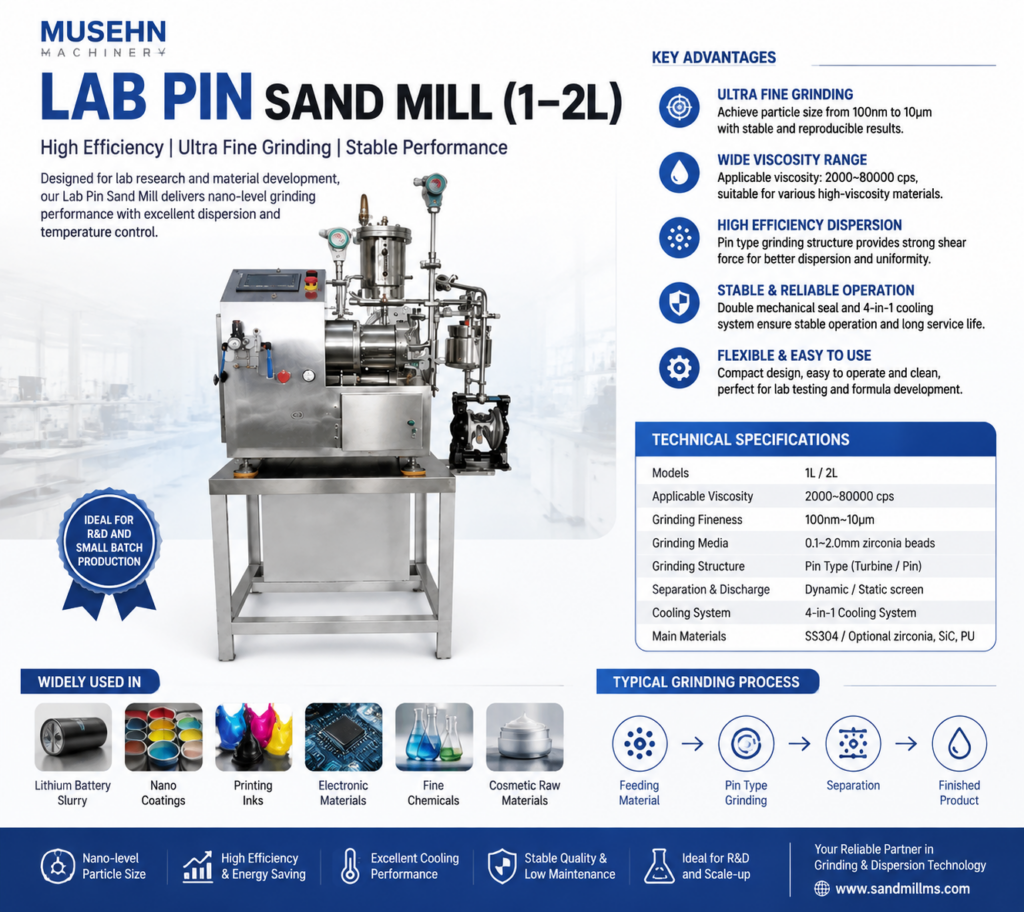
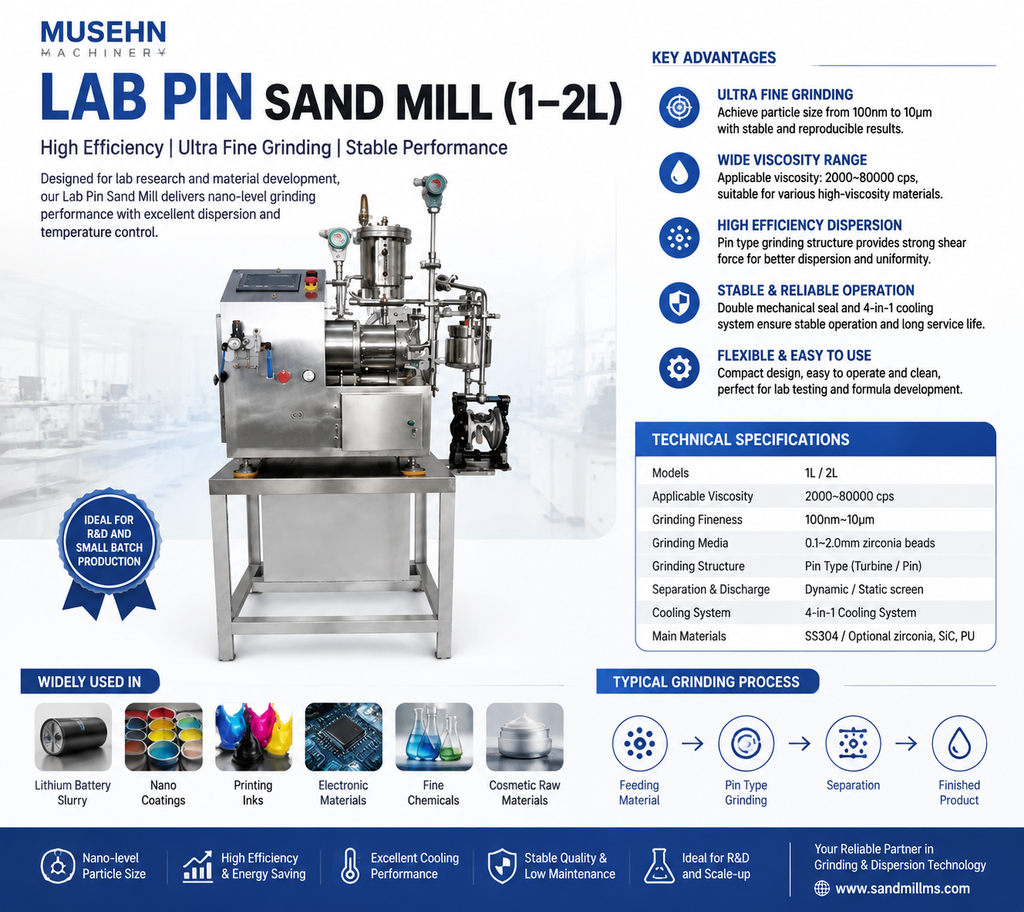
The Lab Pin Sand Mill is designed to solve these problems by providing industrial-level grinding performance in a compact laboratory system.
How Does a Lab Pin Sand Mill Improve Laboratory Grinding?
A common problem in laboratory development is the difference between test results and mass production performance.
Small laboratory mixers may achieve temporary dispersion, but they cannot simulate the high-energy grinding conditions used in industrial production.
The Lab Pin Sand Mill uses a high-efficiency pin-type grinding structure to create intensive impact and shear forces between zirconia beads and material particles.
This allows researchers to achieve:
- More uniform particle size distribution
- Better dispersion stability
- Faster formulation optimization
- Reliable scale-up results
By using the same grinding principles as industrial bead milling equipment, laboratory engineers can confidently transfer formulas from R&D to production.
Achieving Nano-Level Particle Size Control
Particle size directly affects the performance of many advanced materials.
For example:
- Battery slurry requires stable dispersion for electrode performance
- Printing inks need fine pigments for better color strength
- Nano coatings require uniform particles for surface properties
The Musehn Lab Pin Sand Mill supports grinding fineness from:
100nm to 10μm
With suitable zirconia grinding media, the equipment provides precise particle size control for different formulations.
For larger production requirements, manufacturers can also select a suitable industrial horizontal sand mill for continuous processing.
Processing High Viscosity Materials Without Performance Loss
Many R&D materials have complex rheological properties.
Examples include:
- Conductive carbon slurry
- High-solid coatings
- Functional chemical materials
- Cosmetic ingredients
Low-power laboratory equipment often struggles with high viscosity materials, resulting in:
- Poor circulation
- Uneven grinding
- Excessive motor load
The Lab Pin Sand Mill is designed for viscosity ranges up to:
2000–80000 cps
The strong pin grinding structure maintains stable material movement and improves grinding efficiency.
Protecting Sensitive Materials with Advanced Cooling System
During nano grinding, mechanical energy is converted into heat.
For heat-sensitive materials, uncontrolled temperature increases may cause:
- Chemical changes
- Material degradation
- Unstable test results
To solve this problem, the Lab Pin Sand Mill integrates a:
4-in-1 Cooling System
Including:
- Grinding chamber cooling
- Cover cooling
- Mechanical seal cooling
- Shaft cooling
This design helps maintain stable temperature conditions during extended laboratory testing.
Reliable Material Compatibility for Different Applications
Different industries require different contact materials.
The grinding chamber can be customized according to application requirements.
Zirconia / Silicon Carbide (SiC)
Recommended for:
- Lithium battery materials
- Electronic ceramics
- High purity chemicals
Advantages:
- Low contamination risk
- Excellent wear resistance
- Suitable for advanced materials research
Polyurethane (PU)
Suitable for:
- Abrasive formulations
- Special chemical applications
Stainless Steel
Suitable for:
- Coatings
- Printing inks
- General chemical development
Applications of Lab Pin Sand Mill
The equipment is widely used in:
Lithium Battery Slurry Development
Improve dispersion of active materials and conductive additives.
Printing Ink Research
Achieve finer pigment distribution and improved printing performance.
Nano Coatings
Support development of functional coating materials.
Electronic Materials
Provide stable grinding results for advanced applications.
Cosmetics and Fine Chemicals
Improve ingredient uniformity and product consistency.
Technical Specifications
| Item | Specification |
|---|---|
| Model | 1L / 2L |
| Applicable Viscosity | 2000–80000 cps |
| Grinding Fineness | 100nm–10μm |
| Grinding Media | 0.1–2.0mm Zirconia Beads |
| Grinding Structure | Turbine / Pin Type |
| Separation System | Dynamic / Static Screen |
| Cooling System | 4-in-1 Cooling System |
| Materials | SS304 / Zirconia / SiC / PU |
Why Choose Musehn Lab Pin Sand Mill?
Selecting laboratory grinding equipment is not only about machine size.
The key is whether the equipment can provide:
- Accurate experimental data
- Stable grinding performance
- Easy cleaning and operation
- Reliable scale-up capability
Musehn Lab Pin Sand Mill helps material developers reduce testing costs, improve formulation efficiency, and accelerate the transition from laboratory research to industrial production.
Conclusion
Modern material development requires more than simple mixing.
Researchers need precise grinding, stable dispersion, and repeatable experimental results.
The Lab Pin Sand Mill provides an efficient solution for nano grinding and small batch production, helping companies develop better products with lower trial costs.
For laboratory testing or customized grinding solutions, contact Musehn Machinery.