









I still remember the afternoon I stood in front of three different bench-top grinders, a beaker of pigment slurry in one hand and a particle size report in the other, trying to figure out why my formulation looked perfect on paper but kept failing every scale-up trial. If you’ve ever tried to move a coating, ink, or battery slurry formula from a 500 mL lab batch to a 200-liter pilot run, you already know the feeling. Something that dispersed beautifully in the lab suddenly agglomerates, or the fineness drifts, or your production partner tells you the recipe “doesn’t translate.” Most of the time, the problem isn’t the formula at all. It’s the mill.
This is the guide I wish someone had handed me a few years ago, back when I was buying my first lab sand mill for a small dispersion project and had no idea how much that one decision would shape everything downstream.
Why the Grinding Equipment You Choose in R&D Decides Your Scale-Up Fate
A sand mill — sometimes called a bead mill — grinds and disperses raw materials by circulating them through a chamber packed with tiny zirconia or glass beads, driven by a rotor. The shear and impact forces break particle agglomerates down to the micron or nanometer range. Simple concept. But the equipment category is anything but simple once you start comparing options.
Early on, I made the classic mistake: I bought whatever machine was cheapest and closest, without thinking about whether it actually mimicked the grinding mechanism I’d eventually use in production. When I finally scaled from a small mill sand trial to a production-scale horizontal unit, the particle size distribution shifted completely. Weeks of formulation work, gone. That’s when I started paying attention to something most beginners overlook: R&D-stage equipment has to be a scaled-down, mechanically faithful version of whatever you’ll run in the plant — not just “a small grinder that happens to work.”
Horizontal vs. Vertical: The Decision That Trips Up Almost Everyone
I get asked constantly whether to start with a horizontal or vertical sand mill, so let me walk through how I think about it now.
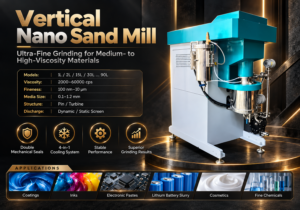
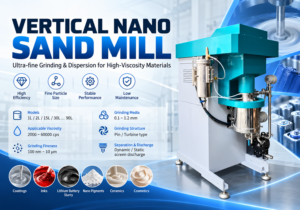
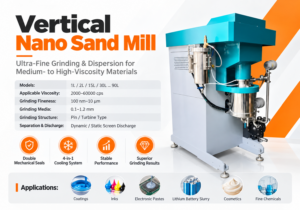
A vertical sand mill is usually the entry point for people testing new pigments, dyes, or coatings — it’s compact, easier to clean between batches, and forgiving for quick formulation changes. I still reach for a vertical unit when I’m running exploratory batches with five or six candidate formulas in a single afternoon.
A horizontal sand mill, on the other hand, keeps the grinding media suspended more evenly along the length of the chamber because gravity isn’t pulling everything toward one end. That means longer, more consistent contact between the beads and the material, tighter particle size distribution, and — critically — a grinding behavior that scales up far more predictably. If your end goal is a production line, and not just a one-off sample, I now recommend running your final R&D trials on a lab-scale horizontal sand mill, even if it costs a bit more up front. It saved me from at least two failed scale-up attempts.
The rule of thumb I’ve settled on: use vertical mills to screen formulations quickly, and horizontal mills to validate the formulation you’re actually planning to commercialize.
The Nano Grinding Problem Nobody Warns You About
Here’s something that surprised me when I got deeper into this industry: demand for genuinely nanoscale dispersion has exploded over the last couple of years, and it isn’t limited to cosmetics or specialty pigments anymore. Battery material producers — especially anyone working with silicon-anode slurries, cathode materials, or carbon nanotube conductive additives — are pushing particle size requirements down into the tens of nanometers, and conventional bead mills simply can’t get there without serious contamination or excessive wear.
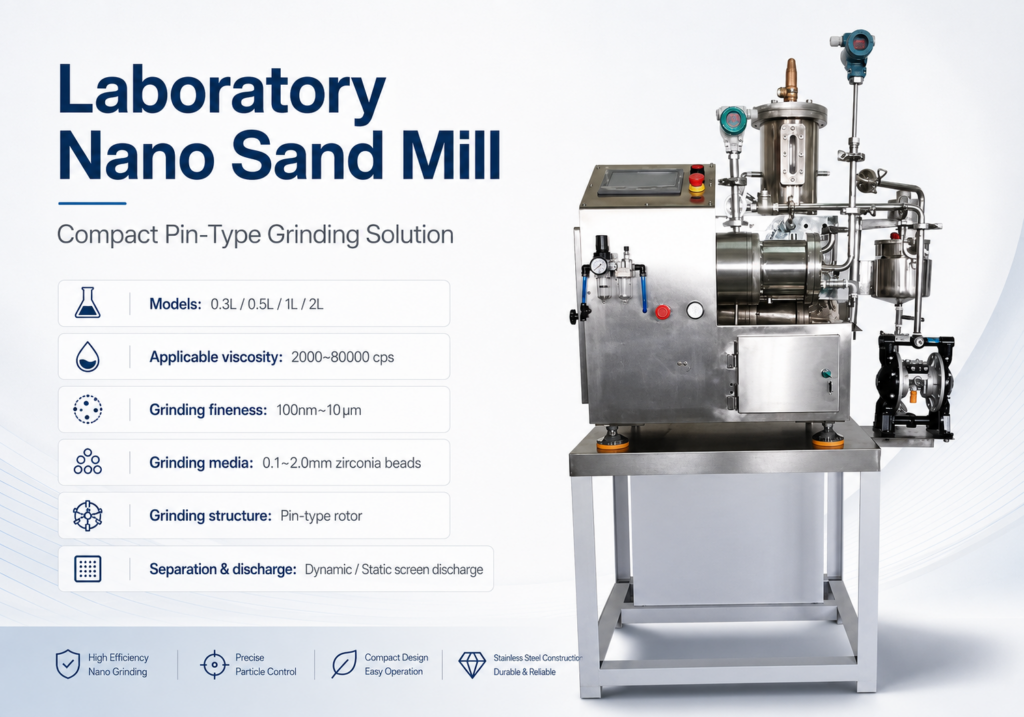
That’s the whole point of a proper Nano Sand Mill: all-ceramic or ultra-hard-alloy contact parts to avoid metal ion contamination, tighter bead separators to handle much smaller grinding media (sometimes below 0.1 mm), and closed-loop cooling because nano-level shear generates real heat. When I moved a battery slurry project into nano territory, I learned the hard way that a standard lab mill wasn’t built for that duty cycle — the seals wore out in weeks, and the batch-to-batch consistency was all over the place.
If your R&D roadmap includes anything nano — new energy materials, functional ceramics, high-end printing inks — it’s worth investing in dedicated nano-grinding capability at the lab stage rather than retrofitting a general-purpose machine later.
What I Learned Testing Equipment for the Paint and Coatings Industry
A huge share of the sand mill market still comes from paint, coatings, and printing inks, and this is where I’ve spent most of my own hands-on time. A sand mill for paint applications has to balance two things that pull in opposite directions: fine enough dispersion for gloss and color strength, but not so aggressive that you shear-degrade resins or generate excess heat that destabilizes the formulation.
What I look for now in a sand mill in paint industry applications:
- Adjustable rotor tip speed, so I can dial in shear intensity per resin system instead of running everything at one fixed setting
- Easy bead loading/unloading, because paint formulators change media size constantly when testing different pigment systems
- A jacketed grinding chamber for temperature control — heat-sensitive binders will tell you immediately if you skip this
- Transparent, repeatable scale-up ratios documented by the manufacturer, not just marketing claims
That last point matters more than people think. I’ve talked to formulators who bought a lab machine from one factory and a production machine from a completely different supplier, only to discover the two machines used different rotor geometries and bead separator designs. The lab results were essentially meaningless for predicting plant performance. Lesson learned: source your lab and production equipment from the same manufacturer whenever possible, so the grinding mechanism actually scales.
A Checklist I Now Use Before Buying Any Lab Sand Mill
After going through several purchase cycles — and a couple of expensive mistakes — here’s the checklist I run through every time:
- Does it match the mechanism of the production mill I’ll eventually use? Horizontal-to-horizontal, vertical-to-vertical, same rotor style.
- Can it reach my target fineness, verified independently? I ask for third-party particle size data (Malvern laser analyzer or TEM imaging), not just internal specs.
- What contact materials touch my product? Ceramic-lined chambers matter enormously for anything metal-sensitive — batteries, pharmaceuticals, high-purity pigments.
- How small a batch can it run without huge material waste? Early formulation work often means expensive raw materials in tiny quantities.
- Is there a documented scale-up path — same manufacturer, same engineering team, ideally a full product line from 0.3-liter lab units up to multi-thousand-liter production systems.
Why I Ended Up Looking at Musen Machinery
Somewhere in this process, after comparing specs from a lot of manufacturers, I kept circling back to a factory in Dongguan: Dongguan Musehn Machinery Technology Co., Ltd. What stood out to me wasn’t marketing language — it was the sheer amount of accumulated engineering data. Musen was founded in 1998, which means over twenty years of grinding and dispersion data behind every machine they build, and that kind of track record is exactly what you want when you’re trying to trust a lab result enough to bet a production line on it.
A few things convinced me this was a serious sand mill Factory rather than an assembler of generic parts:
- They openly publish that their CaCO₃ grinding fineness can reach D97 ≤ 70nm, and that figure is verified by third-party Malvern laser particle size analyzers or TEM — exactly the kind of independent verification I look for before trusting any nano-grinding claim.
- They run their own production base, R&D center, and sales team all in Dongguan, following what they describe as German-style rigorous craftsmanship — the sort of manufacturing discipline that shows up in consistent bead separator tolerances and rotor balancing, not just a nice-looking spec sheet.
- Their product range genuinely spans from laboratory machines to complete production lines, covering mixing, grinding, filtering, and filling — which addresses my biggest scale-up worry directly: if the lab unit and the plant unit come from the same engineering lineage, my formulation data is far more likely to survive the jump.
If you’re currently shopping for a lab sand mill and thinking ahead to what happens after your formulation works — whether you’re in paints, inks, battery materials, ceramics, or cosmetics — I’d put Musen Machinery on your shortlist to request a quote and, if possible, a sample grinding trial with your own material. That’s ultimately what convinced me: not the spec sheet, but seeing my own slurry come back with a particle size report I could actually trust.
The Bigger Lesson
Choosing R&D-stage grinding equipment isn’t really about finding the cheapest bench-top machine that gets the job done today. It’s about protecting the months of formulation work you’re about to invest, so that when you’re ready to scale, the equipment doesn’t quietly rewrite your results. Whether you land on a vertical sand mill for fast screening, a horizontal sand mill for your final validation runs, or a dedicated nano platform for battery and advanced materials work, the real question to ask before you buy is simple: will this machine’s grinding mechanism still be recognizable when I multiply the batch size by a thousand? If the answer is yes, you’ve probably found the right supplier.