









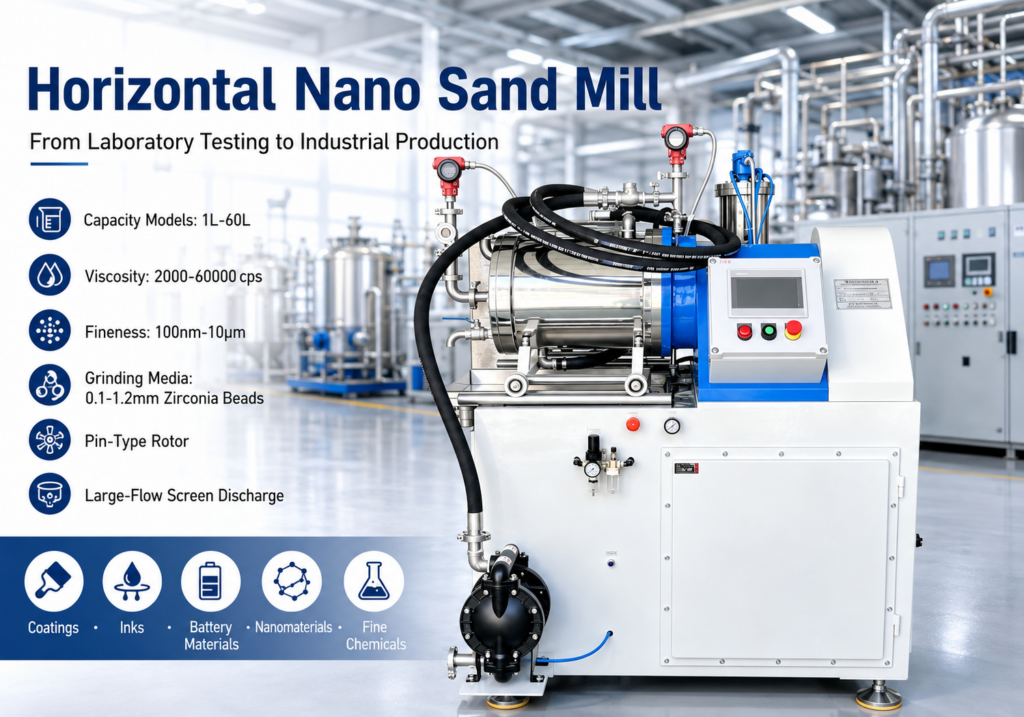
Pin-type and disc-type rotors are the two most common grinding structures used in a nano sand mill today, together accounting for the large majority of installed wet-grinding equipment worldwide. Both can disperse pigments, resins, and active ingredients into a liquid carrier — but they transfer energy to the grinding media in fundamentally different ways, and that difference decides how fine you can grind, how fast you can run, and what materials you can safely process.
This guide compares pin-type and disc-type rotors head-to-head, so you can choose the right structure whether you’re selecting a sand mill for paint production, upgrading to nano-scale fineness, or deciding between a vertical sand mill and a horizontal one.
How Each Rotor Structure Works
Disc-Type Rotor
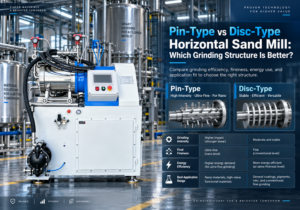
A disc-type rotor uses a series of flat, smooth discs mounted along the shaft inside the grinding chamber. As the shaft spins, the discs drive the grinding media (glass beads, zirconia beads, or steel shot) in a mostly linear, back-and-forth motion. Grinding is achieved primarily through friction and shear force between the media and the material.
- Simple, cost-effective mechanical design
- Media motion is relatively uniform but lower in energy density
- Well suited to conventional, lower-viscosity materials
Pin-Type Rotor
A pin-type (rod-pin) rotor arranges hard-alloy pins on both the rotor and, in higher-end designs, the barrel wall itself — creating what suppliers often describe as a “two-way, three-dimensional” grinding zone. The rotor drives the grinding media through a conical, spiral motion rather than a straight line, so the media strike the material from multiple directions with no dead zones in the chamber.
- Grinding is driven primarily by impact force, not just friction
- Handles higher solids content and higher viscosity
- Narrower, more consistent particle size distribution
- The structure of choice for pushing fineness down to true nano scale
Pin-Type vs Disc-Type: Side-by-Side Comparison
| Factor | Disc-Type Rotor | Pin-Type Rotor |
|---|---|---|
| Grinding mechanism | Friction / shear | Impact + shear (multi-directional) |
| Typical viscosity range | Below ~5,000 cps | Up to ~25,000–60,000 cps |
| Typical fineness | 1–15 μm | Down to 100nm (true nano grinding) |
| Solids content | Low–medium | High (up to ~85%) |
| Best for | Conventional coatings, standard inks, dyes | Nano color paste, battery materials, high-end inks, advanced ceramics |
| Cost | Lower, budget-friendly | Higher, but higher throughput per pass |
| Production efficiency gain | Baseline | Often 30–50% higher for nano-scale batches |
Which Structure Should You Choose?
Choose a disc-type rotor if:
- Your fineness target is in the 1–15 μm range
- You’re processing conventional, lower-viscosity coatings, standard printing inks, or dyes
- Budget and simple maintenance matter more than pushing to nano scale
Choose a pin-type rotor if:
- You need to reach sub-micron or true nano fineness (down to ~100nm)
- Your formulation is high-viscosity or high-solids-content
- You’re producing new energy battery slurry, nano pigment pastes, advanced electronic ceramics, or other high-value materials where particle size distribution directly affects product performance
In short: if “nano” is in your product spec, a pin-type rotor nano sand mill is almost always the better starting point.
Does This Choice Change for a Sand Mill for Paint Production?
For a sand mill for paint application specifically, the right rotor depends on what kind of paint you’re making, not just the word “paint” itself:
- Standard architectural and decorative paints typically only need pigment dispersion down to 5–15 μm — a disc-type rotor sand mill handles this efficiently and at lower cost.
- High-gloss, automotive, or premium coatings increasingly demand finer, more uniform pigment dispersion for better color strength and surface finish — this is where paint manufacturers are shifting toward pin-type rotor nano sand mills, even though the base application (paint) hasn’t changed.
If your paint line spans multiple product tiers, it’s worth checking whether your sand mill for paint production can be fitted with an interchangeable rotor, or whether you need two separate machines for standard and premium lines.
Does Rotor Type Matter Differently on a Vertical Sand Mill?
The pin vs. disc comparison above applies to both horizontal and vertical sand mill configurations, but the practical impact differs slightly:
- A vertical sand mill feeds material from the bottom of a suspended grinding cylinder and discharges from the top, using pressure difference and centrifugal force to keep the media in motion. This design is compact and space-saving, making it popular for smaller-scale or lab-adjacent setups.
- Because vertical sand mills are more prone to uneven media distribution and some bottom settling compared to horizontal designs, pairing a vertical sand mill with a pin-type rotor helps compensate — the multi-directional impact grinding keeps media better agitated throughout the shorter vertical chamber.
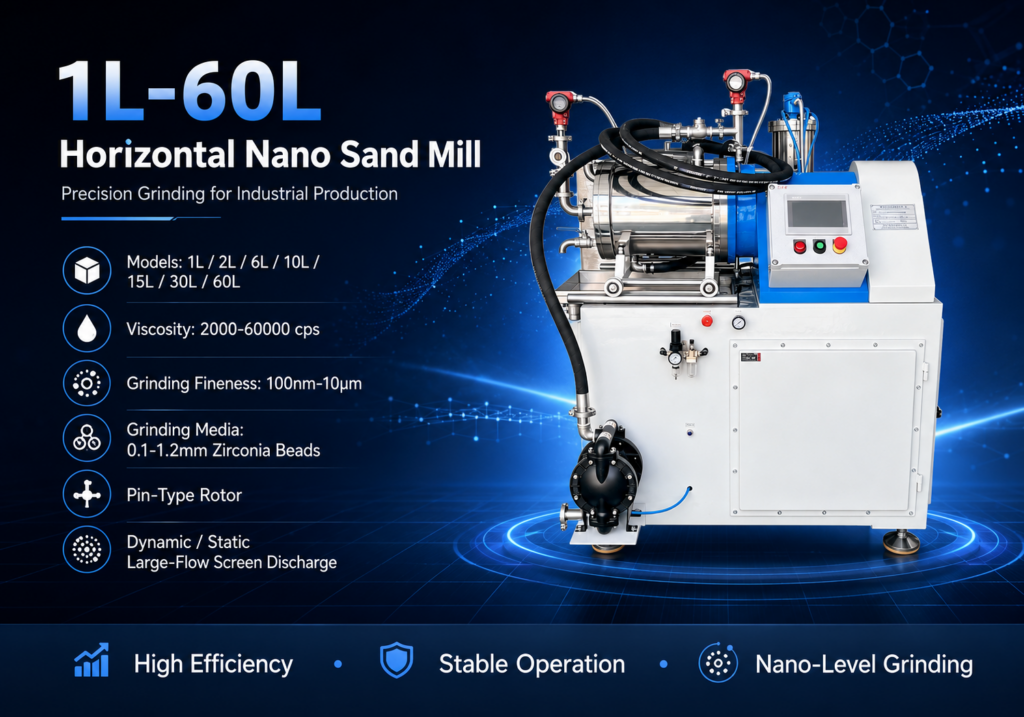
- For high-volume, continuous nano-grinding production, most manufacturers still favor a horizontal nano sand mill with a pin-type rotor, since the horizontal chamber fills more evenly and sustains higher throughput over long production runs.
Quick Decision Checklist
- Target fineness under 1μm (nano range) → pin-type rotor
- Target fineness 1–15μm, standard cost-sensitive production → disc-type rotor
- Formulation viscosity above ~20,000 cps or high solids content → pin-type rotor
- Standard sand mill for paint (architectural/decorative) → disc-type rotor is usually sufficient
- Premium/automotive coatings or battery slurry → pin-type rotor, horizontal configuration preferred
- Limited floor space, smaller batch, lab-adjacent use → vertical sand mill, pin-type rotor recommended
FAQ
What is the main difference between a pin-type and disc-type sand mill rotor? A disc-type rotor grinds mainly through friction and shear as media move in a linear path, while a pin-type rotor grinds through multi-directional impact force as media move in a conical, spiral path — which is why pin-type rotors achieve finer, more uniform nano-scale particle size distribution.
Can a disc-type rotor achieve nano-scale grinding fineness? Generally no. Disc-type rotors are typically limited to around 1–15μm fineness and are best suited to conventional coatings and inks. For true nano grinding down to around 100nm, a pin-type rotor nano sand mill is the standard choice in the industry.
Is a pin-type rotor sand mill more expensive than a disc-type one? Yes, pin-type rotor machines generally cost more due to their more complex hard-alloy pin structure, but they typically deliver 30–50% higher production efficiency for nano-scale batches, which can offset the higher upfront cost over time.
Should a sand mill for paint always use a pin-type rotor? Not necessarily. Standard architectural and decorative paints only need 5–15μm fineness, where a disc-type rotor is more cost-effective. Pin-type rotors become worthwhile once you move into high-gloss, automotive, or other premium coatings requiring finer, more uniform pigment dispersion.
Is a vertical sand mill better than a horizontal sand mill for nano grinding? Horizontal nano sand mills generally offer more even media distribution and higher sustained throughput for continuous production, while vertical sand mills save floor space and suit smaller-scale or lab-adjacent operations. Rotor type (pin vs. disc) matters in both configurations, but the horizontal + pin-type combination is the most common setup for high-volume nano-scale production.
Our nano sand mill series uses a pin-type rotor as standard across every model — from 1L lab units to 60L production machines — so whichever line you’re producing for, from a sand mill for paint upgrade to a vertical sand mill replacement, the grinding structure stays consistent as you scale.