









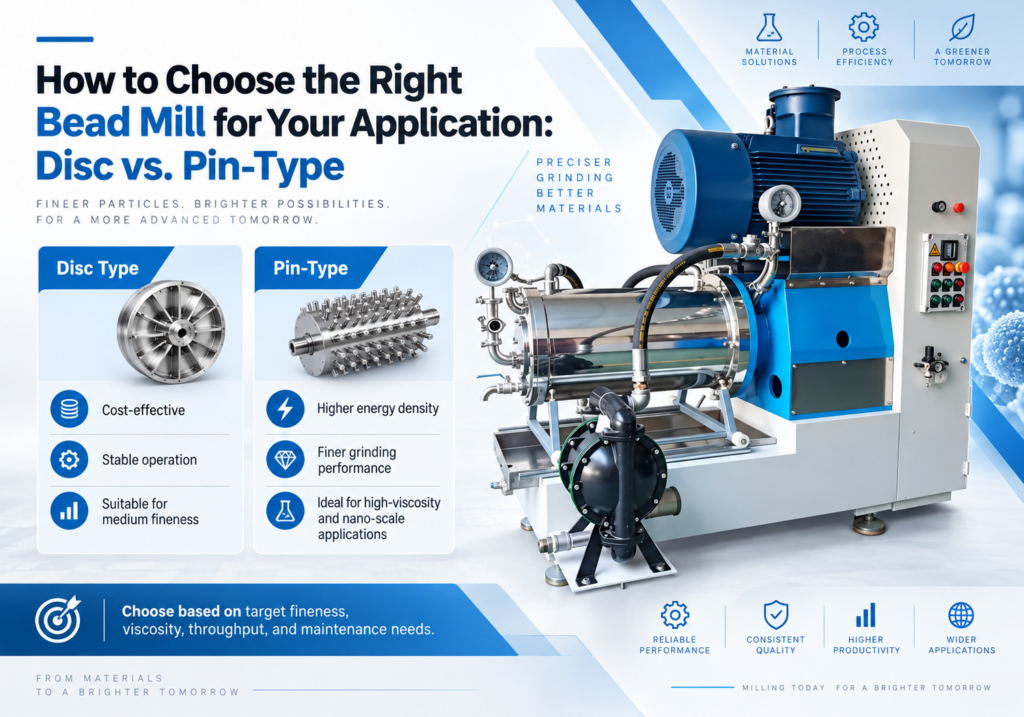
Selecting the right bead mill (also widely known as a sand mill or grinding and dispersion mill) is one of the most important equipment decisions a processing plant will make. Whether you are producing pigments, inks, coatings, pesticides, pharmaceuticals, cosmetics, or battery materials, the wrong mill configuration can mean poor particle size distribution, excessive downtime, or unnecessary energy costs. Among the many bead mill designs on the market, two configurations dominate industrial-scale wet grinding: the disc-type bead mill and the pin-type bead mill. Understanding how each one works — and where each excels — is the key to matching your process needs with the correct sand milling machine.
What Is a Bead Mill?
A bead mill, or sand mill, is a piece of wet grinding and dispersion equipment that uses the shearing, impact, and rolling friction generated by small grinding media (glass beads, zirconia beads, or steel beads) inside a rotating chamber to reduce particle size in a liquid slurry. The rotor — driven by a motor shaft — agitates the media and the product simultaneously, producing extremely fine and uniform dispersions. Bead mills are core equipment in industries such as paints and coatings, printing inks, agrochemicals, pigments and dyes, pharmaceuticals, cosmetics, nanomaterials, and new energy battery materials (like cathode/anode slurry grinding).
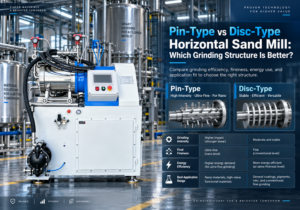
The two most common rotor designs used in horizontal and vertical bead mills are the disc rotor and the pin rotor. Each produces a distinct flow pattern and shear profile inside the grinding chamber, which directly affects fineness, efficiency, and suitability for different viscosities.
Disc-Type Bead Mill: How It Works and Where It Excels
A disc-type sand mill uses a series of rotating discs mounted along a central shaft. As the discs spin at high speed, they generate strong centrifugal force that pushes grinding media outward, creating intense shear zones between the disc edges and the mill body.
Key advantages of disc-type bead mills:
- Higher shear force — ideal for breaking down agglomerates and achieving ultra-fine, even nano-level particle sizes
- Better suited for high-viscosity and high-solid-content slurries, such as heavy-duty coatings, resins, and certain pigment pastes
- Lower grinding media wear in many formulations due to more controlled media movement
- Excellent temperature control, since the disc design allows for efficient cooling jacket integration
Typical applications: High-viscosity inks, industrial coatings, ceramic slurries, and specialty chemical dispersions that require fine, consistent particle distribution.
Pin-Type Bead Mill: How It Works and Where It Excels
A pin-type bead mill (sometimes called a pin-disc mill) uses cylindrical pins arranged radially or in rows on the rotor shaft instead of flat discs. As the pins rotate, they drive the grinding media through a more turbulent, high-velocity circulation pattern, producing rapid impact and collision forces.
Key advantages of pin-type bead mills:
- Higher throughput and faster grinding speed, making it well-suited for large-batch, high-volume production lines
- Better performance with low-to-medium viscosity materials, such as water-based paints, agrochemical suspensions, and pharmaceutical slurries
- More uniform bead motion, reducing the risk of media clumping in less viscous formulations
- Simplified maintenance and media replacement, since the pin rotor design generally allows easier disassembly
Typical applications: Water-based coatings, agrochemical formulations (pesticides/herbicides), food-grade dispersions, and pharmaceutical intermediates that need efficient, high-throughput fine grinding.
Disc vs. Pin-Type Bead Mill: Quick Comparison
| Factor | Disc-Type Bead Mill | Pin-Type Bead Mill |
|---|---|---|
| Shear intensity | Higher, more localized shear | Broader, more distributed impact |
| Best for viscosity | Medium to high viscosity | Low to medium viscosity |
| Throughput | Moderate | High |
| Fineness capability | Excellent (down to nano-scale) | Very good for most industrial fineness needs |
| Energy consumption | Slightly higher per batch | More energy-efficient at scale |
| Maintenance | Moderate | Generally easier |
How to Choose the Right Bead Mill for Your Process
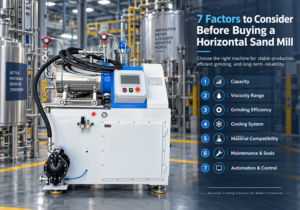
When selecting between a disc-type and pin-type sand grinding mill, consider the following:
- Material viscosity and solid content — High-viscosity pastes favor disc rotors; low-viscosity, high-flow slurries favor pin rotors.
- Target particle size — If sub-micron or nano-level fineness is required, disc-type mills generally offer more precise control.
- Production volume — For continuous, high-volume manufacturing, pin-type mills often deliver better throughput economics.
- Grinding media type and size — Both rotor types must be matched correctly with bead size (typically 0.3–2.5mm) for optimal grinding efficiency.
- Cooling and temperature sensitivity — Heat-sensitive formulations (such as certain pharmaceutical or cosmetic products) may benefit from the more efficient cooling design of disc mills.
In many production facilities, both rotor types are used side by side across different process lines, since no single configuration is universally “better” — the right choice always depends on your specific formulation, particle size target, and throughput requirements.
About Musehn Machinery
Dongguan Musehn Machinery Technology Co., Ltd. is a premier manufacturer specializing in high-end chemical grinding, dispersion, and conveying equipment, including a full range of disc-type and pin-type bead mills and sand mills engineered for coatings, inks, agrochemicals, pharmaceuticals, cosmetics, and new energy materials.
As a dedicated subsidiary of LECJX, Musehn Machinery represents the global arm of our group — while LECJX remains focused on the Chinese domestic market, Musehn is strategically positioned to lead our group’s expansion and service operations in overseas markets.
Building on a manufacturing legacy established in 1998, Musehn has integrated cutting-edge Swiss technology with premium German materials. Our engineering philosophy centers on dimensional stability and full component interchangeability, ensuring that every machine meets international industrial standards. We strictly adhere to ISO9001 quality protocols and 5S management systems to guarantee excellence in every unit we export — giving overseas customers the same reliability and precision that has defined our brand for over two decades.
Whether you need a disc-type bead mill for ultra-fine, high-viscosity dispersion, or a pin-type sand mill for high-throughput production, Musehn Machinery’s engineering team can help you specify the right configuration for your application.
Frequently Asked Questions (FAQ)
Q1: What is the main difference between a disc-type and pin-type bead mill? A: The core difference lies in the rotor design and the resulting flow pattern. Disc-type mills generate strong, localized shear force ideal for high-viscosity materials and ultra-fine grinding, while pin-type mills produce broader, high-velocity impact suited to low-to-medium viscosity materials and high-throughput production.
Q2: Can one bead mill handle both disc and pin functions? A: Some modular sand mill platforms allow the rotor assembly to be swapped between disc and pin configurations, giving manufacturers flexibility across multiple product lines without purchasing separate machines. Consult your equipment supplier about interchangeable rotor options.
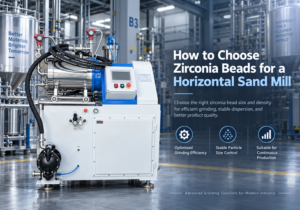
Q3: What grinding media should I use with a bead mill? A: Common media includes zirconium silicate beads, zirconia (YSZ) beads, glass beads, and steel beads, typically ranging from 0.3mm to 2.5mm in diameter. Media selection depends on the target fineness, material hardness, and required purity (e.g., zirconia beads for high-purity pharmaceutical or battery material applications).
Q4: How do I know if I need a disc-type or pin-type bead mill for my product? A: Consider your slurry’s viscosity, solid content, desired particle size, and production volume. As a general rule, high-viscosity, fine-particle-size applications favor disc mills, while high-volume, lower-viscosity processes favor pin mills. Our engineering team can help evaluate your formulation and recommend the correct configuration.
Q5: Does Musehn Machinery offer both disc-type and pin-type sand mills? A: Yes. Musehn Machinery manufactures a full range of horizontal and vertical bead mills in both disc and pin rotor configurations, built to ISO9001 standards using Swiss technology and German-grade materials, and supplied to customers across global overseas markets.
Q6: What industries commonly use bead mills / sand mills? A: Bead mills are widely used in paints and coatings, printing inks, pigments and dyes, agrochemicals, pharmaceuticals, cosmetics, nanomaterials, and new energy battery material production for achieving fine, stable, and uniform particle dispersions.