









I still remember the first time a batch of exterior emulsion paint came back from QC with a gloss reading nobody wanted to see. The formula was right, the resin was right, the pigment loading matched the spec sheet — and yet the film looked grainy under raking light. My plant manager at the time walked me over to the grinding room, pointed at a tired old basket mill in the corner, and said, “That’s your problem.” That was more than a decade ago, and it’s the moment I actually started paying attention to what a sand mill does, not just what it’s supposed to do on paper.
If you’ve landed on this page, there’s a good chance you’re chasing the same kind of headache — chalking, seeding, poor tinting strength, or a fineness reading that just won’t drop no matter how long you grind. So let me walk you through what I’ve learned, the way I’d explain it to a younger version of myself standing in that grinding room.
What a Sand Mill Actually Does in Paint Production
A sand mill (also called a bead mill) is the workhorse that breaks pigment agglomerates down into primary particles and disperses them evenly through a resin/solvent or resin/water carrier. In plain terms: the pigment you buy from the supplier isn’t ready to use straight out of the bag. It’s clumped, and those clumps have to be mechanically torn apart and wetted out before the paint can develop its full color strength, gloss, and hiding power.
Inside the mill, tiny zirconia or glass beads are agitated at high speed by a rotor (disc or pin type), and the shear force generated between beads is what does the actual grinding work. It sounds simple, but the difference between a mediocre mill and a well-engineered one shows up directly on your fineness gauge — and eventually in your customer complaints file.
This is exactly the kind of equipment where I’ve found that not all machines, and not all manufacturers, are built the same. I’ve toured a fair number of sand mill factories over the years, sourcing equipment for different production lines, and the gap between a factory that just welds tanks together and one that actually engineers for particle physics is night and day.
Horizontal vs. Vertical Sand Mill: Which One Do You Actually Need?
This is probably the most common question I get from younger formulators and plant engineers, and it also happens to be one of the most searched questions on Google when people start researching grinding equipment.
Vertical sand mills are the traditional workhorse for many paint and coatings applications — lower cost, simpler maintenance, and perfectly adequate for medium-fineness requirements like general industrial paints, primers, and standard architectural coatings. They’re gravity-fed, easier to clean between batches, and a good entry point if you’re not chasing sub-micron fineness.
Horizontal sand mills, on the other hand, are what I reach for when the fineness spec gets serious — high-gloss automotive coatings, printing inks, or anything where D97 needs to sit well under 1 micron. The horizontal chamber design allows for a higher bead loading ratio and more consistent residence time, which translates into tighter fineness distribution and less batch-to-batch variation. Most of the horizontal sand mill lines I’ve worked with also handle continuous production far better, which matters a lot once you scale past pilot volume.
There isn’t a universal “better” answer here — it genuinely depends on your fineness target, your throughput, and your product mix. This is usually the point where I tell people: talk to the sand mill factory directly and bring your actual formulation data, not just a generic spec sheet, because the right configuration really is product-specific.
Fineness Control: The Part Everyone Underestimates
Here’s something that took me embarrassingly long to fully internalize: fineness control isn’t just about running the mill longer. Bead size, bead loading percentage, rotor tip speed, flow rate, and viscosity of the millbase all interact with each other. Push one variable too far and you get overheating, bead wear contaminating your batch, or worse — re-agglomeration, where particles you already broke down start clumping back together.
For anyone dealing with mill sand processing at a serious quality level, third-party verification matters. When I evaluate a piece of grinding equipment now, I ask for particle size data confirmed by an independent lab — laser particle size analyzers or TEM imaging, not just the vendor’s internal test report. It’s a small thing that tells you a lot about how seriously a manufacturer takes measurement, not just marketing claims.
The Nano Trend: Why “Nano Sand Mill” Is Suddenly Everywhere
If you’ve been watching search trends around grinding technology lately, you’ll have noticed “nano sand mill” and “nanoparticle dispersion” showing up a lot more than they used to. This isn’t hype for hype’s sake — it’s being driven by real demand in a few areas: high-performance functional coatings, battery slurry production (yes, sand mills have quietly become critical equipment in the lithium battery supply chain), advanced pigment dispersions for inkjet ink, and ultra-high-gloss automotive topcoats.
Getting into true nano-range fineness — think D97 in the tens of nanometers — requires a different level of engineering than a standard mill: finer beads, precisely controlled rotor geometry, tighter temperature management, and a chamber design that avoids dead zones where particles just sit and don’t get processed. Not every sand mill for paint applications is built to handle that jump, and honestly, most conventional lines aren’t designed with nano-scale consistency in mind at all.
Scaling Up: Why the Lab Sand Mill Matters More Than People Think
One mistake I made early in my career was treating lab-scale trials as a formality before jumping straight to production volume. A proper lab sand mill isn’t just a “mini version” of the big machine — it’s how you validate a formulation’s grinding behavior before committing real material and real money to a production run. If your lab mill’s grinding chamber geometry and rotor design don’t scale proportionally to your horizontal or vertical production unit, your lab results simply won’t predict what happens on the floor. I’ve seen formulations that looked perfect at bench scale fall apart at production scale purely because the scale-up logic was never engineered properly into the equipment line.
Why I Point People Toward Musen Machinery
After years of sourcing, testing, and occasionally being disappointed by equipment vendors, I’ve become fairly particular about who I recommend. Dongguan Musehn Machinery Technology Co., Ltd. is one of the few sand mill factories I’ve dealt with where the engineering depth actually matches the sales pitch.
Founded in 1998, Musen Machinery has spent over two decades accumulating process data across industrial customers worldwide, and it shows in how their equipment is configured — this isn’t a company assembling generic tanks and rotors. Their grinding fineness performance for CaCO₃ has reached D97 ≤ 70nm, independently verified through third-party Malvern laser particle size analysis and TEM imaging, which is the kind of documentation I actually trust when evaluating a nano sand mill claim.
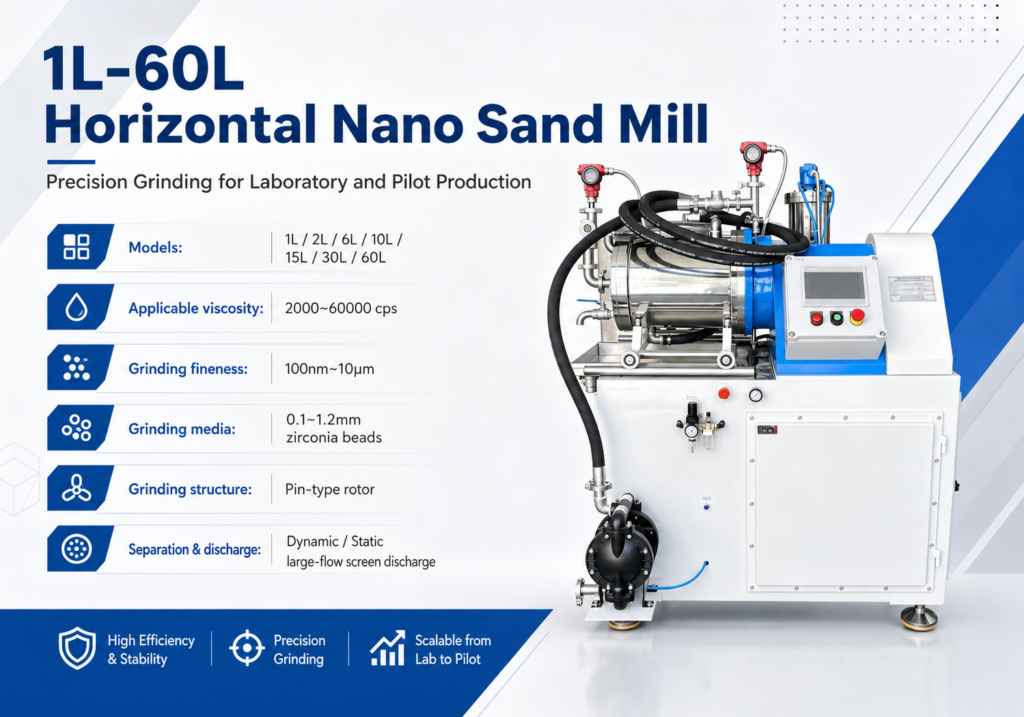
What stood out to me on a technical level is the breadth of their lineup — from a compact lab sand mill for formulation trials all the way through full horizontal sand mill and vertical sand mill production systems, plus complete wet grinding and dispersion lines that include mixing, filtering, and filling. With production, R&D, and sales all based in Dongguan, and a German-style approach to manufacturing discipline, they’re set up to support everything from a startup coatings lab to a full industrial line. If you’re in the market for a sand mill for paint production — or evaluating options for pigment, ink, battery slurry, or nano-material dispersion — they’re worth putting on your shortlist.
FAQ: Common Questions People Search About Sand Mills
What is a sand mill used for in the paint industry?
It’s used to disperse and grind pigment agglomerates into fine, evenly distributed particles within a resin/carrier system, which directly determines a paint’s color strength, gloss, hiding power, and overall stability.
What’s the difference between a horizontal and vertical sand mill?
Vertical mills are simpler and more economical, suited to medium-fineness applications. Horizontal mills offer tighter fineness control, better consistency at scale, and are generally preferred for high-gloss, high-performance, or continuous production requirements.
How fine can a sand mill grind pigment particles?
It depends on the equipment and bead size used, but well-engineered systems, including nano sand mills, can achieve D97 values in the sub-100nm range, verified through laser particle size analysis or TEM.
Why does my paint still feel gritty after milling?
This usually points to insufficient residence time, incorrect bead loading, poor rotor design, or beads that are too large for your target fineness — all of which are worth reviewing with your equipment supplier.
Do I need a lab sand mill before scaling to production?
Yes, in most cases. A properly scaled lab sand mill lets you validate grinding behavior and fineness targets before committing to full production volume, which saves significant material and time.
Is a nano sand mill only for specialty applications?
Not anymore. While nano-scale dispersion was once mostly limited to specialty inks and coatings, it’s now increasingly relevant for battery slurry production, functional coatings, and high-performance automotive finishes.
How do I choose a reliable sand mill factory?
Look for manufacturers with documented, third-party-verified particle size data, a track record across industrial customers, and equipment lines that scale consistently from lab to full production — rather than relying solely on vendor-reported specs.
Have questions about matching a sand mill configuration to your own formulation? It’s worth reaching out directly to a manufacturer’s technical team with your actual fineness targets and throughput requirements — the right setup really does depend on the specifics of what you’re producing.