









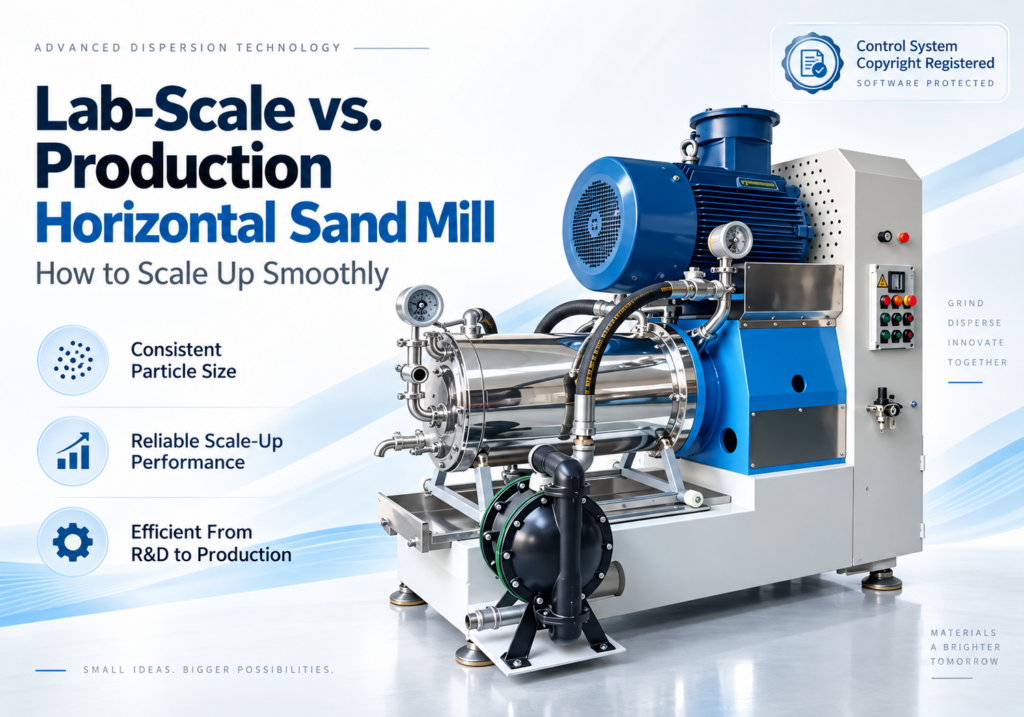
One of the most common — and most costly — mistakes in process development is assuming that results achieved on a lab-scale mill will translate directly to full production. When it comes to wet grinding and dispersion, scaling from a lab-scale horizontal sand mill to a full production horizontal sand mill involves far more than simply buying a bigger machine. Chamber geometry, rotor tip speed, cooling capacity, and media dynamics all behave differently at scale. This guide explains the key differences between lab-scale and production horizontal sand mills, and how to scale up your process smoothly without losing the particle size, stability, or quality you validated in the lab.
Why Scale-Up Isn’t Just “Buying a Bigger Horizontal Sand Mill”
A horizontal sand mill works by transferring rotor energy into grinding media inside a jacketed chamber. At lab scale, a small chamber volume and low flow rate make it relatively easy to achieve tight process control and fine particle size. But as chamber volume increases at production scale, several variables shift simultaneously:
- Residence time distribution changes — larger chambers create different flow patterns, which can affect how consistently particles are exposed to grinding energy
- Heat generation increases disproportionately — larger batches generate more total heat, requiring proportionally greater cooling jacket capacity, not just a linear increase
- Rotor tip speed and energy density must be recalibrated — simply scaling motor power linearly rarely reproduces the exact shear profile achieved in the lab
- Media dynamics shift — grinding media that separates cleanly in a small chamber may behave differently under the higher flow rates and pressures of a production-scale horizontal sand mill
Because of these factors, a properly planned scale-up strategy — supported by a manufacturer experienced in both lab-scale and production-scale horizontal sand mill engineering — is essential to avoid costly reformulation or trial-and-error at full production volume.
Lab-Scale Horizontal Sand Mill: Purpose and Characteristics
A lab-scale horizontal sand mill is designed for formulation development, feasibility testing, and small-batch validation before committing to full production investment. Key characteristics include:
- Small chamber volume, typically processing just a few liters per batch
- Precise, adjustable process control, allowing R&D teams to fine-tune rotor speed, media loading, and flow rate
- Lower capital cost, making it accessible for formulation trials across multiple product variants
- Flexibility to test multiple rotor configurations (disc-type or pin-type) on the same platform
The primary goal of a lab-scale horizontal sand mill is not production output — it’s generating reliable, scalable data about your formulation’s grinding behavior.
Production Horizontal Sand Mill: Purpose and Characteristics
A production-scale horizontal sand mill is engineered for continuous, high-volume manufacturing, with a focus on throughput, consistency, and long-term operational reliability. Key characteristics include:
- Large chamber volume, engineered for continuous or high-batch-volume processing
- Industrial-grade drive systems and cooling capacity, sized for sustained heavy-duty operation
- Wear-resistant components, built to withstand extended operating hours
- Modular, interchangeable parts, supporting fast maintenance without extended downtime
The goal at this stage shifts from process discovery to reliable, repeatable output at commercial volume.
How to Scale Up from Lab-Scale to Production Horizontal Sand Mill Smoothly
1. Use Consistent Scale-Up Ratios, Not Guesswork
Work with your equipment supplier to apply proven scale-up methodology — typically based on maintaining consistent energy density (energy input per unit volume) rather than simply scaling chamber size and assuming shear behavior stays the same.
2. Validate with an Intermediate Pilot-Scale Run
Where possible, run an intermediate pilot-scale horizontal sand mill trial between lab and full production. This step often reveals scale-up issues — such as cooling insufficiency or media separation instability — before they become expensive problems at full commercial volume.
3. Recheck Cooling Capacity at Each Scale
Because heat generation does not scale linearly with volume, cooling capacity must be recalculated — not just proportionally increased — at each stage of scale-up to avoid thermal degradation of your product.
4. Confirm Rotor and Media Compatibility Across Scales
If your lab-scale trials used a specific rotor type (disc or pin) and media size, confirm that the production-scale horizontal sand mill can replicate the same shear profile and media dynamics, adjusting configuration as needed rather than assuming a direct match.
5. Work With a Single Manufacturer Across the Scale-Up Journey
Using a manufacturer that offers both lab-scale and production-scale horizontal sand mill platforms — built on the same engineering philosophy and component standards — significantly reduces scale-up risk, since chamber geometry, rotor design principles, and quality tolerances remain consistent from R&D through full commercial production.
Lab-Scale vs. Production Horizontal Sand Mill: Quick Comparison
| Factor | Lab-Scale Horizontal Sand Mill | Production Horizontal Sand Mill |
|---|---|---|
| Primary purpose | Formulation development, feasibility testing | Continuous commercial manufacturing |
| Chamber volume | Small (liters per batch) | Large (continuous or high-batch volume) |
| Cooling capacity | Adequate for small batch | Must be recalculated, not linearly scaled |
| Component durability | Standard-duty | Heavy-duty, wear-resistant |
| Maintenance design | Simple | Modular, interchangeable for minimal downtime |
| Capital investment | Lower | Higher, long-term production asset |
About Musehn Machinery
Dongguan Musehn Machinery Technology Co., Ltd. is a premier manufacturer specializing in high-end chemical grinding, dispersion, and conveying equipment, offering both lab-scale and production-scale horizontal sand mills engineered on a consistent design platform to support smooth, low-risk scale-up across coatings, inks, agrochemicals, pharmaceuticals, cosmetics, and new energy materials.
As a dedicated subsidiary of LECJX, Musehn Machinery represents the global arm of our group — while LECJX remains focused on the Chinese domestic market, Musehn is strategically positioned to lead our group’s expansion and service operations in overseas markets.
Building on a manufacturing legacy established in 1998, Musehn has integrated cutting-edge Swiss technology with premium German materials. Our engineering philosophy centers on dimensional stability and full component interchangeability, ensuring that every horizontal sand mill we produce — from lab-scale development units to full production platforms — meets international industrial standards. We strictly adhere to ISO9001 quality protocols and 5S management systems to guarantee excellence in every unit we export.
Our engineering strength is backed by numerous national patents. These include Patent No. LC30037688.0, as well as a utility model patent (Certificate No. 10926915) covering a circulating-lubrication, enclosed-type grinding mill design — Patent No. ZL 2020 2 3251398.6, publication No. CN 214836925 U, granted on November 9, 2021. This patented, modular design approach is engineered to minimize maintenance downtime and operational costs for our clients at every scale of production. We believe that superior quality is the ultimate global currency.
Supported by expert technical consulting and a 24/7 global service hotline, Musehn Machinery is committed to guiding international buyers through the full journey — from lab-scale horizontal sand mill trials to production-scale commercial deployment — with reliable, precision-engineered solutions for the global fine chemical and new material industries.
Frequently Asked Questions (FAQ)
Can I use the same particle size results from a lab-scale horizontal sand mill in full production?
Not automatically. Lab-scale results provide a reliable starting point, but chamber geometry, cooling capacity, and media dynamics change at production scale. A proper scale-up methodology — often validated with an intermediate pilot run — is needed to reproduce lab-scale particle size results at commercial volume.
What is the biggest risk when scaling up from lab-scale to production horizontal sand mill?
The most common risk is underestimating cooling capacity requirements, since heat generation does not scale linearly with chamber volume. Insufficient cooling at production scale can cause thermal degradation, viscosity drift, or inconsistent particle size distribution that wasn’t present in lab trials.
Should I buy my lab-scale and production horizontal sand mill from the same manufacturer?
It’s generally recommended. Using a manufacturer that offers both lab-scale and production-scale platforms built on consistent engineering standards reduces scale-up risk, since chamber design principles, rotor configurations, and quality tolerances remain aligned from R&D through full production.
Does Musehn Machinery offer both lab-scale and production horizontal sand mills?
Yes. Musehn Machinery manufactures horizontal sand mills across both lab-scale and production-scale platforms, engineered under ISO9001 quality protocols with patented, modular design — including Patent No. LC30037688.0 and utility model Patent No. ZL 2020 2 3251398.6 — to support smooth scale-up for international buyers.
How long does the scale-up process typically take?
Scale-up timelines vary depending on formulation complexity, target particle size, and whether an intermediate pilot-scale trial is included. Share your product specifications and production timeline with our engineering team for a realistic scale-up roadmap.
Can Musehn Machinery help validate my formulation before I invest in a full production horizontal sand mill?
Yes. Our engineering team can support lab-scale and pilot-scale trials using your actual formulation, helping validate particle size, stability, and process parameters before committing to full production-scale equipment.