









I still remember the first time a customer sent back a batch of exterior paint with a one-line complaint: “the gloss just isn’t there.” No sagging, no odor issues, nothing wrong with the resin — just a flatness to the color that shouldn’t have been there. That was the moment I stopped thinking of grinding as a background step in production and started treating it as the step. If you work anywhere near coatings, inks, or dispersions, you already know the machine I’m talking about: the sand mill. And over the last two years, the conversation around it has shifted almost entirely toward one number — how far below 100 nanometers can you actually push a particle, and can you prove it.
Why “Nano” Suddenly Became the Whole Conversation
For most of my career, “fine grinding” meant getting pigment down to a few microns and calling it a day. Sub-micron was the ambitious target. Somewhere around the last product cycle, that bar moved. Battery slurry producers started asking for D50 values under 200nm for separator coatings. Pigment suppliers wanted particles fine enough to boost tinting strength without adding a single gram of extra colorant. Cosmetic and ceramic formulators wanted transparency and gloss that only comes from particles small enough to stop scattering visible light. Search interest around “nano sand mill,” “nano dispersion,” and “wet grinding to nanometer” has climbed steadily — and when I looked into why, it wasn’t hype. It was the industry catching up to what a properly engineered mill can now actually deliver.
The physics hasn’t changed. What’s changed is the equipment: rotor-stator geometry tighter than anything I used a decade ago, zirconium beads down to 0.1–0.3mm that used to be impossible to separate from product without clogging a screen, and closed-loop cooling that keeps heat-sensitive slurries from degrading mid-run. Put those three things together correctly and sub-100nm isn’t a lab curiosity anymore — it’s a production spec.
What Actually Happens Inside a Nano Sand Mill
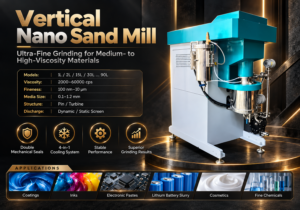
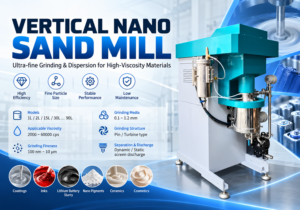
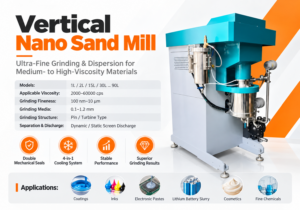
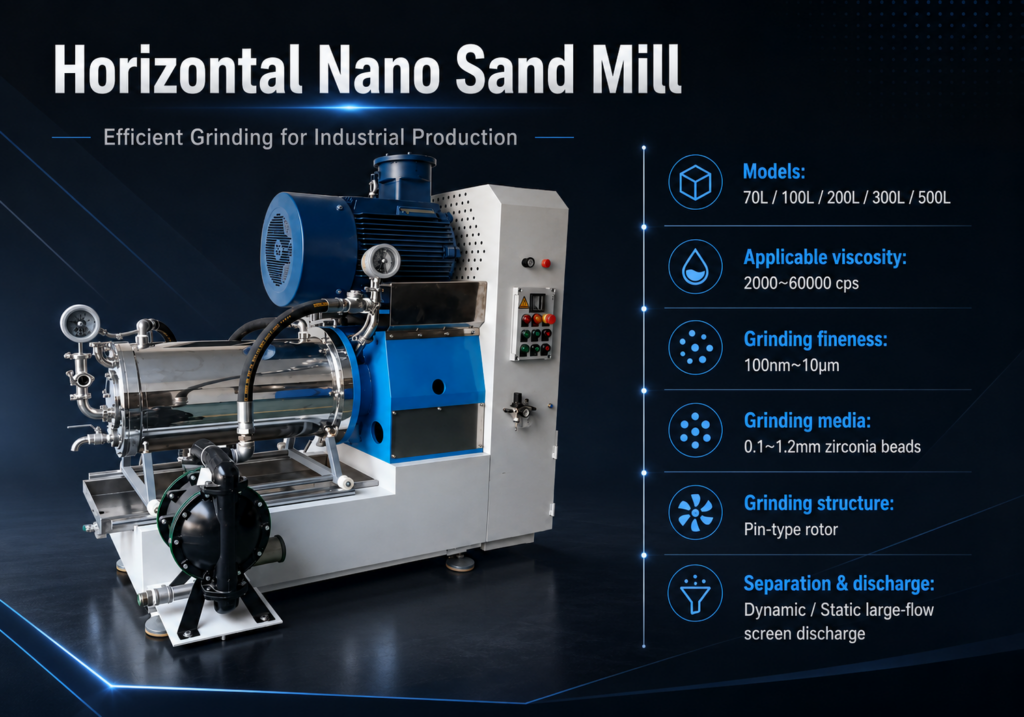
Walk into any wet-grinding workshop and you’ll see the same basic layout: a mixing/pre-dispersion tank feeding a grinding chamber packed with ceramic or zirconium micro-beads, agitated by a high-speed rotor. The material passes through, gets hit by thousands of shear and impact events per second, and exits through a dynamic separator fine enough to let product through but hold the beads back. Simple to describe. Brutally hard to engineer well at the nano scale.
The failure points are always the same ones I’ve chased for years on a factory floor: bead wear contaminating the batch, temperature spikes cooking the resin, uneven flow leaving a tail of oversized particles that ruins an otherwise perfect distribution curve. A mill that’s actually built for sub-100nm work solves all three at once — hardened alloy or SiC-lined chambers, precise flow control so every bit of slurry gets equal residence time, and a cooling jacket that’s doing real work, not just decoration on a spec sheet.
The Part Nobody Talks About: Proving It
Here’s what changed my own approach more than anything else. It’s not enough to grind fine — you have to be able to show it. I’ve sat across the table from customers who’d been burned before by suppliers quoting “nano” fineness with nothing to back it up. These days, the first question any serious buyer asks is: third-party verified, or take my word for it? A Malvern laser particle size analyzer readout or a TEM image settles that conversation in about thirty seconds. If a factory can’t hand you that data, the fineness claim isn’t real — it’s marketing.
That’s exactly the gap that pushed me toward Dongguan Musen Machinery Technology Co., Ltd. when I was sourcing equipment for a CaCO₃ processing line last year. Musen has been building wet grinding and dispersion equipment since 1998 — over two decades of accumulated process data, not just machine-building experience. Their calcium carbonate grinding fineness reaches D97 ≤ 70nm, and it’s not a number they just print on a brochure — it’s verified through third-party Malvern laser particle size analysis and TEM imaging, the same standard I’d expect from any lab I’d trust my own formulations to.
Why the Factory Behind the Machine Matters as Much as the Machine
I’ve toured a lot of production bases over the years, and you can tell within an hour whether a factory actually engineers its own equipment or just assembles bought-in parts. Musen runs its production base, R&D center, and sales team all out of Dongguan, which means the people designing the rotor geometry are the same people who hear about it when a customer’s viscosity profile doesn’t behave as expected. There’s a German-style rigor to how they iterate — tight tolerances, methodical upgrades, nothing shipped until it’s been pushed past spec in testing. That kind of discipline is rare, and it’s the difference between a mill that performs in a demo and one that still performs on day 400 of continuous production.
What I appreciate most is that Musen doesn’t just sell a single machine and disappear. They specialize in full wet grinding and dispersion systems — mixing, grinding, filtering, and filling — so a coatings or chemical producer can go from a laboratory-scale nano sand mill all the way up to a complete production line without stitching together equipment from five different vendors that were never designed to talk to each other. If you’re scaling from R&D batches to full production, that continuity alone saves months of integration headaches.
Where I See This Heading
Every conversation I’m having lately — with battery material producers, with pigment houses, with agrochemical formulators — circles back to the same pressure point: finer particles, tighter distributions, faster verification, lower energy cost per kilogram ground. The mills that win in this environment aren’t the ones with the flashiest spec sheet. They’re the ones with two decades of real production data behind the numbers, a factory that stands behind third-party verification instead of hiding from it, and a team that treats grinding as a science, not an afterthought.
If you’re evaluating equipment for your own line and sub-100nm fineness is genuinely non-negotiable, don’t just ask what a supplier claims to achieve — ask them to show you the Malvern report. That single request will tell you more about a factory than any brochure. It’s what led me to Musen, and it’s the question I’d hand to anyone else standing where I was a couple of years ago, staring at a batch of paint that just wasn’t glossy enough.
Dongguan Musen Machinery Technology Co., Ltd. Wet grinding & dispersion equipment — from laboratory nano sand mills to complete production lines. Production base, R&D center, and sales team based in Dongguan, China, serving global industrial customers since 1998.