









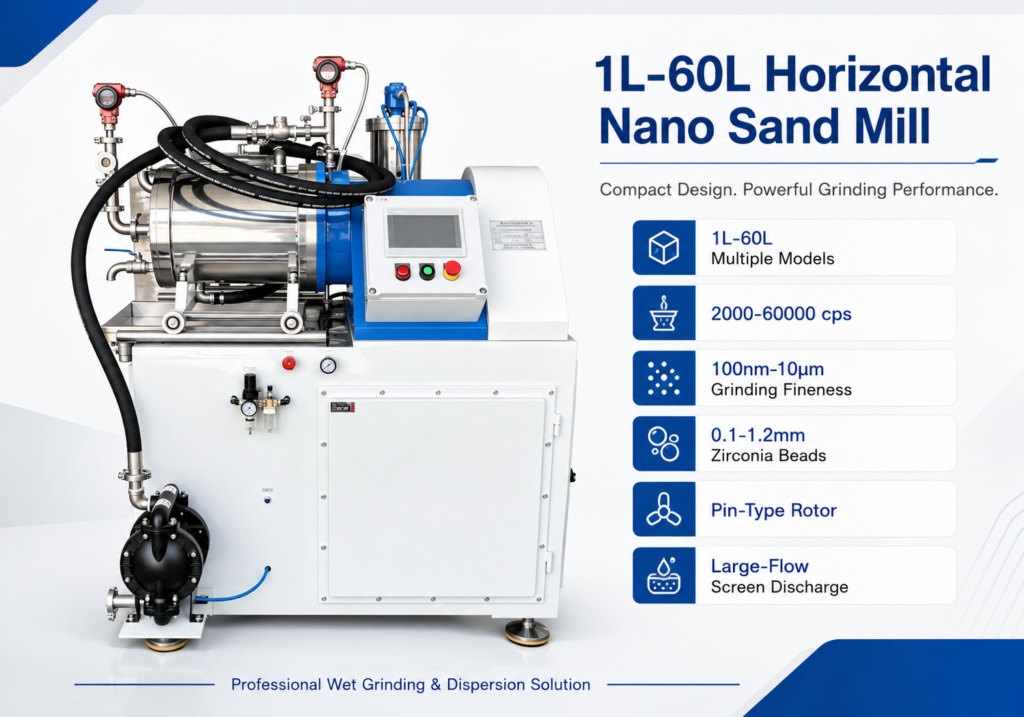
If you produce paint, ink, pigment, battery slurry, or any fine-particle dispersion, the grinding equipment you choose determines your product’s fineness, consistency, and production cost. Among all wet grinding machines, the horizontal sand mill is the industry standard for continuous, high-efficiency dispersion — but “choosing a horizontal sand mill” is not a one-size-fits-all decision.
This guide breaks down exactly how to evaluate and select a horizontal sand mill, whether you need a lab sand mill for R&D-scale testing or a full production unit for sand mill in paint industry applications, using real selection criteria: viscosity, fineness, grinding media, rotor structure, and discharge system.
What Is a Horizontal Sand Mill?
A horizontal sand mill (also called a horizontal bead mill) is a wet grinding and dispersing machine in which material and grinding media — typically zirconia beads, glass beads, or zirconium silicate beads — are agitated inside a horizontal cylindrical chamber by a rotating shaft fitted with discs or pins. The shearing and impact forces generated between the beads reduce solid particles suspended in a liquid down to micron or nanometer scale, while a separation screen at the discharge end keeps the beads inside the chamber and lets the finished slurry flow out.
Compared with vertical sand mills, horizontal sand mills fill the grinding chamber more evenly, avoid media settling at the bottom, and deliver higher, more consistent throughput — which is why they’re now the mainstream choice for continuous industrial production, from small 1L lab units to large 60L production-scale machines.
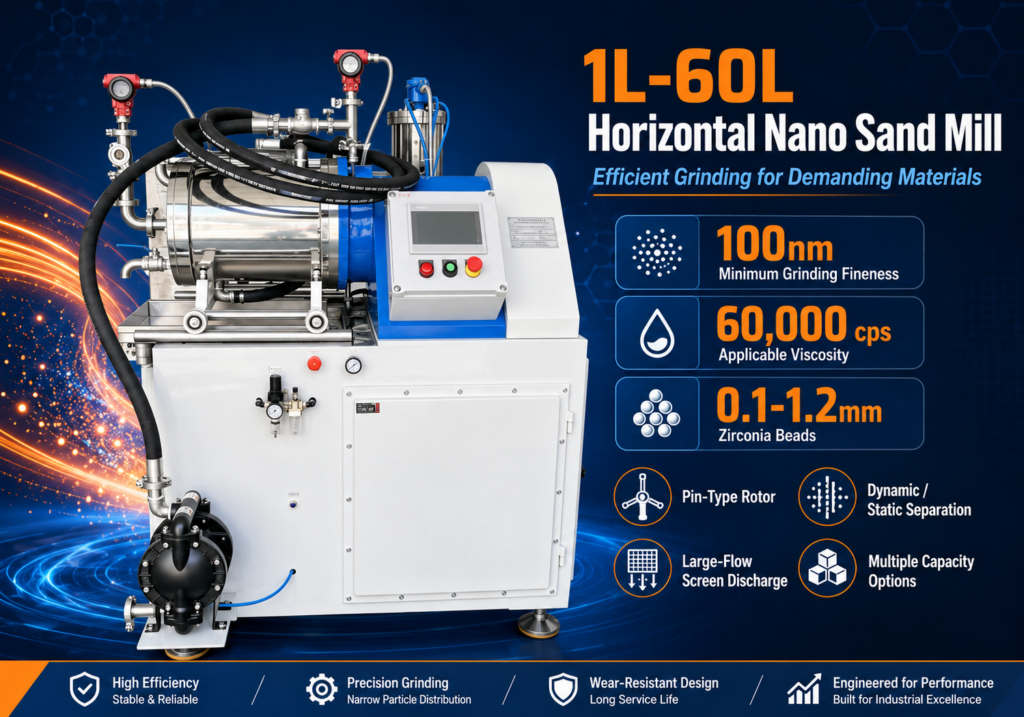
Where Horizontal Sand Mills Are Used
Horizontal sand mills are used wherever a liquid formulation needs fine, uniform particle dispersion:
- Sand mill in paint industry applications — architectural paint, automotive coatings, industrial coatings, where pigment dispersion determines color strength, gloss, and hiding power
- Printing inks and pigment pastes
- New energy battery slurry (cathode/anode/separator coating)
- Electronic ceramics and functional ceramic powders
- Cosmetics and pharmaceutical suspensions
- Agrochemicals (pesticide suspension concentrates)
- Dyes, magnetic powders, and photosensitive materials
Each of these industries has different viscosity ranges, fineness targets, and hygiene/cleaning requirements — which is exactly why selection criteria matter more than “brand” or “price” alone.
How to Choose the Right Horizontal Sand Mill: 5 Key Selection Criteria
1. Match the Mill to Your Material’s Viscosity
Every horizontal sand mill has a rated viscosity range it can handle efficiently — for example, a mid-size unit is typically rated for 2,000–60,000 cps. Low-viscosity, water-thin materials and thick, paste-like formulations both stress the pump and seal system differently, so the feed pump, chamber design, and motor power all need to be matched to your actual production viscosity — not just the nominal capacity of the tank.
Practical tip: always test your real formulation, not water or a generic slurry, since viscosity has the single biggest impact on throughput and heat generation during grinding.
2. Define Your Required Grinding Fineness
Fineness requirements vary enormously by end use:
- Standard paint/ink pigment dispersion: 5–20 μm
- High-gloss coatings, fine inks: 1–5 μm
- Battery slurry, advanced ceramics, nano-coatings: 100nm–1μm
A horizontal sand mill rated for 100nm–10μm fineness gives you the flexibility to run both standard micron-level dispersion and true nano-grinding on the same platform — useful if your product line spans multiple fineness specs.
3. Choose the Right Grinding Media Size
The rule of thumb in bead milling is that grinding media diameter should be roughly 10–100× the target particle size. Smaller beads create more contact points and grind faster to finer particle sizes, but place higher demands on the separation/discharge system to prevent bead loss or blockage. A mill that accepts 0.1–1.2mm zirconia beads covers both standard dispersion (larger beads, higher flow) and fine nano-grinding (smaller beads, higher energy density) without changing machines.
4. Compare Rotor Structure: Pin-Type vs. Disc-Type
The rotor inside the grinding chamber is the single biggest factor in grinding efficiency:
- Pin-type (rod-pin) rotors generate strong impact and shear forces and are well suited to nano-scale grinding and higher-viscosity materials — this is the structure most nano sand mills use.
- Disc-type rotors are the traditional workhorse for general paint, ink, and pigment dispersion, offering good throughput at lower energy input.
If your priority is pushing fineness down toward the sub-micron/nano range, a pin-type rotor structure is generally the better starting point.
5. Check the Separation & Discharge System
This is where many buyers underestimate the impact of design on real-world uptime. Two main discharge methods are used in modern horizontal sand mills:
- Static/dynamic gap separators — the traditional approach, reliable but more prone to clogging with fine media
- Dynamic/static large-flow screen discharge — a more advanced design that improves flow rate and significantly reduces clogging, especially important when running small (sub-0.3mm) beads for nano-fineness grinding
If your production involves fine beads and continuous, unattended runs, prioritize a mill with a large-flow, self-cleaning discharge screen over the older gap-separator design.
Lab Sand Mill vs. Production Sand Mill: Do You Need Both?
Most manufacturers don’t jump straight from formulation idea to full production. A lab sand mill (typically 0.3L–2L capacity) lets your R&D or QC team:
- Trial new formulations and pigment/media combinations without wasting large batches of raw material
- Determine the optimal viscosity, media size, and grinding time before committing to full-scale production
- Match colors and fine-tune dispersion recipes for small-batch or custom orders
Because a true horizontal sand mill product line — from 1L lab units up to 60L production machines — shares the same rotor structure, media type, and discharge design, results from your lab sand mill scale up predictably. This “scale-up” consistency is one of the most overlooked criteria when comparing suppliers: a lab unit that behaves nothing like its production-scale sibling will cost you time and material during scale-up trials.
| Capacity | Typical Use Case |
|---|---|
| 1L–2L | Lab R&D, formulation trials, color matching |
| 6L–10L | Pilot batches, small-scale/custom production |
| 15L–30L | Mid-volume production |
| 60L | Full continuous industrial production |
Quick Selection Checklist
Before comparing horizontal sand mill suppliers, confirm these five specs against your actual production needs:
- Viscosity range covers your formulation (e.g., 2,000–60,000 cps)
- Fineness range meets your target spec (e.g., 100nm–10μm)
- Grinding media size range fits your product (e.g., 0.1–1.2mm zirconia beads)
- Rotor structure (pin-type vs. disc-type) matches your fineness/viscosity priority
- Discharge/separation system supports continuous, low-clog operation at your bead size
FAQ
What is the difference between a horizontal sand mill and a vertical sand mill?
Horizontal sand mills fill their grinding chamber more evenly and avoid the media-settling issues common in vertical designs, giving more consistent output and higher throughput — which is why they’re the mainstream choice for continuous production, while vertical sand mills are often used for smaller-scale or space-constrained setups.
Can one horizontal sand mill handle both micron and nano fineness?
Yes, provided the machine’s rated fineness range covers both — for example, a unit rated 100nm–10μm with adjustable grinding media size (0.1–1.2mm) can run standard pigment dispersion and nano-grinding on the same platform.
Why is a lab sand mill important if I already have a production sand mill?
A lab sand mill lets you trial new formulations, colors, and media combinations on a small scale before committing raw material to a full production run — and because results scale up reliably across a matched product line (1L to 60L), you avoid costly surprises when moving from R&D to production.
What causes clogging in a horizontal sand mill’s discharge system?
Clogging most often occurs with older static gap-separator designs when running fine grinding media. A dynamic/static large-flow screen discharge system is designed specifically to handle small beads at higher flow rates with far less clogging.
Looking for a horizontal sand mill that scales from lab to production? Our 1L–60L series shares the same pin-type rotor and dynamic/static large-flow screen discharge across every model — so your lab results scale up exactly as expected.