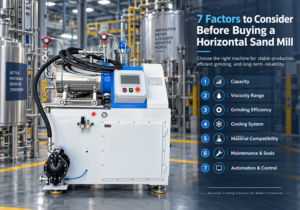










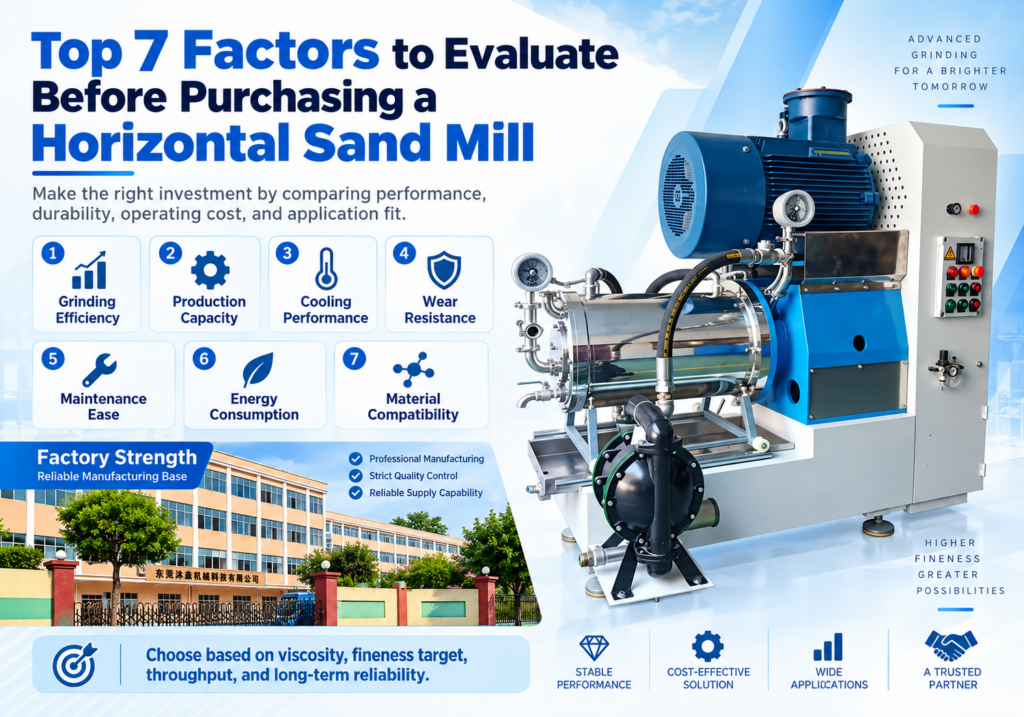
Investing in a horizontal sand mill is a major capital decision for any manufacturer working in coatings, inks, pigments, agrochemicals, pharmaceuticals, cosmetics, or new energy battery materials. As the industry-standard configuration for continuous, high-volume wet grinding and dispersion, the horizontal sand mill (also called a horizontal bead mill) directly determines your product’s particle fineness, production efficiency, and long-term operating costs. Choosing the wrong machine — or the wrong supplier — can lead to costly downtime, inconsistent quality, and expensive rework. Before you purchase, here are the seven most important factors to evaluate.
1. Production Capacity and Throughput Requirements
The first question to answer before selecting a horizontal sand mill is: how much product do you need to process per hour, and at what target particle fineness? Undersized equipment creates production bottlenecks, while oversized equipment wastes capital and energy. Work with your supplier to match chamber volume, motor power, and flow rate to your actual production targets — not just current volume, but anticipated growth over the next several years.
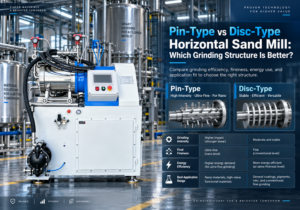
2. Rotor Configuration: Disc-Type vs. Pin-Type
Horizontal sand mills are generally built with either a disc-type or pin-type rotor. Disc rotors generate stronger, more localized shear — ideal for high-viscosity materials and ultra-fine particle targets. Pin rotors offer higher throughput and are well-suited to lower-viscosity, high-volume formulations. Some horizontal sand mill platforms offer interchangeable rotor assemblies, giving you flexibility to adjust as your product mix evolves.
3. Cooling System Capacity
Wet grinding generates substantial frictional heat, particularly with high-viscosity or high-solid-content materials. A properly engineered horizontal sand mill should offer a cooling jacket with sufficient heat-exchange surface area to keep your product within a stable temperature range throughout production. Inadequate cooling can cause product degradation, viscosity drift, and inconsistent particle size distribution — so always request cooling capacity specifications relative to your material’s thermal sensitivity.
4. Grinding Media Compatibility
Different formulations require different grinding media types and sizes — zirconia beads, zirconium silicate beads, glass beads, or steel beads, typically ranging from 0.3mm to 2.5mm. Before purchasing, confirm that the horizontal sand mill‘s separation system (screen, gap, or centrifugal separator) is compatible with your required media size, and that the chamber design minimizes media wear and loss over long production runs.
5. Wear Resistance and Component Durability
Abrasive slurries and high-solid-content formulations accelerate wear on the grinding chamber lining, rotor, and seals. Evaluate the build quality and material specifications of the horizontal sand mill — including dimensional stability and component interchangeability — since these factors directly determine service life, maintenance frequency, and total cost of ownership. Machines built with premium, wear-resistant materials cost more upfront but typically deliver significantly lower long-term operating costs.
6. Maintenance Design and Downtime Minimization
Unplanned downtime is one of the biggest hidden costs in wet grinding operations. Look for a horizontal sand mill with a modular design that allows for quick disassembly, media replacement, and seal servicing without extensive production interruption. Ask your supplier whether critical wear parts are standardized and readily available — machines with fully interchangeable components are far easier and faster to maintain over their operating life.
7. Manufacturer Reputation, Certification, and After-Sales Support
Finally, evaluate the supplier itself. A horizontal sand mill is a long-term production asset, so the manufacturer’s engineering credibility, quality certifications (such as ISO9001), manufacturing history, and after-sales service network matter as much as the machine’s specifications. Ask about technical consulting availability, spare parts lead time, and whether the supplier offers ongoing global service support — especially important for overseas buyers who need responsive support across time zones.
Quick Reference: 7-Factor Purchase Checklist
| # | Factor | Why It Matters |
|---|---|---|
| 1 | Production capacity | Prevents bottlenecks or wasted capital |
| 2 | Rotor type (disc/pin) | Determines shear profile and viscosity range |
| 3 | Cooling system capacity | Protects product quality and thermal stability |
| 4 | Grinding media compatibility | Ensures efficient, consistent fineness |
| 5 | Wear resistance | Lowers total cost of ownership |
| 6 | Maintenance/modular design | Minimizes downtime |
| 7 | Manufacturer reputation & support | Reduces long-term risk |
About Musehn Machinery
Dongguan Musehn Machinery Technology Co., Ltd. is a premier manufacturer specializing in high-end chemical grinding, dispersion, and conveying equipment, including a full range of industrial-grade horizontal sand mills engineered for coatings, inks, agrochemicals, pharmaceuticals, cosmetics, and new energy materials.
As a dedicated subsidiary of LECJX, Musehn Machinery represents the global arm of our group — while LECJX remains focused on the Chinese domestic market, Musehn is strategically positioned to lead our group’s expansion and service operations in overseas markets.
Building on a manufacturing legacy established in 1998, Musehn has integrated cutting-edge Swiss technology with premium German materials. Our engineering philosophy centers on dimensional stability and full component interchangeability, ensuring that every horizontal sand mill we produce meets international industrial standards. We strictly adhere to ISO9001 quality protocols and 5S management systems to guarantee excellence in every unit we export.
With numerous national patents — including Patent No. LC30037688.0 — and a modular design approach, Musehn’s horizontal sand mill equipment is engineered specifically to minimize maintenance downtime and operational costs for our clients, addressing Factors 5 and 6 above at the design level. We believe that superior quality is the ultimate global currency.
Supported by expert technical consulting and a 24/7 global service hotline, Musehn Machinery is committed to delivering reliable, precision-engineered horizontal sand mill solutions to the international fine chemical and new material industries — giving overseas buyers confidence in factor 7: manufacturer reputation and after-sales support.
Frequently Asked Questions (FAQ)
Q1: What is the single most important factor when choosing a horizontal sand mill?
A: There isn’t one universal answer — the right priority depends on your product. High-viscosity, temperature-sensitive formulations should prioritize cooling capacity and rotor type, while high-volume commodity production should prioritize throughput and wear resistance. A qualified equipment supplier can help you weigh these factors against your specific process.
Q2: How does modular design reduce downtime on a horizontal sand mill?
A: A modular, fully interchangeable component design allows wear parts (seals, liners, rotor components) to be replaced quickly without extensive disassembly, minimizing production interruption and simplifying long-term maintenance planning.
Q3: Does Musehn Machinery hold any patents related to its horizontal sand mill technology?
A: Yes. Musehn Machinery holds numerous national patents, including Patent No. LC30037688.0, reflecting our ongoing investment in proprietary engineering for our horizontal sand mill and related grinding/dispersion equipment.
Q4: What kind of after-sales support does Musehn Machinery provide to overseas buyers?
A: We provide expert technical consulting and a 24/7 global service hotline, along with spare parts support and installation guidance, to ensure reliable long-term operation for international customers.
Q5: How do I determine the right horizontal sand mill capacity for my facility?
A: Provide your target production volume (kg/hour or liters/hour), product viscosity, solid content, and required particle fineness to our engineering team, and we can recommend the appropriate chamber size, motor power, and rotor configuration.
Q6: What certifications should I look for when purchasing a horizontal sand mill?
A: ISO9001 quality management certification is a key baseline indicator of a manufacturer’s process discipline. Musehn Machinery manufactures under strict ISO9001 protocols and 5S management systems, ensuring consistent quality across every exported unit.
Q7: Can Musehn Machinery customize a horizontal sand mill for a specific application?
A: Yes. Our engineering team works directly with buyers to configure rotor type, grinding media compatibility, cooling capacity, and chamber size based on the specific viscosity, throughput, and fineness requirements of your application.