









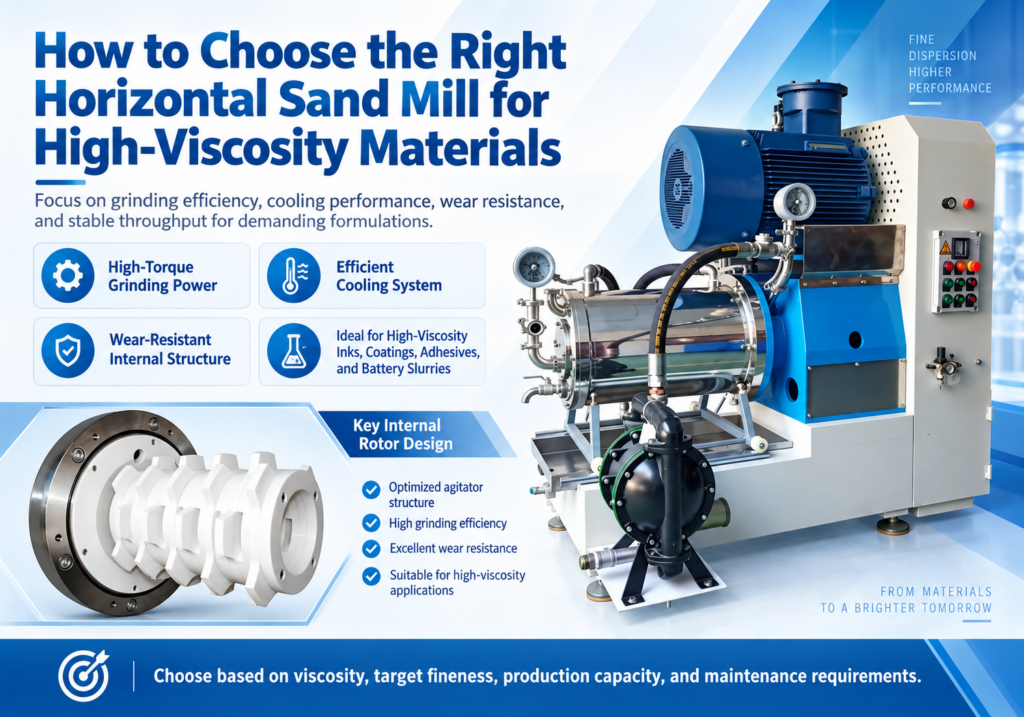
Grinding and dispersing high-viscosity materials is one of the most demanding challenges in wet processing. Thick pastes, resin-based coatings, high-solid-content pigment concentrates, and heavy-duty adhesives all require a grinding and dispersion machine capable of delivering consistent shear force without overheating the product or excessively wearing down equipment. For this reason, the horizontal sand mill — also referred to as a horizontal bead mill — has become the industry-standard sand milling machine for processing high-viscosity formulations at industrial scale. This guide explains what to look for when selecting a horizontal sand mill for high-viscosity applications, and how to avoid common selection mistakes.
Why a Horizontal Sand Mill Is Preferred for High-Viscosity Materials
Unlike vertical configurations, a horizontal sand mill positions its grinding chamber along a horizontal axis, allowing the product to flow steadily through a jacketed cylinder while the rotor (disc-type or pin-type) drives the grinding media in a controlled, high-shear pattern. This design offers several distinct advantages when working with thick, high-viscosity, or high-solid-content slurries:
- Larger cooling jacket surface area — critical for dissipating the heat generated when grinding thick, high-resistance materials
- More stable media-to-product separation at high viscosity, reducing media loss and screen blockages
- Consistent shear delivery over long production runs, even as viscosity fluctuates during batch processing
- Better pressure handling, allowing the mill to push dense, viscous slurries through the chamber without stalling or excessive back-pressure
These characteristics make the horizontal sand mill the preferred bead mill configuration across industries such as heavy-duty industrial coatings, printing inks, resin dispersions, adhesives, sealants, and high-solid-content pigment pastes.
Key Selection Criteria for a High-Viscosity Horizontal Sand Mill
1. Rotor Type: Disc vs. Pin
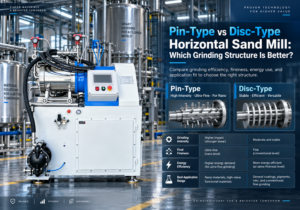
For high-viscosity materials, a disc-type rotor typically delivers stronger, more localized shear force, making it well-suited to breaking down agglomerates in thick pastes. Some horizontal sand mill platforms offer interchangeable rotor assemblies, allowing you to switch between disc and pin configurations as your product line evolves.
2. Grinding Media Selection
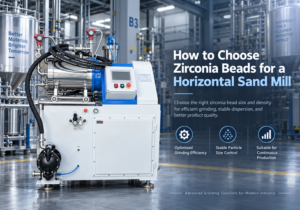
High-viscosity slurries generally require denser, larger-diameter grinding media (such as zirconia or zirconium silicate beads in the 1.0–2.5mm range) to generate sufficient impact force. Media hardness and density should be matched to your product’s viscosity and target fineness.
3. Cooling System Capacity
Because high-viscosity grinding generates significant frictional heat, the horizontal sand mill‘s cooling jacket capacity is one of the most important specifications to evaluate. Insufficient cooling can lead to product degradation, viscosity changes during processing, or equipment overheating.
4. Motor Power and Drive Stability
High-viscosity materials place greater load on the drive system. Choose a horizontal sand mill with adequate motor power and a stable drive train to maintain consistent rotor speed even under heavy load, avoiding inconsistent particle size distribution.
5. Chamber Wear Resistance
Abrasive, high-viscosity, high-solid-content materials accelerate wear on the grinding chamber lining. Look for horizontal sand mills constructed with high-quality wear-resistant materials and dimensionally stable components to extend service life and reduce maintenance costs.
6. Feed and Discharge System Design
A well-engineered feed pump and discharge separator system ensures that thick slurries move through the horizontal sand mill smoothly, without clogging or inconsistent flow rates — both of which can compromise grinding quality.
Common Mistakes When Selecting a Horizontal Sand Mill for High-Viscosity Applications
- Underestimating cooling requirements, leading to product overheating or thermal degradation
- Choosing undersized motor power, resulting in inconsistent shear and poor particle size uniformity
- Using the wrong grinding media size or density, reducing grinding efficiency and increasing energy costs
- Overlooking chamber wear resistance, leading to premature equipment failure with abrasive high-solid-content materials
How to Choose the Right Horizontal Sand Mill: Summary Checklist
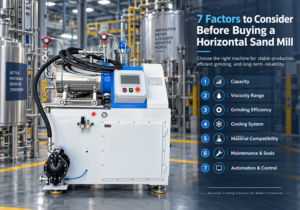
- Confirm your product’s viscosity range and solid content
- Select the appropriate rotor type (disc-type generally preferred for high viscosity)
- Match grinding media size and material to your target fineness
- Verify cooling jacket capacity against your production heat load
- Confirm motor power and drive stability for continuous high-load operation
- Choose a horizontal sand mill built with wear-resistant, dimensionally stable components
About Musehn Machinery
Dongguan Musehn Machinery Technology Co., Ltd. is a premier manufacturer specializing in high-end chemical grinding, dispersion, and conveying equipment, with particular expertise in industrial-grade horizontal sand mills engineered specifically for high-viscosity, high-solid-content applications across coatings, inks, resins, adhesives, agrochemicals, pharmaceuticals, and new energy materials.
As a dedicated subsidiary of LECJX, Musehn Machinery represents the global arm of our group — while LECJX remains focused on the Chinese domestic market, Musehn is strategically positioned to lead our group’s expansion and service operations in overseas markets.
Building on a manufacturing legacy established in 1998, Musehn has integrated cutting-edge Swiss technology with premium German materials. Our engineering philosophy centers on dimensional stability and full component interchangeability, ensuring that every horizontal sand mill we produce meets international industrial standards — even under the demanding wear and thermal loads of high-viscosity grinding. We strictly adhere to ISO9001 quality protocols and 5S management systems to guarantee excellence in every unit we export.
For manufacturers processing thick pastes, resins, or high-solid-content dispersions, Musehn Machinery’s engineering team can help specify the right horizontal sand mill configuration — including rotor type, media selection, cooling capacity, and drive system — for your specific application.
Frequently Asked Questions (FAQ)
Q1: What is the typical lead time for a horizontal sand mill order? A: Lead time depends on machine size, customization level, and current production schedule. Standard configurations are generally faster to deliver, while fully customized horizontal sand mills built to specific viscosity, cooling, or capacity requirements may take longer. Contact our sales engineering team with your specifications for an accurate quotation and delivery timeline.
Q2: Can Musehn Machinery customize a horizontal sand mill for our specific product viscosity and capacity requirements? A: Yes. Our engineering team works directly with buyers to specify rotor type (disc or pin), grinding media size, chamber volume, cooling jacket capacity, and motor power based on your product’s viscosity, solid content, and required throughput.
Q3: Does the horizontal sand mill come with international certifications? A: Musehn Machinery manufactures under strict ISO9001 quality protocols and 5S management systems, and our equipment is engineered to meet international industrial standards for export markets. Please contact us for documentation specific to your target market’s requirements (CE, etc.).
Q4: What is the minimum order quantity (MOQ) for horizontal sand mills? A: As industrial processing equipment, horizontal sand mills are typically sold on a per-unit basis rather than bulk MOQ. We work with both single-unit buyers commissioning a new production line and larger buyers scaling multiple lines.
Q5: What after-sales support and warranty does Musehn Machinery provide for overseas buyers? A: We provide standard equipment warranty coverage along with remote technical support, spare parts supply, and installation/commissioning guidance for overseas customers. Contact our team for specific warranty terms applicable to your order.
Q6: How do I know which horizontal sand mill model fits my production capacity? A: Model selection depends on your required output volume (kg/hour or liters/hour), target particle fineness, and product viscosity. Share your process parameters with our engineering team, and we can recommend the appropriate horizontal sand mill model and configuration.
Q7: Can Musehn Machinery ship horizontal sand mills internationally, and what shipping/incoterm options are available? A: Yes, as the overseas-market subsidiary of our group, Musehn Machinery is set up specifically to handle international shipping and export logistics. We can discuss FOB, CIF, or other incoterm arrangements based on your location and preferences.
Q8: What grinding media is recommended for high-viscosity materials in a horizontal sand mill? A: For high-viscosity, high-solid-content materials, denser media such as zirconia or zirconium silicate beads (typically 1.0–2.5mm) are generally recommended to generate sufficient impact force. Our team can recommend specific media based on your formulation.