









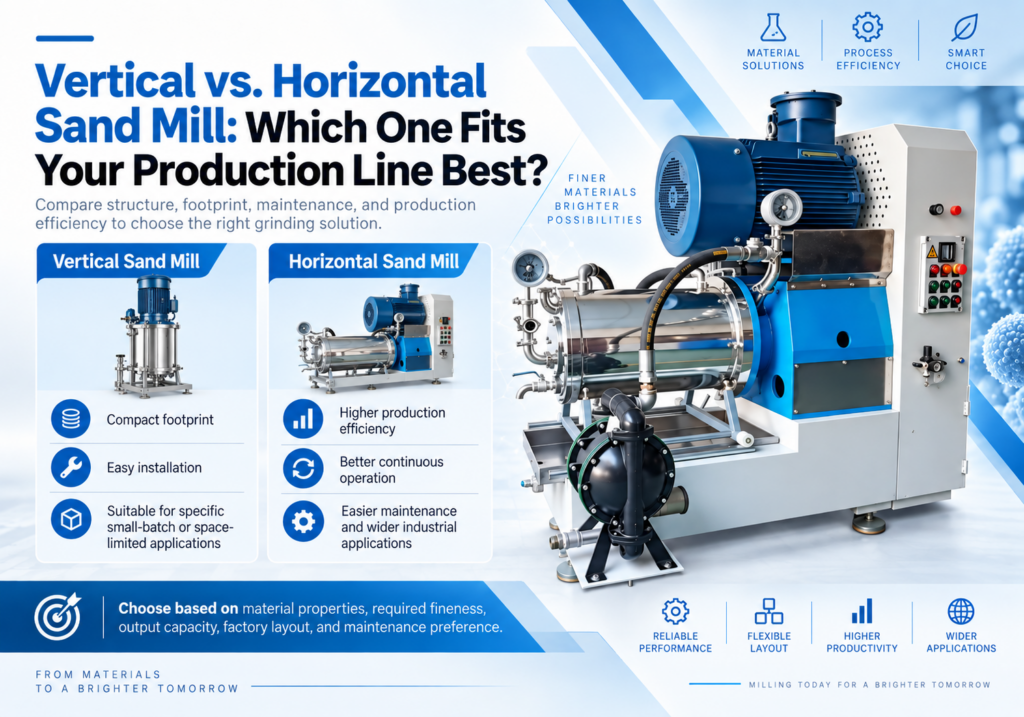
When scaling up wet grinding and dispersion processes, one of the most critical equipment decisions a plant manager will face is choosing between a vertical sand mill and a horizontal sand mill. Both are core types of bead mill used across paints and coatings, printing inks, pigments, agrochemicals, pharmaceuticals, cosmetics, and new energy battery material production. But while they share the same basic grinding principle — using small grinding media to reduce particle size in a liquid slurry — their chamber orientation leads to very different performance characteristics, footprint requirements, and ideal use cases. This guide breaks down the differences so you can determine which sand milling machine configuration is the right fit for your production line.
What Is a Sand Mill (Bead Mill)?
A sand mill, also known as a bead mill or grinding and dispersion mill, is wet-processing equipment that uses a rotating shaft to agitate grinding media (glass beads, zirconia beads, or steel beads) together with a product slurry inside an enclosed chamber. The resulting shear, impact, and friction forces break down particles and agglomerates to achieve fine, stable, and uniform dispersions. Sand mills are essential in industries that require precise particle size control, including coatings, inks, agrochemical suspensions, and battery slurry manufacturing.
The two dominant chamber configurations on the market are the vertical sand mill and the horizontal sand mill — and the difference between them goes far beyond simple orientation.
Vertical Sand Mill: Structure and Strengths
A vertical sand mill positions its grinding chamber upright, with the product typically fed from the bottom and discharged at the top (or vice versa, depending on design). The grinding media moves under gravity in combination with the rotor’s centrifugal force.
Key advantages of vertical sand mills:
- Compact footprint — ideal for facilities with limited floor space
- Lower initial investment in many small-to-mid batch configurations
- Simple structure, making it easier to operate for smaller-scale or R&D-level production
- Good fit for lower-viscosity, small-batch formulations
Common limitations:
- Media separation and screen wear can be more pronounced at higher throughput
- Less suited to continuous, large-volume industrial production
- Cooling efficiency is generally lower than horizontal designs, which can limit processing of heat-sensitive materials
Horizontal Sand Mill: Structure and Strengths
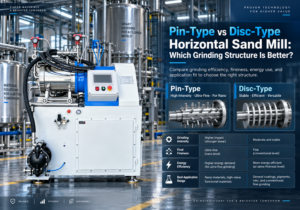
A horizontal sand mill — the configuration favored by most large-scale industrial manufacturers — positions the grinding chamber horizontally, with the product flowing along the length of the cylinder while the rotor (disc-type or pin-type) drives the grinding media in a controlled, high-velocity pattern.
Key advantages of horizontal sand mills:
- Superior cooling efficiency, since the horizontal jacket design allows for larger heat-exchange surface area — critical for temperature-sensitive formulations and continuous operation
- Higher throughput and better suitability for large-scale, continuous production lines
- More stable media separation, resulting in lower media loss and more consistent particle size distribution over long production runs
- Better handling of high-viscosity and high-solid-content slurries
- Easier to scale, from lab-scale horizontal sand mills to full industrial production units, while maintaining consistent grinding performance
Because of these advantages, the horizontal sand mill has become the standard configuration across the coatings, ink, pharmaceutical, agrochemical, and new energy battery material industries wherever consistent quality, high output, and long operational uptime are required. Most professional-grade horizontal bead mills also offer modular rotor designs (disc-type or pin-type), enabling manufacturers to fine-tune shear intensity for their specific formulation — see our related guide on choosing between disc and pin rotor types for more detail.
Typical applications of horizontal sand mills: industrial coatings and paints, printing inks, pigment and dye dispersions, agrochemical formulations, pharmaceutical intermediates, cosmetic emulsions, and lithium battery cathode/anode slurry grinding.
Vertical vs. Horizontal Sand Mill: Quick Comparison
| Factor | Vertical Sand Mill | Horizontal Sand Mill |
|---|---|---|
| Footprint | Smaller, space-saving | Larger, requires more floor space |
| Throughput | Lower to moderate | High, suited for continuous production |
| Cooling efficiency | Moderate | Superior, larger heat-exchange area |
| Viscosity handling | Best for low viscosity | Handles low to high viscosity well |
| Media separation stability | Can degrade at scale | Stable over long production runs |
| Ideal scale | R&D, small/mid batch | Industrial, mass production |
| Maintenance | Simple | Moderate, but consistent long-term performance |
How to Choose the Right Sand Mill for Your Production Line
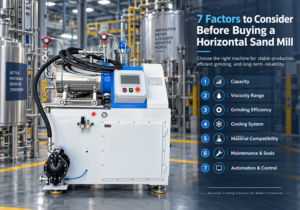
- Production volume — If you’re running continuous, high-volume manufacturing, a horizontal sand mill is almost always the better long-term investment due to its throughput and stability advantages.
- Available floor space — Facilities with tight space constraints or smaller batch requirements may lean toward a vertical configuration.
- Temperature sensitivity of your formulation — Heat-sensitive products (pharmaceuticals, certain cosmetics, battery slurries) benefit significantly from the superior cooling design of horizontal sand mills.
- Scalability plans — If you anticipate scaling from pilot production to full industrial output, starting with a horizontal sand mill platform avoids the need to re-engineer your process later.
- Viscosity and solid content — Horizontal sand mills generally offer more flexibility across a wider viscosity range.
For most manufacturers planning long-term, high-volume operations, the horizontal sand mill remains the industry-preferred choice — which is why it forms the core of most professional bead milling product lines today.
About Musehn Machinery
Dongguan Musehn Machinery Technology Co., Ltd. is a premier manufacturer specializing in high-end chemical grinding, dispersion, and conveying equipment, with a strong focus on industrial-grade horizontal sand mills as well as vertical sand mills, engineered for coatings, inks, agrochemicals, pharmaceuticals, cosmetics, and new energy materials.
As a dedicated subsidiary of LECJX, Musehn Machinery represents the global arm of our group — while LECJX remains focused on the Chinese domestic market, Musehn is strategically positioned to lead our group’s expansion and service operations in overseas markets.
Building on a manufacturing legacy established in 1998, Musehn has integrated cutting-edge Swiss technology with premium German materials. Our engineering philosophy centers on dimensional stability and full component interchangeability, ensuring that every machine — including our full range of horizontal sand mill and horizontal bead mill systems — meets international industrial standards. We strictly adhere to ISO9001 quality protocols and 5S management systems to guarantee excellence in every unit we export.
Whether your production line requires a compact vertical sand mill for smaller-batch R&D work or a heavy-duty horizontal sand mill built for continuous, high-volume industrial output, Musehn Machinery’s engineering team can help you specify the right configuration for your application.
Frequently Asked Questions (FAQ)
Q1: What is the main difference between a vertical and horizontal sand mill? A: The main difference is chamber orientation and how it affects performance. Vertical sand mills have a compact, space-saving design suited to smaller batches, while horizontal sand mills offer superior cooling, higher throughput, and better stability for continuous, large-scale industrial production.
Q2: Why do most large manufacturers prefer a horizontal sand mill? A: A horizontal sand mill offers a larger heat-exchange surface area for better temperature control, more stable grinding media separation over long production runs, and higher throughput — making it the preferred choice for continuous, industrial-scale operations across coatings, inks, agrochemical, pharmaceutical, and battery material industries.
Q3: Can a horizontal sand mill handle high-viscosity materials? A: Yes. Horizontal sand mills are generally more flexible across a wide viscosity range, from low-viscosity water-based dispersions to high-viscosity, high-solid-content pastes, making them suitable for a broad set of industrial formulations.
Q4: Is a vertical sand mill suitable for industrial-scale production? A: Vertical sand mills are typically better suited to R&D, pilot-scale, or smaller-batch production. For continuous, high-volume manufacturing, a horizontal sand mill generally delivers better throughput, cooling performance, and long-term operational stability.
Q5: Does Musehn Machinery manufacture horizontal sand mills? A: Yes. Musehn Machinery produces a full range of horizontal sand mills (in both disc-type and pin-type rotor configurations) as well as vertical sand mills, built to ISO9001 standards using Swiss technology and German-grade materials, and supplied to overseas customers worldwide.
Q6: How do I know whether to choose a vertical or horizontal sand mill? A: Consider your production volume, available floor space, temperature sensitivity of your formulation, and long-term scalability plans. Our engineering team can evaluate your specific process requirements and recommend the correct sand mill configuration.