









Toyota has poured more than $15 billion into solid-state batteries and holds more patents in the space than anyone else. QuantumScape has shipped sample cells to automakers. Samsung SDI is racing toward 2027 mass production. CATL, BYD, and a wave of Chinese challengers like Greater Bay Technology are chasing GWh-scale output before the end of 2026. Everyone from Stuttgart to Shenzhen seems to be fighting the same war for the “holy grail” of EV batteries.
And yet, if you talk to the engineers actually running these programs, they’ll tell you something the headlines rarely mention: the hard part was never finding the right chemistry. It’s manufacturing it at scale. Solid-state cells demand tolerances measured in microns, and the entire promise of the technology — higher energy density, faster charging, dramatically improved safety — collapses if the electrolyte particles aren’t ground fine enough or dispersed evenly enough. That unglamorous step happens on the sand mill floor, long before anyone talks about range or charge time.
Why grinding decides who wins the solid-state race
Sulfide electrolytes, the chemistry favored by Toyota, Samsung SDI, and Solid Power, conduct ions well but are notoriously moisture-sensitive and difficult to process without degrading. Oxide electrolytes like LLZO are more stable but suffer from high interface resistance unless particle size and dispersion are tightly controlled. Either way, the material has to be broken down to a consistent, nano-scale particle distribution before it can even be tested — let alone shipped to an automotive partner for validation.
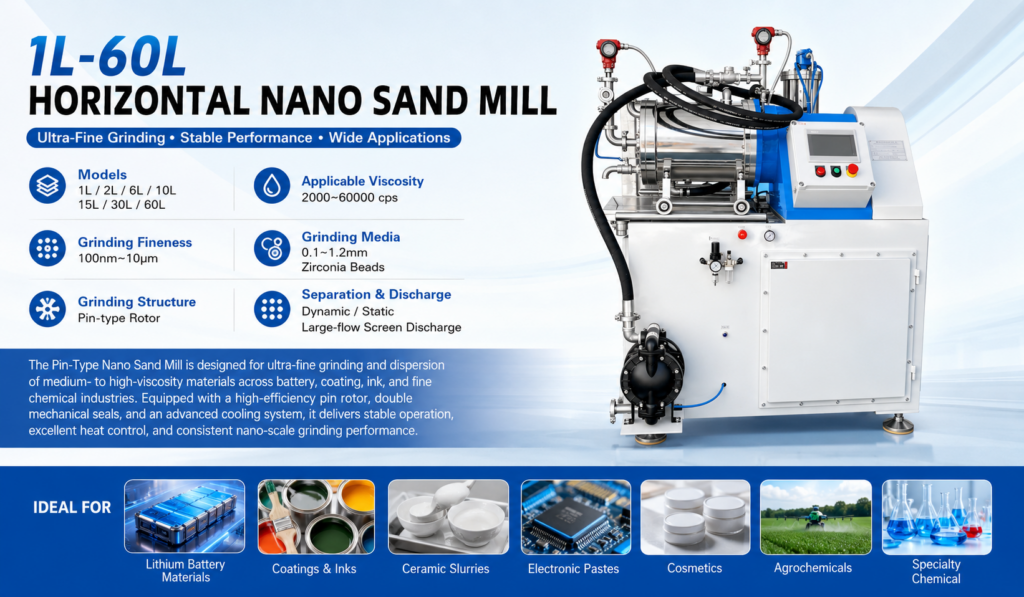
This is exactly the gap a 1L-60L Horizontal Nano Sand Mill is built to close. With a grinding fineness range of 100nm to 10μm and support for viscosities from 2000 to 60000 cps, it’s designed for the kind of medium-to-high viscosity slurries that solid-state electrolytes, silicon-rich anodes, and next-gen cathode materials demand.
Scaling without starting over
One of the quiet frustrations in battery R&D right now is that a formula that works beautifully in a 1L lab batch often falls apart the moment it’s scaled to a pilot line — different shear forces, different heat buildup, different flow behavior. QuantumScape’s own strategy update this year leaned heavily on this exact problem, describing itself as still in an “ascending phase” of development while manufacturing partners work to translate lab-level performance into repeatable production.
The 1L-60L model range (1L / 2L / 6L / 10L / 15L / 30L / 60L) is built around that reality. Teams can develop a process at bench scale and carry the same rotor design, media size, and grinding logic straight through to production volume, instead of re-engineering the process every time the batch size changes. For battery material developers racing against 2026-2027 qualification deadlines, that saved development cycle can be the difference between hitting a customer’s timeline and missing it.
Built for the viscosity problem nobody talks about
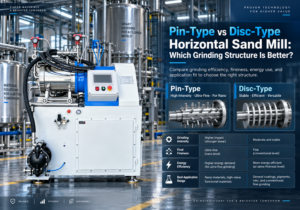
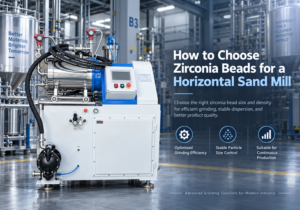
Battery slurries are rarely easy to work with. High-viscosity electrolyte and electrode pastes tend to clog conventional mills, generate excess heat, and lose grinding efficiency fast. The pin-type rotor structure in this sand mill is specifically engineered for medium-to-high viscosity materials, paired with 0.1-1.2mm zirconia grinding media for consistent, nano-scale results. A dynamic/static large-flow screen discharge system keeps material moving smoothly, reducing clogging and downtime — both of which matter enormously when a production line is trying to hit gigawatt-hour-scale output on a tight qualification schedule.
Heat is the other silent killer in nano-grinding. Friction during ultra-fine grinding generates significant heat, and temperature-sensitive materials like solid-state electrolytes can degrade if that heat isn’t managed. Double mechanical seals and an advanced cooling system keep the mill running stably over long production cycles — which is often the real difference between a lab success story and a manufacturing partner willing to sign off on volume supply.
Not just for batteries
While solid-state batteries and next-generation lithium materials are the industry’s loudest story right now, the same grinding and dispersion technology serves a much wider range of industries:
- Ceramic slurries and electronic pastes, where particle uniformity directly affects electrical performance
- Cosmetics, where fine, consistent dispersion determines texture and stability
- Agrochemicals, where finer particle size improves active ingredient efficacy
- Specialty and fine chemicals, wherever nano-scale dispersion is non-negotiable
The takeaway
The solid-state battery race will be decided less by who has the boldest press release and more by who can consistently, repeatably manufacture electrolyte and electrode materials at nano-scale precision — at gigawatt-hour volume, not just in a lab. As Toyota, Samsung SDI, QuantumScape, CATL, and a growing list of challengers push toward their 2026-2028 production targets, the companies that quietly solve the grinding and dispersion step will be the ones actually shipping cells on schedule.
If your team is working on solid-state electrolytes, silicon-based anodes, ceramic slurries, or any other high-viscosity material that needs to go from lab batch to production volume without losing performance, get in touch to talk through the right 1L-60L Horizontal Nano Sand Mill configuration for your process.
Keywords: nano sand mill, horizontal sand mill, solid-state battery electrolyte grinding, lithium battery material dispersion, nano grinding equipment, zirconia bead mill, ceramic slurry grinding, battery material manufacturing equipment