









Meta Title: High-Efficiency Disperser Mixer for Coatings, Inks & Resins | 1.5kW–55kW Meta Description: As VOC regulations tighten and waterborne formulations go mainstream, manufacturers need dispersion equipment that keeps up. See why the high-efficiency disperser mixer (5L–3000L) is becoming the standard choice.
If you’ve been paying attention to the coatings and ink industry over the past couple of years, you’ve probably noticed the same conversation coming up again and again: VOC regulations are getting stricter, customers are asking for greener formulations, and waterborne systems are no longer a “nice to have” — they’re becoming the default. The EU’s REACH updates, tightening EPA rules in the US, and similar moves across Southeast Asia have pushed a lot of manufacturers to reformulate products that had been running the same way for decades.
That shift sounds simple on paper. In practice, it puts real pressure on production equipment.
The Hidden Bottleneck: Dispersion, Not Formulation
Most conversations about going waterborne or low-VOC focus on chemistry — new resins, new binders, new additive packages. But there’s a less-talked-about problem hiding underneath all of it: waterborne and high-solid formulations are often harder to disperse evenly than their solvent-based predecessors. Pigments clump differently. Viscosity behaves differently. What used to take one pass through an old mixer now needs finer control over shear force and mixing speed to avoid batch inconsistency.
This is where a lot of manufacturers hit a wall. Equipment that was perfectly fine for older formulations starts producing uneven color, poor gloss, or batch-to-batch variation once the underlying chemistry changes. And in coatings, ink, and adhesives, inconsistency isn’t a minor issue — it shows up immediately in quality control, customer complaints, and rework costs.
What Actually Solves It
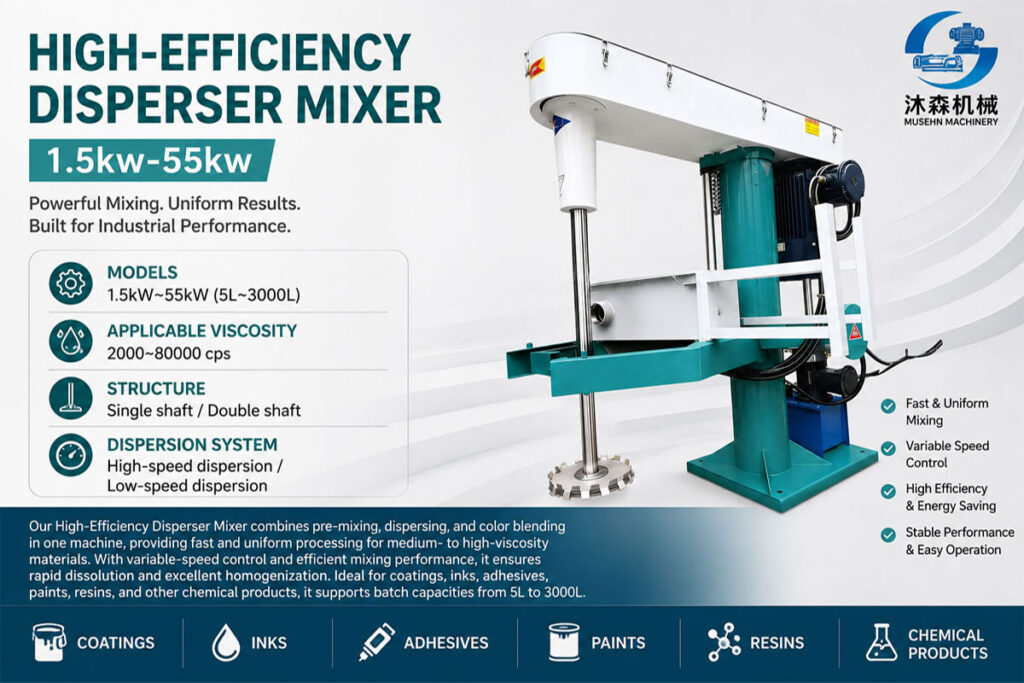
The fix isn’t necessarily a new formulation — it’s often a mixer that can handle a wider viscosity range with more precise control. That’s the gap a high-efficiency disperser mixer is built to close. Instead of running pre-mixing, dispersing, and color blending as three separate steps on three different machines, everything happens in one unit, which cuts both processing time and the risk of inconsistency between stages.
A few specs matter more than people expect here:
- Viscosity range (2,000–80,000 cps): wide enough to cover both thinner waterborne systems and thicker, high-solid pastes without switching equipment.
- Variable-speed, high/low dispersion control: lets operators match shear intensity to the specific formulation instead of using one setting for everything.
- Single or double shaft configuration: double-shaft setups are particularly useful for high-viscosity resins and adhesives where a single disperser blade alone can leave dead zones in the tank.
- Scalable capacity (5L–3000L): the same equipment logic that works in an R&D lab can scale to full production batches, which matters a lot when a company is piloting a new low-VOC formulation before committing to a full production line.
For manufacturers reformulating products to meet new environmental standards, that kind of flexibility is often what separates a smooth transition from months of trial-and-error.
A Second Trend Worth Watching: Reshoring and Smaller Batch Runs
There’s another shift happening alongside the sustainability push — more manufacturers are reshoring production or diversifying suppliers away from single-region dependence, partly due to ongoing supply chain disruptions and partly due to tariff changes. That’s led to more mid-sized production facilities running smaller, more frequent batches instead of a few massive runs a year.
Equipment that only makes sense at 3,000L scale doesn’t fit that model anymore. Modular systems that perform well from small lab batches (5L) up through full production (3,000L) give manufacturers room to grow — or to serve smaller regional customers — without needing to invest in an entirely new line every time production needs change.
Where This Fits: Coatings, Inks, Adhesives, and Resins
None of this is really about one narrow use case. The same underlying challenge — needing consistent dispersion across a range of viscosities — shows up across:
- Architectural and industrial coatings moving to waterborne systems
- Printing inks adjusting formulations for low-VOC compliance
- Adhesives and sealants where viscosity control affects bond strength
- Resin producers supplying reformulated products to downstream coatings manufacturers
In each case, the equipment question is really the same one: can this mixer keep pace as formulations keep changing?
The Bottom Line
Regulatory pressure toward greener formulations isn’t slowing down, and neither is the push toward more flexible, smaller-scale production. Manufacturers who treat their mixing equipment as a fixed, one-time investment often find themselves reformulating around their machines instead of the other way around. A disperser mixer built for a wide viscosity range, adjustable shear control, and scalable batch sizes gives production teams room to adapt as both regulations and customer demands continue to shift.
If your team is in the middle of reformulating for compliance — or just outgrowing equipment that was designed for a different era of production — it’s worth taking a closer look at what your current mixer can actually handle.
Explore our High-Efficiency Disperser Mixer (1.5kW–55kW, 5L–3000L) — [contact us] for a configuration suited to your formulation and batch size.